Paks gagne 20 centimètres pour €15 millions
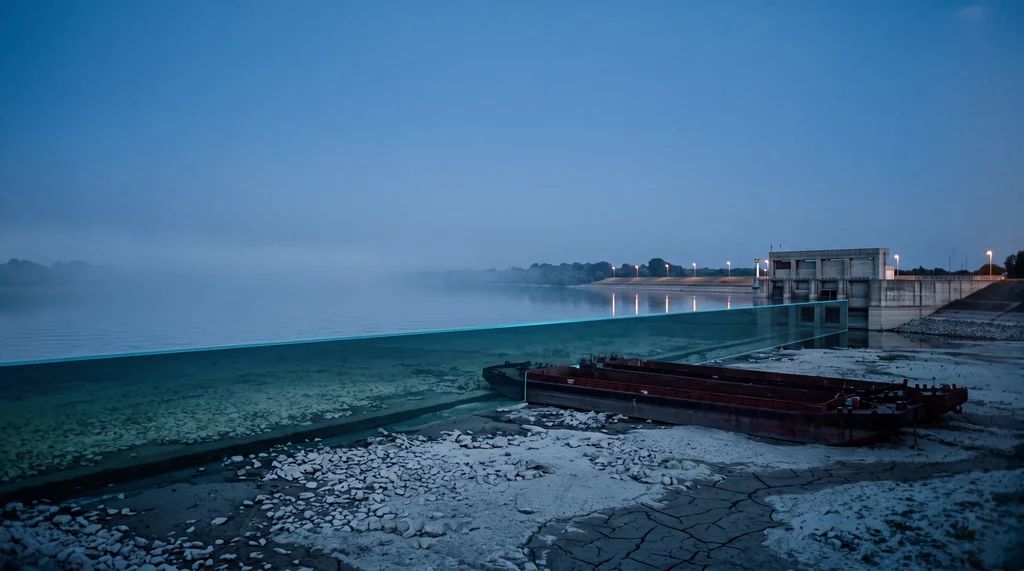
Twenty centimetres of water bring Hungary’s nuclear heart back online.
Composition d image · tobriefLa Hongrie a relevé le niveau du Danube près de la centrale nucléaire de Paks en coulant deux barges et en construisant un seuil provisoire. L’opération, chiffrée à 15 millions d’euros, a permis de relancer une partie de la production. Mais elle montre surtout la dépendance physique du nucléaire fluvial à des rivières de plus en plus basses.
À Paks, quelques dizaines de centimètres ont suffi à faire la différence entre une centrale à l’arrêt et un redémarrage progressif. Des équipes ont coulé deux barges et construit un barrage temporaire sur le lit du Danube afin de relever le niveau d’eau à la prise de refroidissement. L’intervention a fonctionné : au 23 août, la seule centrale nucléaire hongroise avait remis en service quatre de ses huit turbines, produisait plus de 800 MW, et le gouvernement tablait sur un retour à pleine capacité, soit 2 000 MW, d’ici le milieu de semaine (Portfolio, Euronews HU). L’épisode compte au-delà de la Hongrie, parce que la Roumanie a tenté des travaux comparables à Cernavodă, sa seule centrale nucléaire, sans éviter l’arrêt de ses deux réacteurs. L’ingénierie d’urgence peut rétablir une marge de pompage. Elle ne maîtrise pas le débit d’un fleuve.
Ce que les équipes ont construit, et pourquoi cela a suffi
Une centrale nucléaire consomme d’importants volumes d’eau fluviale pour refroidir la vapeur après son passage dans les turbines. À pleine puissance, Paks a besoin d’environ 100 mètres cubes par seconde d’eau du Danube. Lorsque le fleuve est tombé à des niveaux historiquement bas, les pompes de la centrale, installées à profondeur fixe, ne pouvaient plus prélever assez d’eau (MVM). L’opérateur MVM a donc commencé à réduire la production fin juillet.
Le 12 août, le gouvernement a ordonné deux interventions. La première consistait à poser un seuil de fond, c’est-à-dire une structure basse sur le lit du fleuve qui ralentit le courant et fait remonter l’eau vers la prise. La seconde prévoyait le coulage contrôlé de deux barges de 80 mètres afin de bloquer davantage le flux. Le coût total, 6,1 milliards de forints (environ 15 millions d’euros), a été comparé par les autorités à une facture d’au moins 50 milliards de forints par mois pour remplacer l’électricité perdue en cas d’arrêt complet (kormany.hu, Energy Connects). Pour Budapest, l’arbitrage était donc simple : dépenser 15 millions d’euros pour éviter une perte mensuelle plusieurs fois supérieure.
Au 22 août, 242 mètres de seuil avaient été construits. L’effet combiné des travaux avait relevé le niveau d’eau de plus de 20 cm. Sept des huit pompes de refroidissement fonctionnaient et la prise d’eau s’approchait de sa capacité normale (kormany.hu, MTI).
L’avertissement roumain
La Roumanie a suivi une logique proche à Cernavodă, qui fournit en temps normal environ un cinquième de son électricité (World Nuclear). Les équipes ont dynamité une formation rocheuse, dragué des chenaux et coulé des barges pour rediriger le flux du Danube vers la prise d’eau (The Guardian, Financial Intelligence). La première intervention a relevé l’eau de 8 cm et donné environ neuf jours supplémentaires à l’unité 2 (HotNews). Puis le Danube a continué de baisser. L’unité 2 s’est arrêtée le 13 août, et Bucarest a depuis approuvé un deuxième paquet de mesures d’urgence, signe que la première opération avait acheté du temps, pas de la sécurité (AGERPRES).
L’écart ne tient pas à la compétence des ingénieurs. Les deux pays ont mobilisé des moyens lourds face au même problème physique. En Hongrie, 20 cm suffisaient, et le seuil les a fournis. En Roumanie, 8 cm ont retardé l’arrêt, tandis que le déficit d’eau continuait de se creuser.
Qui a payé, qui en a profité
Lorsque Paks s’est rapprochée de l’arrêt, les prix hongrois de l’électricité à une semaine ont bondi autour de 250 à 263 EUR/MWh, soit environ 15 % à 20 % de plus que la veille (Argus). Pour les industriels, ce type de hausse se transmet en quelques jours. La Hongrie a doublé ses importations d’électricité, jusqu’à environ 4 GW la nuit, et le gouvernement a demandé aux ménages d’éviter lave-linge et sèche-linge entre 17 h et 22 h (Euractiv). Un décret distinct a autorisé le gestionnaire du réseau à couper les grands consommateurs industriels au-dessus de 0,5 MW, avec des pénalités fixées à 200 % du prix spot : les usines qui ignoraient l’ordre payaient deux fois le prix de marché (HVG). Aux ménages, on a demandé. Aux usines, on a imposé.
La vulnérabilité roumaine a été plus brutale encore. Un soir, les importations ont atteint 1 839 MW, couvrant 27,4 % de la consommation (Curs de Guvernare). La Bulgarie en a tiré le bénéfice immédiat : ses exportations ont grimpé à environ 32 000 à 33 000 MWh par jour à mesure que la production nucléaire voisine disparaissait (Mediapool). La Slovaquie, dont les centrales de Mochovce et Bohunice utilisent des tours de refroidissement plutôt que l’eau directe du fleuve, a continué à produire à pleine puissance et à capter, sans bruit, des prix régionaux plus élevés (Info.sk).
Le fleuve garde le dernier mot
La Hongrie a évité le coût immédiat d’un remplacement de Paks. Le dispositif seuil-barges a coûté 15 millions d’euros, contre des pertes qui se seraient chiffrées en dizaines de millions d’euros par mois. Mais le redémarrage ne supprime pas la vulnérabilité : Paks prélève toujours son eau de refroidissement dans le Danube au moyen de pompes à profondeur fixe, et le prochain épisode de basses eaux pourrait durer plus longtemps que ce qu’un seuil provisoire peut compenser. En France, EDF prévoit d’investir 9 milliards d’euros sur 15 ans pour adapter son parc nucléaire au changement climatique (Le Monde). La Hongrie, elle, a construit 242 mètres de seuil en onze jours. Reste à savoir si cela suffira encore en août prochain.
Details about this article
- Model:
- claude-opus-4-6
- Generated:
- 8/24/2026, 1:51:24 AM
- Pipeline run:
- eu_pipeline_20260824_005006
- Watermark:
- SynthID (Google's invisible watermark)
- Human review:
- None before publication