Bosnia’s presidency leads cannot unlock EU talks
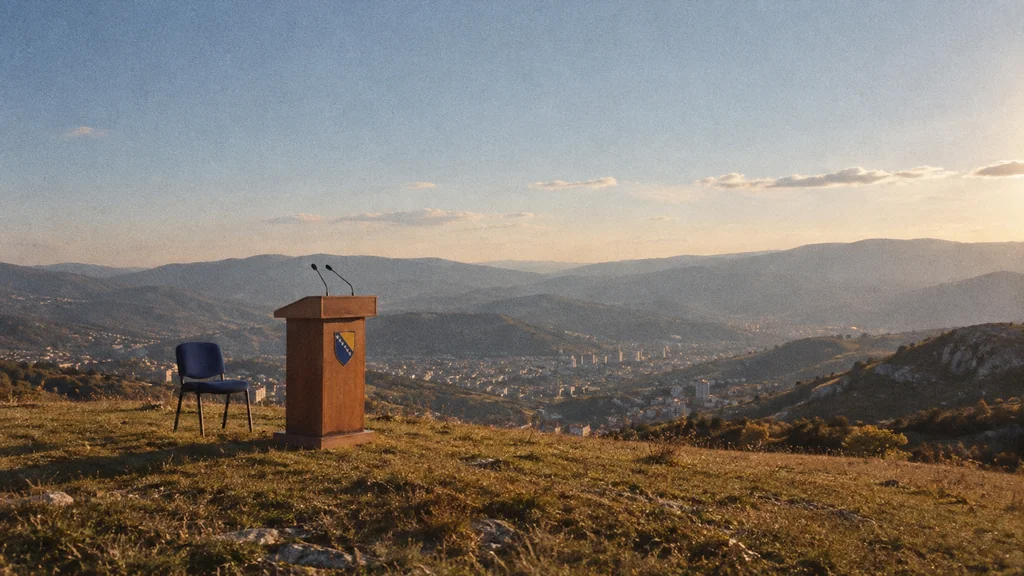
Bosnia’s election settles the presidency, while the cabinet waits for agreement.
Image composition · tobriefPreliminary counts from Sunday's general election put Denis Bećirović, Darijana Filipović and Željka Cvijanović ahead for Bosnia and Herzegovina's three-member presidency (AP, Večer). None of these results is certified. The presidency does not run the country, so Bosnia's stalled EU bid now depends on whether party leaders can build a state government and pass the reforms that formal accession talks require.
The leads look solid. At 20:02, with 80% of polling places processed, Filipović, the Croat candidate of the party HDZ BiH, had 92,854 votes against 55,475 for her nearest rival, Slaven Kovačević (Klix). Bećirović already holds the Bosniak seat. Cvijanović is running for the Serb seat for SNSD, the dominant Serb party.
SNSD's leader, Milorad Dodik, claimed victory for his party on election night and thanked Donald Trump, Vladimir Putin and Serbia's president, Aleksandar Vučić (AFP). He was not on the ballot. According to DW, he is barred from public office for six years after a conviction linked to defying the High Representative, the international official who oversees the peace settlement. That leaves Dodik outside every body that will approve the next government. As party leader, he will still set what SNSD demands in exchange for joining it.
Who has to agree on a cabinet
The presidency acts as a collective head of state and runs foreign policy, but it cannot form a government. It nominates the chair of the Council of Ministers, Bosnia's state cabinet. The 42-member House of Representatives must then approve that chair and every minister (OHR).
No seat count for that state House has been reported yet. The preliminary figures cover the parliaments of Bosnia's two halves, the Bosniak-Croat Federation and the Serb-majority Republika Srpska. SNSD led Republika Srpska's assembly race with 40.95%, while in the Federation the Bosniak party SDA took 30.63% and an HDZ-led coalition 13.89% (DW). Those numbers do not reveal the state majority. They do show which leaders will speak for their communities when cabinet talks begin: SNSD, SDA and HDZ BiH.
HDZ BiH arrives with a long-standing complaint. Bosniak and Croat presidency members are both elected by Federation voters, and each voter picks a candidate in only one of the two races (Dayton constitution, Annex 4). The party argues that the larger Bosniak electorate has used this to pick the Croat member, as in Željko Komšić's past victories. A Filipović win would hand HDZ BiH the seat it considers rightfully Croat. Croatia's prime minister, Andrej Plenković, campaigned for her in Mostar on 2 October, saying it was time for someone who truly represents Croats (Index). His appearance puts an EU government visibly behind one of the parties now bargaining over Bosnia's cabinet.
The reforms already stuck
The EU's offer is conditional. In March 2024, EU leaders decided to open accession negotiations, but they tied the formal start to Bosnia completing steps the European Commission had already set out (European Council). More than two years later, formal talks still have not begun.
Money depends on the same work. Bosnia agreed a 113-measure Reform Agenda, the list of changes it must deliver to receive funds from the EU's Growth Plan for the Western Balkans. The Konrad Adenauer Foundation, a German political think tank, reported before the vote that representatives of Republika Srpska and four Federation cantons had obstructed that agenda (KAS). The parties that dominate those places are the same ones that will now negotiate the cabinet.
That is the real result of Sunday's vote. The presidency count tells Bosnians who will probably sit in the country's ceremonial top office. It does not resolve the government and reform decisions holding up formal EU talks. Those decisions belong to SDA, HDZ BiH and SNSD, a party steered by a leader who is legally barred from holding any office. Unless their coalition deal also clears the reforms they or their allies have blocked, the next state government will inherit the same impasse as the last one.
Details about this article
- Model:
- claude-opus-5-5
- Generated:
- 10/5/2026, 11:47:35 AM
- Pipeline run:
- eu_pipeline_20261005_005007
- Watermark:
- SynthID (Google's invisible watermark)
- Human review:
- None before publication