Cernavodă’s Nuclear Buffer Falls To 11cm
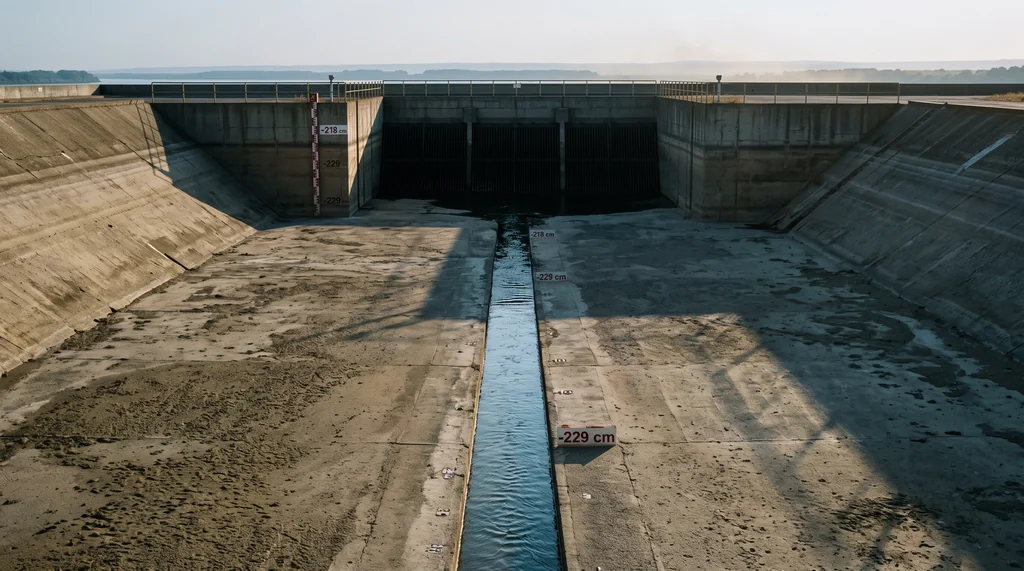
Eleven centimetres of water separate Romania’s grid from another shutdown.
Kompożizzjoni tal-immaġni · tobriefThe water level at Cernavodă’s intake basin stood at about -218 cm on 7 August (Newscenter). Operators must shut down Unit 2, Romania’s last nuclear reactor still running, if it falls to around -229 cm (Capital). That leaves an 11-centimetre margin. The same monitoring reports say the Danube has been dropping by 2–3 cm a day.
Romania has warned Brussels and every EU government under Regulation 2019/941, the EU framework that obliges member states to flag electricity-supply risks when the problem may cross borders (Europa FM). The warning puts the system on alert. It does not produce electricity.
Why a falling river shuts a nuclear plant
Cernavodă’s reactors use Danube water to cool their condensers, the equipment that turns steam back into water after it has driven the turbines. Without enough flow, there is no cooling. Without cooling, there is no power. Unit 1 was already disconnected on 28 July, when flow fell to about 1,630 cubic metres per second, far below the August average of roughly 3,900 (Agerpres, HotNews).
Romania has since blasted a rock formation, dredged the channel and prepared to sink barges to redirect the flow. The rock blast lifted levels by about 2 cm (Euronews România). Nuclearelectrica technical director Emil Macovei said the barge work could buy another two to three days. If the decline continues, Unit 2 will probably stop after that (Digi24).
The neighbours who could help need help too
Unit 2 produces roughly 680 MW, around 8–9% of Romania’s evening peak demand, which the heatwave has pushed towards 8,000 MW (Europa FM). Romania was already importing about 1,700 MW during the evening peak. If Unit 2 stops, the import need could pass 2,500 MW (Financial Intelligence).
The problem is that the countries normally expected to supply that power are exposed to the same river system. Hungary’s Paks plant fell to roughly 480 MW from its normal 2,000 MW in early August, forcing Hungary to import electricity and use gas reserves (Pénzcentrum, MVM).
Bulgaria has been the clearest lifeline. On the morning of 7 August it was exporting 1,355 MW to Romania, using solar and coal generation (economic.bg). But Bulgarian officials said export capacity had been "fully used" in recent days (Bulgarian Energy Ministry). Kozloduy’s nuclear reactors also depend on the same falling Danube.
Who gains, who pays
The short-term winners are traders and flexible generators able to sell scarce evening power. Day-ahead prices across Central and Southeast Europe already show premiums linked to the pressure on Paks and Cernavodă (Serbia Energy).
The first losers are Nuclearelectrica’s customers. The company has warned them it may be unable to meet delivery contracts and has invoked force majeure, the legal argument that an extraordinary external event prevents a company from fulfilling its obligations (ZF). Industrial consumers are likely to face voluntary or imposed demand cuts before households see any change in retail prices. Transelectrica, Romania’s grid operator, has asked large users to keep consumption low to avoid a major grid failure (Mediafax).
Energy Commissioner Dan Jørgensen described the EU’s Electricity Coordination Group as a forum for sharing information (Dan Jørgensen). That matters, but it is a limited tool. Europe’s electricity market is built to move power to where it is scarce. This drought shows the weakness in that model when Romania, Hungary and Bulgaria all need extra electricity in the same evening hours, while the river cooling their plants is the same river running low.
Details about this article
- Model:
- claude-opus-4-6
- Generated:
- 8/8/2026, 1:48:58 AM
- Pipeline run:
- eu_pipeline_20260808_005006
- Watermark:
- SynthID (Google's invisible watermark)
- Human review:
- None before publication