DeepMind maps nine billion DNA swaps
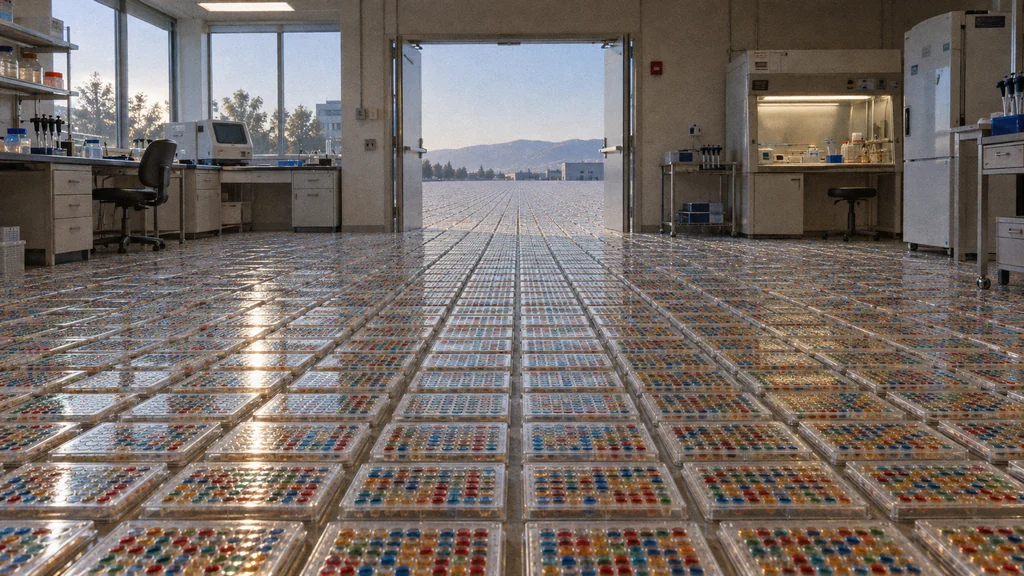
Every possible letter change is ranked before biology delivers its verdict.
Image composition · tobriefThe human genome has about three billion positions, each occupied by one of four DNA letters. Swap any position for one of the other three letters, and you get a hypothetical variant. That's nine billion possible single-letter changes, and Google DeepMind has now run its AlphaGenome model on every one of them. The results, released on 8 September as AlphaGenome Atlas, form a one-petabyte searchable database of model predictions, free for non-commercial research (DeepMind; Nature).
The arithmetic is simple. The value lies in what each entry contains.
A pre-filled reference book for every substitution
For each of those nine billion swaps, AlphaGenome reads up to one million surrounding DNA letters and predicts changes across several kinds of molecular readout: gene activity, RNA splicing (how cells cut and join an RNA copy before it becomes useful), protein-binding patterns, and chromatin structure (how tightly DNA is packaged), across different tissues and cell types. Each variant entry stores an average of roughly 27,000 such predictions, spanning 11 categories (Nature; IEEE Spectrum).
Think of it as a pre-filled reference book. Before Atlas, a researcher wanting to check one variant had to run the model themselves. DeepMind spent the computing power in advance so that a lab without specialised infrastructure can now look up any candidate variant through a web portal (DeepMind).
Alongside the raw predictions, DeepMind introduced the AVI score, which merges AlphaGenome's predictions about gene-control regions with AlphaMissense's protein-level assessments into a single ranking. It also provides feature attributions: a model-level explanation of which outputs and sequence features drove the score. That is not a biological mechanism, but it tells a researcher where to look (DeepMind).
Genome-wide variant scoring existed before. CADD has long offered rankings for every possible single-letter change (CADD paper). SpliceAI provides precomputed predictions of splice disruption (Cell). Atlas combines that breadth with tissue-specific detail across multiple readouts. A researcher can see not just that a variant ranks high, but whether the model expects it to affect splicing in brain tissue or shift gene expression in blood.
Early tests, not independent validation
In a launch collaboration with the Broad Institute's GREGoR Consortium, Atlas flagged a variant buried deep inside the gene DNM1, linked to epileptic encephalopathy. The model predicted it would create an abnormal splice site active in the brain, potentially altering the resulting protein. A laboratory splicing assay supported the predicted RNA effect, contributing to a likely pathogenic classification (DeepMind). The assay confirmed the splice prediction; it did not by itself establish that this variant causes disease in a patient's brain.
Separately, a University of Exeter team applied Atlas predictions to whole-genome data from over 54,000 UK Biobank participants. They reported more associations between variants in gene-control regions and circulating protein levels than a comparison analysis, and in one genomic region narrowed candidates from 526 variants to four (DeepMind). That narrowing is prioritisation. Whether those four variants actually drive the protein changes requires further testing. Both studies were launch collaborations with DeepMind, not independent post-release validations.
What Atlas ranks, and what it doesn't cover
DeepMind researcher Žiga Avsec told Fortune the model performs well for splice and promoter variants (regions near a gene's start that help control its activity) but can miss other effects, particularly at enhancers (distant stretches of DNA that also regulate genes), and "should not be treated as universal truth" (Fortune). The nine billion entries cover every possible single-letter substitution on one reference genome assembly. They do not cover insertions, deletions, structural rearrangements, or the interactions between multiple variants in an individual patient's genome (Nature).
The Atlas technical description was published as a preprint, not yet peer-reviewed. The portal is free for academic use; commercial access will come through Google Cloud at undisclosed pricing (DeepMind).
Atlas gives researchers immediate access to precomputed predictions that can help them choose which variant to test next. For rare-disease research, where genome sequencing often surfaces dozens of candidate variants in poorly understood regions, faster computational triage could shorten the path to the right laboratory experiment. Those rankings still require laboratory and clinical validation before they change a diagnosis. The model generates hypotheses. Biologists and clinicians test them.
Details about this article
- Model:
- claude-opus-4-6
- Generated:
- 9/9/2026, 2:47:02 AM
- Pipeline run:
- eu_pipeline_20260909_005005
- Watermark:
- SynthID (Google's invisible watermark)
- Human review:
- None before publication