ATLAS finds Z bosons quantum-entangled
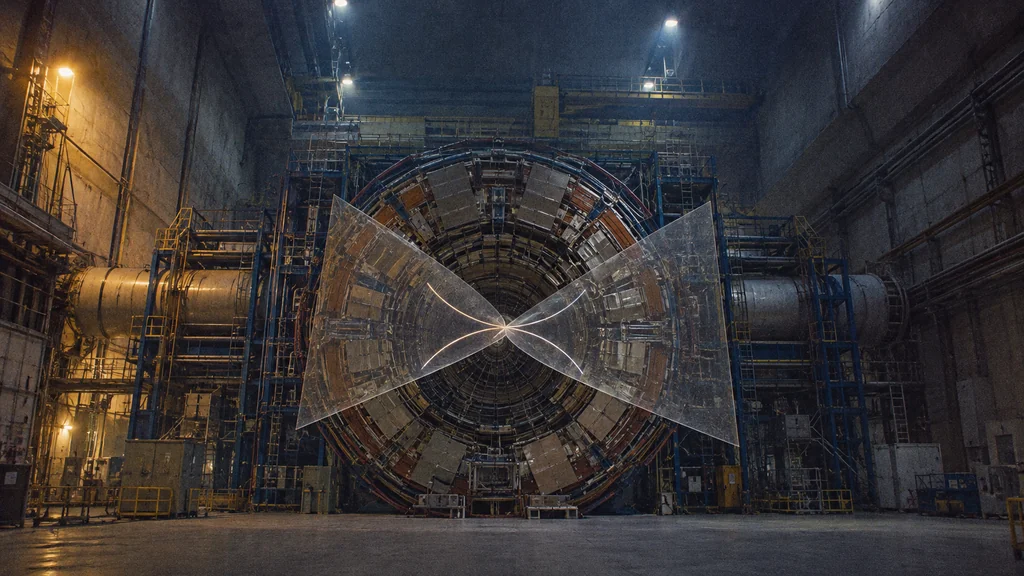
Four surviving tracks reveal a quantum bond between vanished particles.
Image composition · tobriefWhen a Higgs boson decays into two Z bosons, which themselves each split into a pair of electrons or muons, those four particles spray outward through the detector. The Z bosons are already gone. But the angles between those four surviving leptons carry information about the quantum relationship between the two intermediaries that produced them. The ATLAS collaboration at CERN has now found strong evidence that this relationship is entangled: the spin properties of the two Z bosons cannot be described independently of each other. The result, published in Physical Review Letters on 11 September 2026, represents the first dedicated measurement of spin entanglement between a pair of Z bosons produced in Higgs decay (arXiv).
Inferring a quantum state from its debris
Entanglement experiments usually involve photons on a laboratory bench, where researchers control what gets measured and when. A particle collider works differently. The Z bosons decay before they reach any detector element. ATLAS recorded only the tracks and energies of four charged leptons emerging from proton–proton collisions at the Large Hadron Collider.
Each Z boson's polarization, the orientation of its quantum spin, produces a characteristic pattern in the directions its two daughter leptons travel. By analysing several angular distributions across many collisions, including the relative orientation of the two decay planes (imagine the flat surface defined by each lepton pair), physicists tested whether a "separable" model could reproduce the data. A separable model is one where each Z boson's spin state is fully independent of the other's. If that model fails, the joint state is entangled.
The test is statistical. No single collision reveals entanglement. The picture builds over hundreds of events, and hundreds is all there were. ATLAS combined collision data from Run 2 (2015–2018) and the first three years of Run 3 (2022–2024), yet the four-lepton channel is so rare that only about 400 candidate events survived selection (ATLAS briefing). Despite that small sample, the data rejected the separable hypothesis with strong statistical significance.
Why Z bosons make this hard, and interesting
A Z boson has spin 1, which means its spin can take three possible orientations along any axis (physicists call this a qutrit, by analogy with the qubit of spin-½ particles). Two Z bosons together occupy a nine-dimensional spin space. The Higgs boson has zero spin, which tightly constrains how those nine dimensions can be populated. The quantum mechanics of the decay predicts a specific joint superposition whose correlations cannot be reproduced by any mixture of independent Z-boson states. That inseparability is exactly the property ATLAS set out to test.
There is a complication. The Higgs weighs about 125 GeV, but producing two Z bosons at their normal mass would require roughly 182 GeV. So one Z is normally produced "off-shell," carrying less than its standard mass. The analysis accounts for this, working with the full set of four-lepton kinematics rather than assuming two clean Z particles.
ATLAS directly measured two angular coefficients that are sensitive to entanglement. With the current dataset, the uncertainties on these coefficients remain large. The measurements are consistent with the Standard Model within those uncertainties, meaning the quantum correlations look exactly as predicted, but higher precision will require more data.
A new observable for studying the Higgs
The scientific value is not a quantum device or a technological application. It is a new way to study one of the most consequential interactions in particle physics: the coupling between the Higgs boson and the Z boson. This coupling is central to how the Z acquires its mass through the breaking of electroweak symmetry, the mechanism that gives structure to the weak nuclear force.
If undiscovered particles or forces subtly modify this coupling, the polarization correlations between the two Z bosons would shift. ATLAS has now shown that these correlations can be extracted from real data, opening a channel that future, larger datasets can exploit with greater precision. For now, the Standard Model's predictions hold. The entanglement measurement has turned an abstract quantum property into something experimentally accessible at the energy frontier.
Details about this article
- Model:
- claude-opus-4-6
- Generated:
- 9/18/2026, 2:00:32 AM
- Pipeline run:
- eu_pipeline_20260918_005006
- Watermark:
- SynthID (Google's invisible watermark)
- Human review:
- None before publication