Germany’s 17-cent pump promise isn’t law
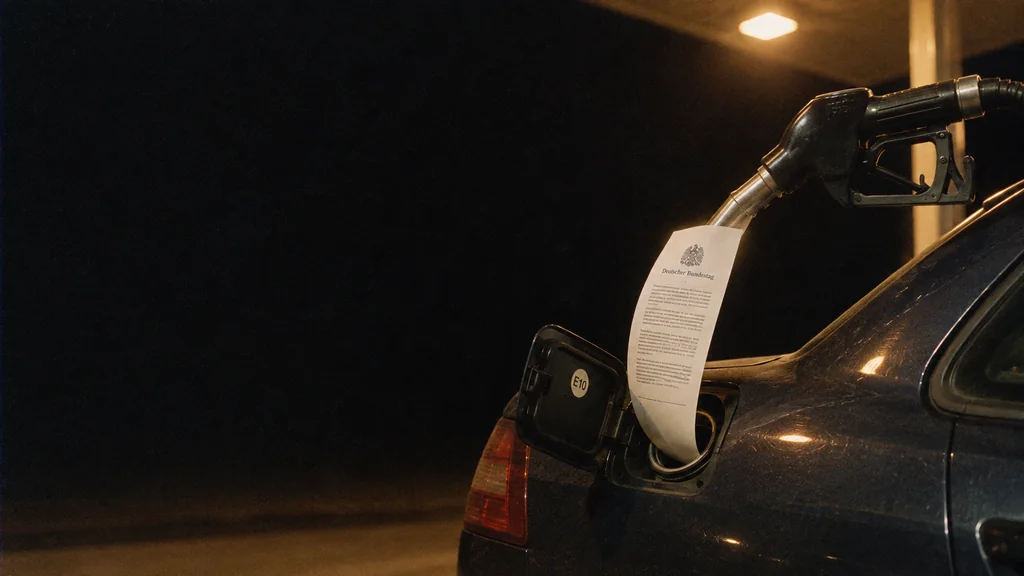
Germany’s promised pump relief still waits to become law.
Image composition · tobriefGermany's federal government and all 16 state governments agreed on 18 September to cut fuel tax temporarily. But the agreement is political, not legal. No statute has been published, and parliament has not voted (Tagesspiegel, ZEIT). Chancellor Friedrich Merz wants the cut in place by 1 October. Until the Bundestag passes the law, drivers will not see cheaper fuel.
The proposed reduction is 14 cents per litre of Energiesteuer (the fixed excise tax on every litre of fuel). Because VAT is charged on top, the maximum saving at the pump would reach roughly 17 cents per litre (Bundesregierung, Deutscher Bundestag). The relief would run through 31 December.
Seventeen Cents Is the Ceiling
That 17-cent figure assumes every station passes the full tax cut on to drivers through lower prices. History suggests they won't. When Germany ran a similar excise cut in summer 2022, the ifo Institute found that stations passed on only part of the reduction, and the share varied between petrol and diesel (ifo Institute).
Why the gap? Pump prices reflect wholesale fuel costs, transport, station margins, excise and VAT. Cutting excise lowers one component. Refiners, distributors or station operators can absorb part of the difference without the driver noticing. The Bundeskartellamt (Germany's competition authority) monitors fuel prices but acknowledges that wholesale costs, currency movements and local competition all move prices at the same time, making a simple before-and-after comparison unreliable (Bundeskartellamt).
The much-discussed price cap is even further from reality. The agreement only instructs Berlin to negotiate a temporary price-limiting mechanism with the oil industry by January 2027. No maximum price, formula, enforcement body or legal basis has been decided (BR).
Who Gains, Who Pays
The relief applies per litre sold, regardless of income. A household that drives little saves little. A logistics company running a fleet saves far more. Non-drivers get nothing. The total cost is an estimated €2.5 billion in foregone tax revenue, and the bulk flows to whoever buys the most fuel (Bundesregierung, Tagesschau).
The 16 state governments agreed to absorb roughly half that cost, about €1.25 billion, through an adjustment to how VAT revenue is divided between Berlin and the states (Bundesregierung, ZDF).
Neighbours Will Feel the Pull
Because fuel tax is collected where the fuel is sold, a German price cut redirects purchases across borders. Dutch petrol was reported at roughly €2.71 per litre on 18 September (Metro NL). If German stations pass on the full cut, the price gap at the Dutch-German border could widen enough to make a short detour attractive for border-area drivers. Czech fuel was recently substantially cheaper than German fuel (DW), so the cut would narrow that gap and potentially pull some German buyers back from Czech stations. In Luxembourg, petrol (E10, the standard 10% ethanol blend) sat around €1.79 (SWR). The German cut would shrink Luxembourg's price advantage, though not eliminate it.
How many drivers actually change their fuelling habits depends on distance, travel time and the size of the gap. The scale of any cross-border shift remains uncertain. But the incentive is real, and border-region stations in the Netherlands, Belgium and Luxembourg have seen it before.
The deal Germany has struck is temporary, untargeted and incomplete. The start date depends on a parliamentary vote that has not been scheduled. The saving at the pump depends on competitive behaviour that the 2022 experience suggests will eat into the headline figure. And the price cap that dominated the political debate is nothing more than a mandate to begin talks. For now, the only thing that is settled is the ambition.
Details about this article
- Model:
- claude-opus-4-6
- Generated:
- 9/19/2026, 1:40:35 AM
- Pipeline run:
- eu_pipeline_20260919_005005
- Watermark:
- SynthID (Google's invisible watermark)
- Human review:
- None before publication