OpenAI forces Navier-Stokes to break
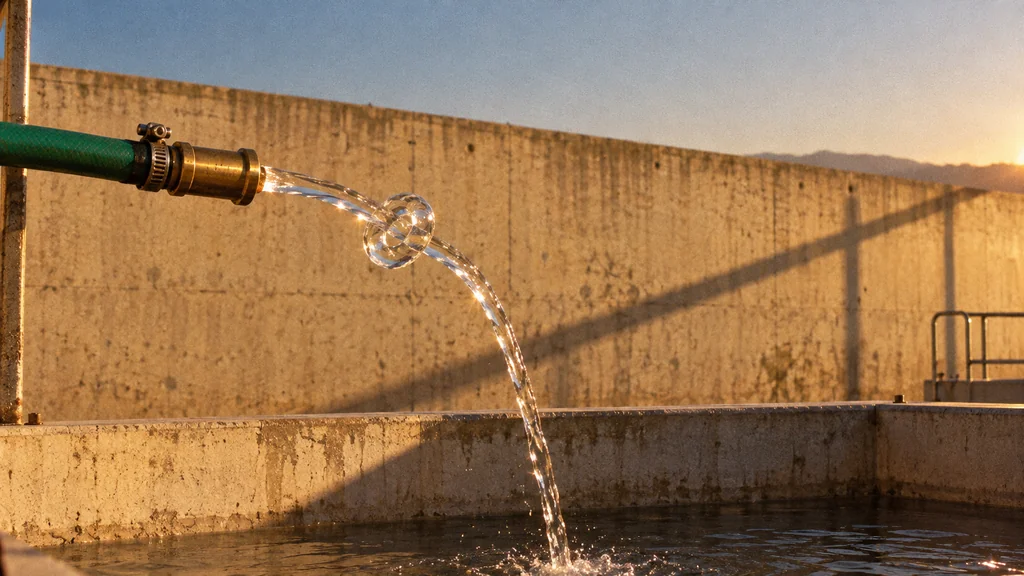
A designed force breaks the flow; the unforced question remains open.
Image composition · tobriefThe Navier-Stokes equations describe how fluids move: every ocean current, every wisp of smoke, every stream from a garden hose. Whether their solutions in three dimensions always remain smooth and finite, or can sometimes blow up into mathematical nonsense, is one of seven Millennium Prize Problems posed by the Clay Mathematics Institute. On 8 September, OpenAI released a 166-page manuscript and a machine-checkable formal proof claiming to resolve it. Three days later, Clay responded that the problem "has apparently been settled," language that is strikingly positive but expressly provisional.
The claim is more specific than most coverage suggests. OpenAI's result concerns forced fluids: cases where a carefully designed smooth external push drives an initially still fluid into a singularity, a point where the mathematics ceases to produce a finite answer, within a finite time. It does not address whether an ordinary, unforced fluid can spontaneously blow up. That distinction is central to understanding what has actually been claimed.
Why forcing matters
Clay's official problem statement offers four routes to a solution. Two ask whether smooth flows always stay smooth. The other two, alternatives C and D, ask whether you can construct a situation where smooth flow inevitably breaks down. Clay's alternatives C and D explicitly permit a smooth external force.
OpenAI took that second route. According to its manuscript, for any level of viscosity (the property that makes honey flow slowly and water flow easily), a specially constructed smooth force can push an initially motionless fluid toward a singularity while total kinetic energy stays bounded. If the proof holds, this satisfies Clay's conditions.
The approach builds on earlier work. Spanish mathematicians Diego Córdoba and Luis Martínez-Zoroa, together with Fan Zheng, had already shown in a preprint that forced blow-up could occur in a weakened version of the equations where viscosity's smoothing effect was artificially reduced. OpenAI's claimed advance is making the strategy survive the full, unmodified equations.
What Lean verifies
The accompanying Lean 4 repository is what makes this claim unusual. Lean is a proof assistant, a program that rejects any logical step unless it follows from the encoded definitions and accepted rules. Each inference is checked by a small, trusted software core.
This is powerful because it makes scrutiny far more tractable than reviewing prose mathematics alone. But Lean checks only internal consistency: whether the conclusions follow from the definitions as encoded. Whether those encoded definitions faithfully capture every condition in Clay's English-language problem statement is a judgment that fluid-dynamics specialists must make. The manuscript and repository are company-released materials, not peer-reviewed publications, and no independent expert audit of the full repository had been publicly documented as of 14 September.
OpenAI says a proprietary system of parallel AI instances produced the analytical result, with its GPT-6 Astra model then formalizing it in Lean (OpenAI). The specific figures the company reports for scale and speed are not independently reproducible: outsiders can inspect the output but cannot replicate the generation process.
Quanta Magazine reported that roughly twelve hours before OpenAI's announcement, NYU's Tristan Buckmaster and Anthropic-affiliated Levent Alpöge released related AI-assisted results on adjacent fluid equations, drawing on the same Córdoba–Martínez-Zoroa strategy. Two corporate AI labs converging on the same university-laid path underscores how much the result owes to prior mathematical work.
What comes next
Clay's prize rules require publication in a qualifying refereed journal, at least two years of community scrutiny, and a finding of general acceptance before a special committee even begins deliberation. No journal submission for OpenAI's manuscript has been identified.
If independent review confirms the proof, it establishes that standard three-dimensional Navier-Stokes equations with smooth forcing can develop a finite-time singularity. The unforced case, whether a fluid left to its own physics can blow up spontaneously, remains open. One half of a centuries-old question would have an answer. The other half would still be waiting.
Details about this article
- Model:
- claude-opus-4-6
- Generated:
- 9/15/2026, 1:41:31 AM
- Pipeline run:
- eu_pipeline_20260915_005006
- Watermark:
- SynthID (Google's invisible watermark)
- Human review:
- None before publication