Hormuz premium lifts Europe’s energy prices 10%
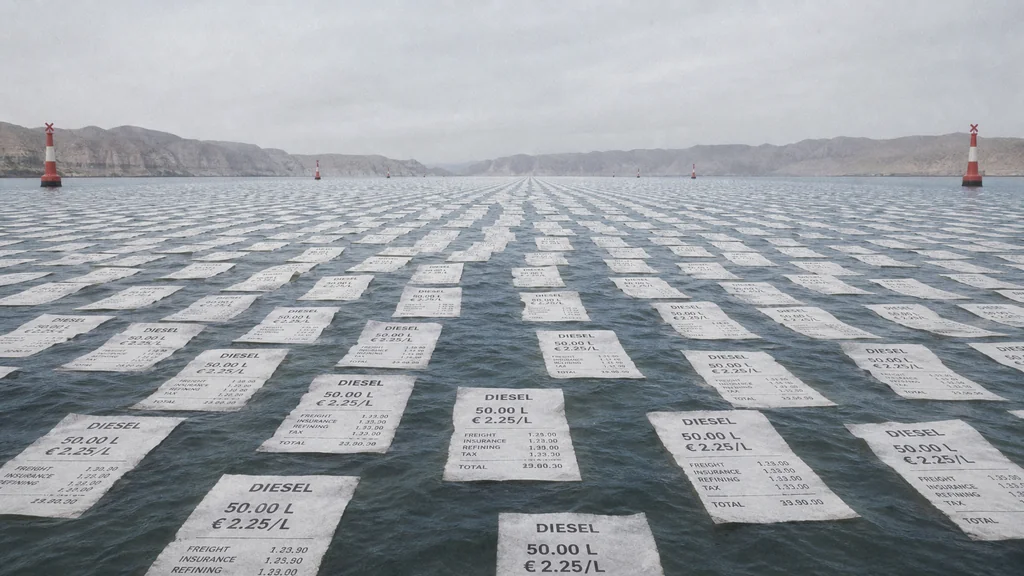
Every mile through Hormuz adds another line to Europe’s fuel bill.
Image composition · tobriefThe Strait of Hormuz carries roughly 20 million barrels of oil per day, about a fifth of global petroleum consumption (EIA). Tankers are still making the transit. But the extra cost of each crossing is showing up in the energy component of Europe's price data: Eurostat's July flash estimate put euro-area energy prices 10.0% higher than a year earlier (Eurostat). Europe faces an affordability shock, not a fuel shortage.
Why cheap oil isn't reaching the pump
Brent crude, the international oil benchmark, has fallen well below its spring peaks. That should bring relief at the pump. It hasn't.
Two costs explain most of the gap. War-risk insurance — a premium shipowners pay to sail through conflict zones — has spiked. A Lloyd's-market clause flagged that paying a proposed Iranian transit fee could void a vessel's cover entirely, making the route technically passable but unusable for insured trade (GCC Freight). Refining margins have also widened. The margin is the gap between what refineries pay for crude and what they charge for diesel and petrol. The ECB (the European Central Bank, which sets interest rates for the eurozone) confirmed on 31 July that refineries charged more on top of already-elevated crude costs, amplifying the price shock before fuel reached consumers (ECB).
Freight costs and sanctions-compliance checks add further layers. Across the EU, fuel prices for personal transport were 13.7% higher in June than a year earlier (Eurostat). Italian consumer group Assoutenti captured the disconnect plainly: with Brent comparable to early March levels, Italian diesel was still €0.38 per litre higher than at the same crude price months earlier (Assoutenti). The oil got cheaper. The supply chain between the barrel and the driver did not.
Who pays, who gains
Drivers pay first. Consumer group Codacons estimated Italian motorists spent €370 million more over the first August travel weekend than in 2025, with a typical diesel fill costing about €22 extra (ANSA). Rome responded with a diesel-tax cut and a tax credit for hauliers.
Governments pay next, through the tax revenue they sacrifice to cushion the blow. In Ireland, diesel costs about €9.50 more per 50-litre fill than in early July. Taoiseach (prime minister) Micheál Martin calculated that removing the current 30 cent excise cut would push prices to about €2.25 per litre (RTÉ). Finance Minister Jack Chambers said cuts could be extended if prices stayed elevated (Irish Examiner). Every month of relief costs Dublin revenue it could spend on housing or health.
Not everyone loses. Croatia's JANAF pipeline signed a take-or-pay contract with Hungary's MOL — meaning MOL pays for pipeline capacity whether it uses all of it or not — to transport 2.05 million tonnes of crude in 2026 (HRT). An Adriatic route into Central Europe becomes more valuable when Gulf shipping gets riskier. Refineries with wider margins may also benefit, though they carry higher input-cost risk.
Why prices stay high even with buffers
Europe will not run out of fuel. EU law requires emergency oil stocks covering at least 90 days of net imports (Council Directive 2009/119/EC). Saudi and UAE pipelines can reroute about 2.6 million barrels per day around Hormuz (EIA).
But emergency stocks and bypass routes do not fix pricing. Rystad Energy assessed that the disruption removed 14.5 million barrels per day from the market at its peak, leaving gaps that emergency releases did not fully replace (Rystad Energy). Qatar's LNG (liquefied natural gas, chilled and shipped by tanker rather than piped) has no land bypass at all. The EIA warned last week that disrupted trade patterns may not return to pre-conflict levels until early 2027 (EIA).
The ECB kept rates unchanged on 23 July, calling energy prices "highly volatile" and "well above pre-conflict levels" (ECB). Its concern is whether this price jump — caused by disrupted supply, not stronger demand — stays a one-off shift or feeds into wages and broader costs. A separate ECB analysis on 7 August warned that large energy disturbances become persistent when they change how firms and workers set prices and negotiate pay (ECB).
The strait is open. The premium Europe pays for using it is not going away.
Details about this article
- Model:
- claude-opus-4-6
- Generated:
- 8/12/2026, 1:52:39 AM
- Pipeline run:
- eu_pipeline_20260812_005006
- Watermark:
- SynthID (Google's invisible watermark)
- Human review:
- None before publication