Trump’s Russia law holds 100% tariffs in reserve
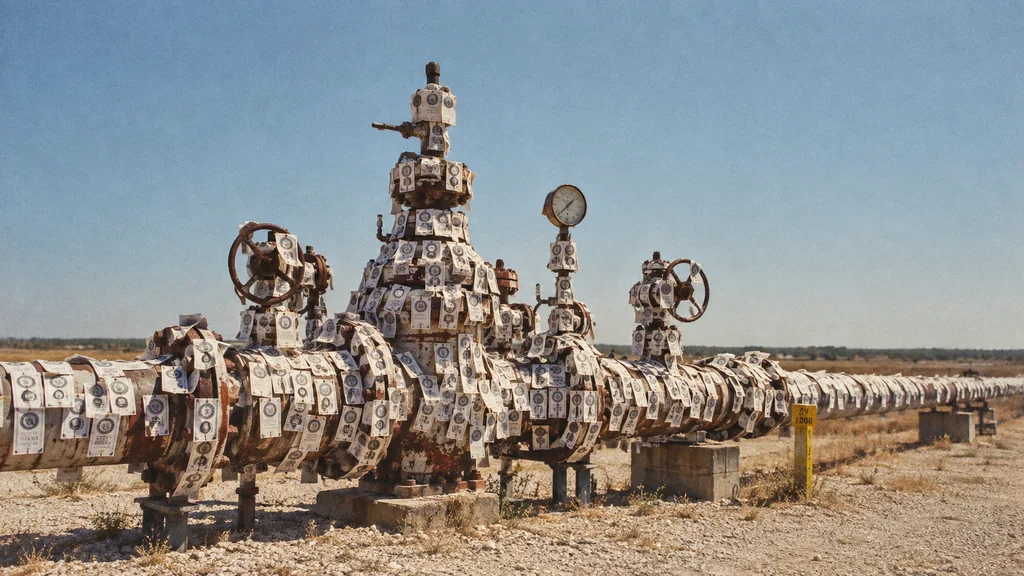
American tariff powers gather around Europe’s remaining Russian energy flows.
Image composition · tobriefThe Lindsey O. Graham Sanctioning Russia and Iran Act, signed on 18 September, does not impose a single tariff on any European country (Congress.gov, White House). It gives President Trump the authority to do so. If the administration identifies a country as one of the five largest buyers of Russian crude oil or natural gas, the president can levy duties of up to 100% on everything that country sells to the United States (BBC).
When we last covered this bill, it had cleared the Senate. Now it is law.
How the trigger works
The law's third-country mechanism sits in Section 113. The US Trade Representative reviews global purchase volumes over the preceding twelve months. Countries ranked among the top five buyers of Russian crude, or the top five for gas, become eligible for tariffs (Congress.gov). Rankings are reassessed every 180 days. A separate provision allows duties of up to 500% on goods imported directly from Russia.
Neither ceiling is an automatic rate. "Up to" means the White House decides what to actually charge. Section 115 lets the president waive any duty by certifying it serves the national interest, without congressional approval (AP). The law hands the administration a discretionary instrument, not a fixed schedule.
Hungary's dependence is real, but the law's test is global
Hungary is the most politically visible case in Europe. Russian crude supplied an estimated 93% of Hungarian crude imports in 2025, flowing at roughly 100,000 barrels a day through the Druzhba pipeline (DW, S&P Global). Slovakia's Slovnaft refinery has reduced its Russian share to roughly 60% but remains configured for Urals-grade crude, the specific Russian blend its equipment was built to process (MOL).
Yet the law does not measure how dependent a country is on Russia. It measures how much Russian energy a country buys in absolute volume, ranked against every other buyer worldwide. China alone takes about half of Russian crude exports; India around 37% (CREA). Hungary's 100,000 barrels a day would not place it in the global top five. The law also contains a gas exception for countries importing less than 15% of Russia's total gas exports, provided they show progress in reducing purchases (CBS).
Who actually pays for a 100% tariff
If Washington did designate a European country, the tariff would be collected from American importers at the US border. Those importers then face three choices: absorb the cost, pass it to American buyers, or find a non-European supplier. European exporters lose sales either way, because their products become dramatically more expensive in the US market.
That matters most for Hungary and Slovakia in automotive parts and machinery. But the economic pressure starts before any tariff is collected. Exporters selling into the US have a direct financial interest in pushing their own governments to diversify away from Russian energy, removing the basis for designation. Banks and investors pricing country risk reach the same conclusion.
This leverage works only if businesses believe designation is credible. Hungary probably falls outside the top-five volume test today. The administration's discretion over how aggressively it applies the rankings, and whether it treats pipeline contracts differently from spot purchases, remains the key uncertainty.
Switching suppliers is slow
Croatia's JANAF pipeline and Krk LNG terminal (liquefied natural gas, where gas is cooled into liquid for shipping) are the most plausible alternative route. But capacity is tight. The pipeline segment toward Hungary can handle roughly 13.2 million tonnes a year, while MOL's two refineries need about 14.2 million tonnes combined (JANAF). A long-duration capacity test began in March 2026; no public results had confirmed enough reliable flow to replace Russian supplies by 19 September.
Hungary's state energy company MVM has acknowledged that alternative LNG would cost more (Telex). Diversification has a price even without American tariffs.
A European dispute, not just a Hungarian one
The EU as a whole has cut Russia's share of its gas imports from 45% in 2021 to about 19% in 2024 (European Commission, Eurostat). Those averages hide sharp national differences. External trade policy is managed by EU institutions, not individual governments (TFEU Article 207). A US tariff aimed at Hungary would likely become an EU-US dispute rather than a bilateral one.
For Europe, this law creates a bargaining tool, not an immediate tariff shock. No rate has been set. The countries most dependent on Russian energy may not meet its volume-based trigger. But the administration's rolling rankings and designation decisions are not yet public, and the political incentive to use the threat is already working.
Details about this article
- Model:
- claude-opus-4-6
- Generated:
- 9/20/2026, 1:38:21 AM
- Pipeline run:
- eu_pipeline_20260920_005006
- Watermark:
- SynthID (Google's invisible watermark)
- Human review:
- None before publication