VW’s EV shortfall risks €1.5 billion
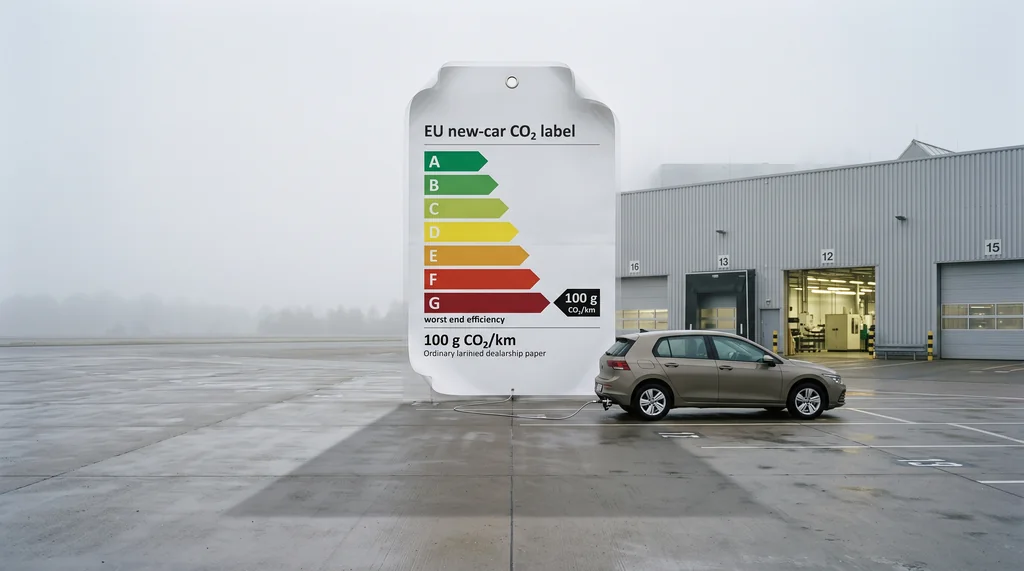
Europe’s emissions arithmetic now towers over Volkswagen’s unfinished electric transition.
Image composition · tobriefVolkswagen could owe the EU between €1.2 billion and €1.5 billion over the next three years for breaching fleet-emissions rules. The estimate comes from CFO Arno Antlitz's own figure of €400–500 million per year (Motorionline, Auto Suivi). Some scenarios push the total above €2 billion (FAZ).
This is not a fine for pollution. It is the cost of selling too many combustion cars and not enough electric ones. Who ends up paying depends on choices VW has not yet made.
How the arithmetic creates a bill
The EU measures the sales-weighted average CO2 emissions of every new car a manufacturer registers in Europe. If that average exceeds the manufacturer's target, the company pays €95 for each gram above target, multiplied by every car sold (EUR-Lex Regulation 2019/631, European Commission). Battery-electric cars count as zero in this calculation, which is why weak EV sales are so expensive: they leave the fleet average high.
VW's reported fleet average sits around 100 g/km. The benchmark is roughly 93.6 g/km, though each manufacturer's legal target is adjusted for the weight of cars it sells (heavier fleets get slightly looser limits), so VW's actual target may be closer to 95 g/km (auto-mania.cz, n-tv). Either way, across roughly three million registrations, even a five-gram gap produces a bill in the billions.
A 2025 amendment lets manufacturers average their performance across 2025–2027 instead of facing annual penalties, so a bad year now can be offset by improvement later (EUR-Lex Regulation 2025/877). That buys time. It does not shrink the gap VW still has to close.
Porsche leaves, Xpeng profits
The most telling response came not from Wolfsburg but from Porsche. On 5 August, according to a European Commission filing, Porsche left VW's compliance pool and formed a new one with Xpeng, a Chinese electric-car maker (DriveMode, Elektromobilni). A pool lets manufacturers be treated as a single entity for compliance. Xpeng sells only electric cars in Europe, so joining forces drags Porsche's average down sharply. The commercial terms are undisclosed (RSE Magazine).
The result is a structural irony. Europe's climate rules were designed to push European carmakers toward electrification. Instead, they have created a market where Chinese EV producers sell regulatory headroom to the very European brands they compete against.
Who pays, who gains
VW has three ways to shrink the bill. Each lands the cost somewhere different.
Discount electric cars. Buyers benefit from lower EV prices, and VW's fleet average improves. The cost falls on VW's margins and, when headquarters looks for savings, on the supplier chain. Polish industry coverage reports European auto suppliers have been losing an average of 142 jobs per day since early 2024, according to dlaProdukcji. Compliance pressure adds to that squeeze.
Pool with a cleaner producer. VW buys time, but the cash flows to an outside partner rather than into its own factories or R&D. Porsche-Xpeng is the template.
Pay the penalty. Money leaves the company without improving its product mix or competitive position. VW's promised €20,000 electric car arrives only from late 2027, too late for most of the current compliance window (Rzeczpospolita).
The pressure crosses borders
This is not only a German story. In Czechia, where more than 180,000 people work directly in the auto sector, VW's compliance calculations shape which Škoda models get hybrid or electric powertrains (Tiscali). In Spain, VW has committed around €7 billion to EV assembly and batteries at Martorell, Landaben and Sagunto (El Español). The compliance bill turns into a fight over which plants and countries get future electric models.
The EU's fleet-emissions rules are producing the price signal they were designed to produce: slow electrification now has a visible, calculable cost. The awkward part is where the money may go. Not into VW's own transition, but toward rivals that already built the electric cars Europe wanted sold.
Details about this article
- Model:
- claude-opus-4-6
- Generated:
- 8/21/2026, 1:53:09 AM
- Pipeline run:
- eu_pipeline_20260821_005006
- Watermark:
- SynthID (Google's invisible watermark)
- Human review:
- None before publication