Four countries march with different demands
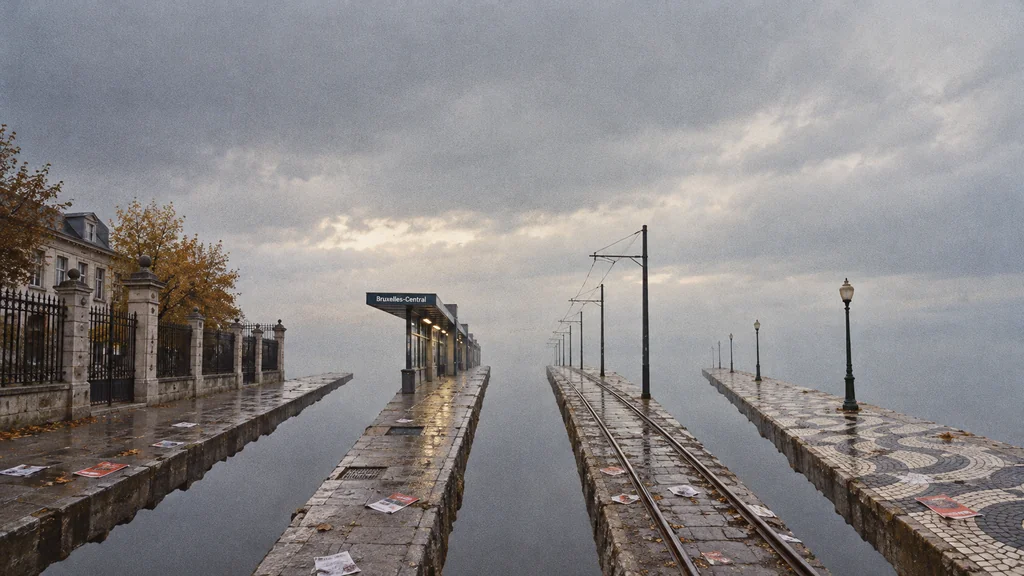
Four countries march on the same day toward different decisions.
Image composition · tobriefHundreds of thousands of people marched across France on Saturday over schools, wages and prices. Interior Minister Laurent Nuñez counted 550,000, while organisers claimed 800,000 (TF1 Info). Belgium, Italy and Portugal also saw protests that day. They happened together, but each brought its own demands to its own government.
A school revolt meets a French budget
The French mobilisation began with calls posted online. Yellow Vests angry about fuel prices joined pupils protesting teacher shortages and cold classrooms, and the CGT and Solidaires unions followed. The pupils' revolt came before the budget did. On 8 October, Reuters reported that blockades of lycées (upper secondary schools) had entered a third week.
Prime Minister Sébastien Lecornu's 2027 budget then gave the pupils a target. Unveiled on 1 October, it raises education spending on paper while cutting 1,588 teaching posts (Le Monde). Education Minister Édouard Geffray argues that falling pupil numbers justify the cut. Pupils answer that their schools already cannot replace absent teachers.
That cut can still change. Lecornu has no reliable majority in the National Assembly, so deputies can bargain over those posts as the budget passes through parliament.
Most marches stayed peaceful, but violence hit particular towns. In Limoges, a fire largely destroyed the nineteenth-century city hall, according to the local prefect (TV5MONDE/AFP). Shortly after midnight, Lecornu said 1,200 people had been detained (TF1 Info). That figure is provisional, and a detention is not a conviction.
Next door, different grievances
In Brussels, social-media calls pointed to the French example. Several hundred young people, mostly francophone pupils, marched from Central Station against changes to their schooling, according to BRUZZ. The march started calmly and ended in clashes with police, with about ten arrests. The pupils' complaint is with the French Community, the francophone government that runs schools in Wallonia and Brussels. Neither the federal cabinet nor the EU decides it.
Italy's march came from outside the usual channels. Italia in Piazza, a citizen network assembled on messaging apps, protested living costs, fuel prices and low wages. In Milan, more than 5,000 people marched before a breakaway group threw stones and firecrackers at police (Corriere della Sera). About 50 people were taken to the police station, nearly half of them minors (ANSA). The network has no union or party leadership, so Giorgia Meloni's government in Rome has no obvious partner to negotiate with.
Portugal's protest was a classic union day. The CGTP confederation marched in Lisbon, Porto and Coimbra, and its leader Tiago Oliveira demanded a 15% general pay rise and a €1,100 minimum wage from January 2027 (CGTP). Its demand has a deadline. The union plans its next protest for 24 November, when parliament is expected to hold the final vote on the 2027 budget (CGTP).
What the EU does and does not decide
The four countries share an economic backdrop. Euro-area inflation reached 3.8% in September, with energy prices 18.8% higher than a year earlier (Eurostat). Borrowing has also become dearer this month. A bond sell-off pushed up the interest rates France and Italy pay on their debt (To Brief).
For three of the four, EU rules also bear on the budget. France, Belgium and Italy are under the excessive-deficit procedure, the EU process for countries whose deficits break the limit of 3% of economic output (Article 126 TFEU, Council of the EU). The procedure limits how fast public spending can grow. It does not say which teaching posts go. That choice belongs to French ministers and deputies.
Saturday's shared timing produced no shared demand and no single authority able to answer one. Whether pupils keep their teachers will be settled by the French deputies voting on the 1,588 posts and by the French Community government in Brussels. Wages and prices are questions for Meloni's government in Rome and for Portugal's parliament when it votes on 24 November.
Details about this article
- Model:
- claude-opus-5-5
- Generated:
- 10/18/2026, 1:37:03 AM
- Pipeline run:
- eu_pipeline_20261018_005006
- Watermark:
- SynthID (Google's invisible watermark)
- Human review:
- None before publication