Europe’s €100 gas reaches factories first
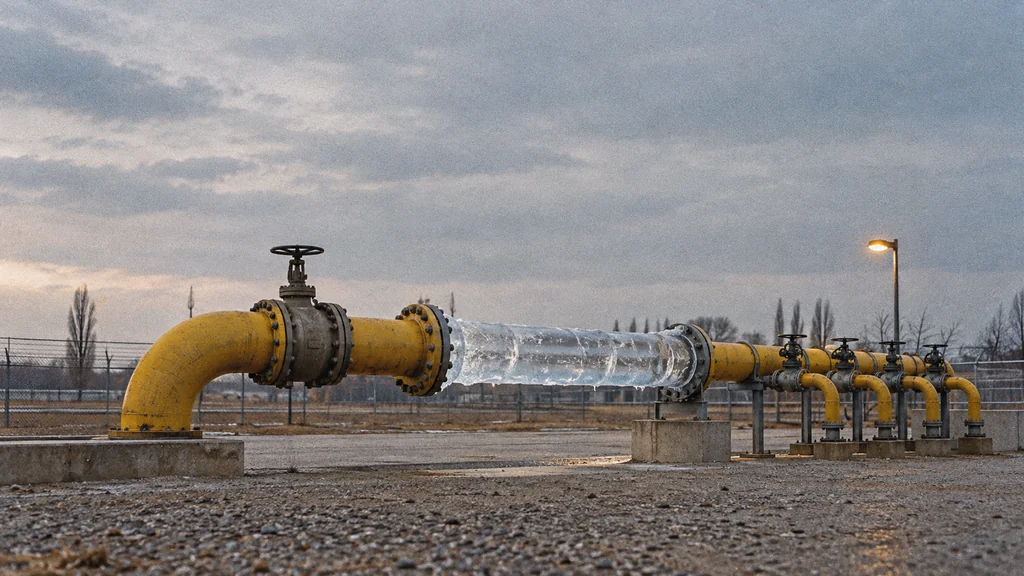
Wholesale gas rises now; household bills follow when contracts reset.
Image composition · tobriefEurope's benchmark gas price briefly touched €100 per megawatt-hour on Wednesday afternoon, about 4% above the previous session and the first time it had reached that level since 2022 (Reuters). The rise reflects Europe paying more to compete with Asia for seaborne gas after shipping through the Strait of Hormuz was disrupted. Factories and gas-heavy power markets feel that price first. Most households feel it later.
The quote comes from the Dutch Title Transfer Facility (TTF), a virtual trading hub that serves as Europe's wholesale reference. The contract in question covers gas delivered in November (ICE). It prices the gas alone, before transport, taxes and supplier margins, and Wednesday's €100 was a brief touch during trading rather than a price the market held.
Why a Gulf blockade lifts Dutch prices
Liquefied natural gas (LNG) is gas chilled into liquid so tankers can carry it. The Hormuz route normally carries roughly 20% of global LNG trade, according to ENTSOG, the association of Europe's gas pipeline operators (ENTSOG). ACER, the EU agency that coordinates national energy regulators, reported that no significant Qatari LNG reached the EU this summer (ACER).
Europe buys relatively little Qatari gas directly, but it still pays. With Gulf cargoes stuck, European and Asian buyers bid for the same flexible shipments, and the hub price rises until enough tankers head to Europe. Buyers on existing contracts pay what those contracts say, which may follow the hub only partly or with a delay.
The squeeze shows in storage. EU underground stores were 74.96% full on 28 October, against about 83% a year earlier (GIE AGSI). Europe enters winter with a thinner cushion.
ENTSOG tested how far that cushion stretches. If LNG arrives as assumed, Europe ends the winter with 29% of its storage still full (ENTSOG). That leaves a reserve for a cold spring. In a scenario with roughly 20% less LNG, the remaining share falls to 13% (ENTSOG). The tanks still do not run dry, though the margin shrinks sharply. ENTSOG notes that the test checks pipes and terminals and does not predict which cargoes will turn up. Germany's network regulator, the Bundesnetzagentur, rates current German supply as stable, with a low risk of tight supply (Bundesnetzagentur). On this evidence, Europe faces a price problem, not a shortage.
Same price, very different bills
Full tanks do not make gas cheap. Italy's stores were 90.88% full against Germany's 61.73% (GIE AGSI), but both countries buy their next cargoes at the same hub price. The bigger difference lies in how far gas reaches into electricity.
In Europe's daily wholesale power auctions, the most expensive plant needed to meet demand in a given hour sets that hour's price, and that plant is often gas-fired. The European Environment Agency estimated that in the first 16 weeks of 2026, gas influenced wholesale power prices in 66% of analysed Italian hours (EEA). Italian power prices therefore move closely with gas. In Spain, where solar and wind often cover demand, the share was only 9% (EEA). Firms and households on fixed contracts do not pay the auction price directly, but their contracts renew at prices that reflect it.
Contracts also delay the rise in gas bills. An ECB analysis found that wholesale gas price changes reached retail gas prices within one to three months in more than half of euro-area countries (ECB). Fixed-price deals, regulated tariffs and suppliers' hedges (gas bought in advance at a locked price) explain why other countries lag. In about a third of them, the pass-through took seven to twelve months (ECB).
Poland shows how far a regulator can stretch the delay. It has held the myORLEN household gas charge at 197.29 zł per megawatt-hour for covered households until 31 December 2026 (URE). Industrial buyers whose contracts track the hub price have no such buffer. Energy-heavy manufacturers, such as chemical plants that use gas as both fuel and raw material, are likely to feel the rise first.
A brief touch of €100 shows neither a supply shortage nor a rise in household bills. ENTSOG's figures suggest Europe can get through winter even with less LNG. The damage depends on whether wholesale prices stay near this level for months, as hedges expire and tariffs reset. If they do, contracts set the order: Italian power users and factories on hub-linked deals pay first, and Polish households, behind a frozen tariff, pay last.
Details about this article
- Model:
- claude-opus-5-5
- Generated:
- 10/29/2026, 7:24:08 AM
- Pipeline run:
- eu_pipeline_20261029_005007
- Watermark:
- SynthID (Google's invisible watermark)
- Human review:
- None before publication