Russian diesel licence hits US import ban
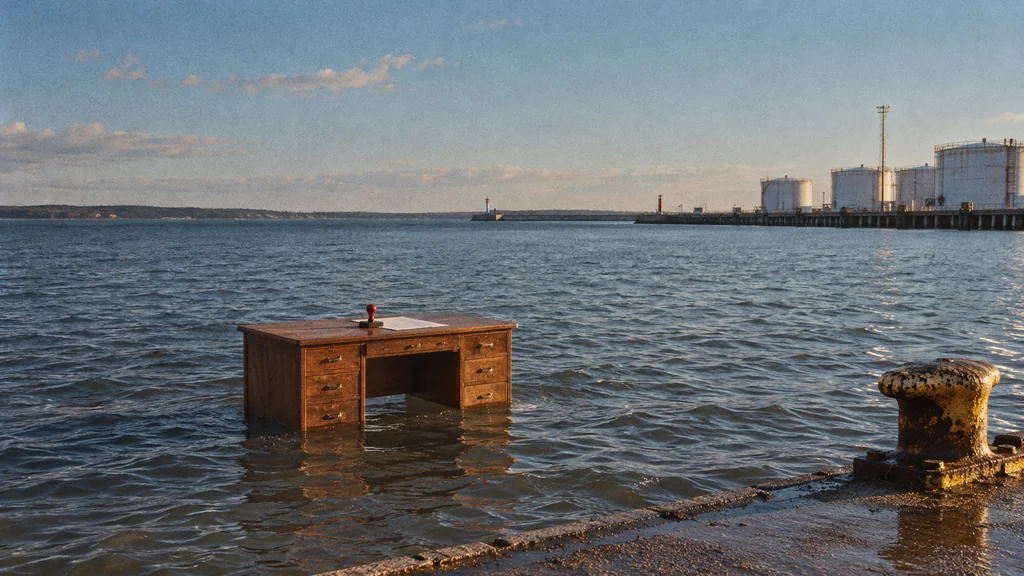
Washington permits Russian diesel trade as its import ban remains in force.
Image composition · tobriefA week after Donald Trump announced Russian diesel shipments, no American buyer or US-bound cargo has been publicly identified. Washington has issued a sanctions licence that permits the trade. That licence cannot lift the 2022 law in which Congress banned imports of Russian petroleum products. Europe's own import ban is untouched, but its control weakens once tankers sail for third countries.
A licence that runs into a law
The Treasury's move is real. Its Office of Foreign Assets Control, the agency that runs US sanctions, issued General License 135. The licence permits the sale and delivery of Russian diesel, including into the United States, until 7 April 2027 (OFAC licence). It names no buyer, volume or price, and it does not require Russia to stop attacking Ukraine.
Congress still forbids what the Treasury now permits. In 2022 it banned imports of Russian petroleum products, and the ban ends only when the president formally certifies to Congress that certain conditions are met. Those conditions include Russian withdrawal and a ceasefire that Ukraine accepts (Public Law 117-109). We found no record of such a certification.
Trump has since said the diesel is for world markets and "not for us" (Reuters). The licence itself contains no such limit. His remark states an intention that the legal text leaves open.
Big numbers, no counterparty
Trump's pledge sounded precise. He promised more than 300,000 tonnes immediately and later stages of up to 3 million tonnes more, depending on Russian refineries (Truth Social). Added together, these produce the 4.8-million-tonne headline that drew European and US criticism earlier this week (To Brief). None of that is a contracted volume.
Moscow opened a narrower door. On 10 October the Russian government allowed an initial 500,000 tonnes onto world markets and left companies to arrange contracts with foreign buyers (Russian government). Nothing in that decision sets cargoes aside for America.
On 14 October, Kremlin adviser Kirill Dmitriev conceded that "many issues" remained while insisting the fuel would reach the United States (Interfax). He named no buyer, vessel or loading date. The diesel tanker reported loading at a Russian Baltic port on 13 October listed Morocco as its destination (Baird Maritime).
Where Europe's control ends
EU sanctions law bans buying or importing Russian diesel into the EU. No American licence can therefore let a tanker unload it in Rotterdam (EU regulation). Changing that would require unanimity, meaning every EU government would have to agree. The European Commission says existing sanctions remain and will be enforced (Commission briefing).
The weak point is diesel heading for countries such as Morocco. There, the EU's leverage runs only through its own shipowners, insurers and banks. Under the price cap, they may serve Russian oil-product trades with non-EU buyers only if the cargo sells below a Western-set ceiling (EU regulation). A tanker that uses no European services falls outside that rule altogether.
Russia may not have much extra diesel to send anyway. The International Energy Agency judged that easing Russia's export curbs was unlikely to change global diesel supply much, because Ukrainian strikes have damaged refineries and limit how much Russia can produce (IEA).
So far Washington has authorised trade in Russian diesel without showing either an American buyer or a way around its own import ban. If a US-bound cargo does appear, the administration owes Congress an explanation of how it fits a 2022 law that remains on the books.
Details about this article
- Model:
- claude-opus-5-5
- Generated:
- 10/15/2026, 1:35:32 AM
- Pipeline run:
- eu_pipeline_20261015_005006
- Watermark:
- SynthID (Google's invisible watermark)
- Human review:
- None before publication