ECB succession race starts with Friday nominations
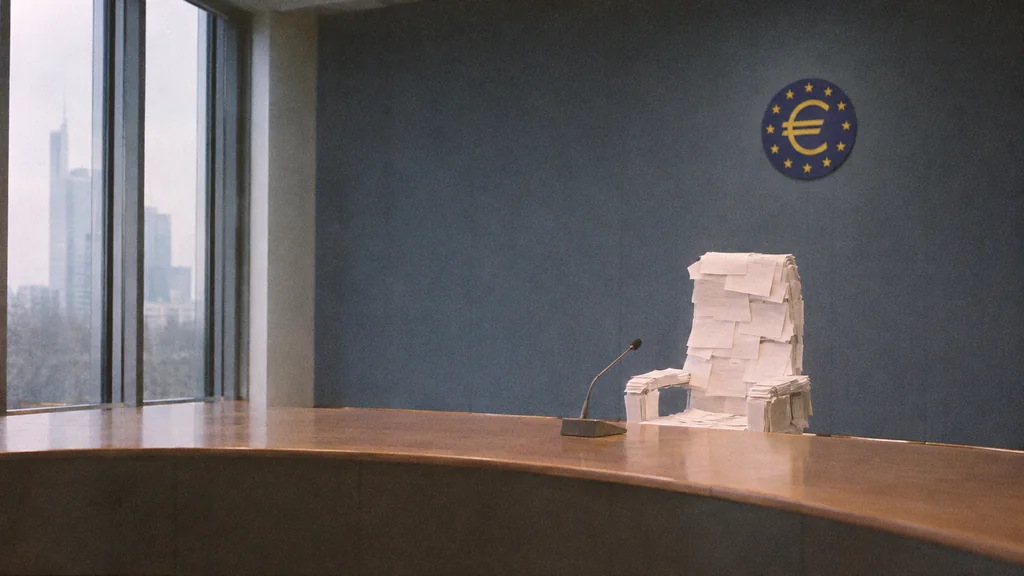
Twenty-one governments submit names; Europe’s central-bank chair remains empty.
Image composition · tobriefEuro area governments must put forward candidates to lead the European Central Bank by Friday, 6 November, after Eurogroup president Kyriakos Pierrakakis asked all 21 capitals for names (Reuters). Governments name candidates now. National leaders choose the president later, while bargaining over several other ECB jobs that fall vacant at the same time. The winner will chair the council that sets interest rates for households and businesses across the currency union, though no president sets those rates alone.
The race opened early. Christine Lagarde confirmed on 29 October that she would leave on 7 February 2027, several months before her term ends (ECB), as we reported at the time (To Brief).
Finance ministers will look at the nominations on Monday, 9 November, but only to take stock, without a vote (Euronews). German chancellor Friedrich Merz wants a decision by the end of 2026 (German government). That is his political target, not a legal deadline.
Who actually decides
Governments propose the names. Their finance ministers, meeting as the Eurogroup, compare them and try to settle on one. The Council of the EU, the formal body where national ministers adopt EU decisions, then turns that preference into an official recommendation.
The final word belongs to the heads of state or government. Before deciding, they must consult the European Parliament, which can question the nominee and give an opinion but cannot block the choice. They must also consult the ECB's Governing Council, the rate-setting body the new president will chair.
The decision needs at least 72% of euro area states, and those states must together represent at least 65% of the euro area's population. In practice that means at least 16 governments that also cover enough people (Council). No capital holds a veto, so a candidate wins by building a coalition.
Two public candidates, several open seats
The treaty requires recognised standing and experience in monetary or banking matters, and gives the president a single eight-year term that cannot be renewed (EUR-Lex). Both publicly backed candidates have run national central banks.
Spain chose Pablo Hernández de Cos in July and said it would nominate him once the procedure opened (RTVE). He governed the Bank of Spain and now heads the Bank for International Settlements, the central bankers' own bank.
Dutch press reports say the government in The Hague backs Klaas Knot, who led the Netherlands' central bank for 14 years (Dagblad van het Noorden).
The presidency is not the only seat coming free. Board member Isabel Schnabel leaves on 3 January, and chief economist Philip Lane's term ends on 31 May (ECB register). With several posts opening within months, governments can trade support for one against another.
One such trade has already surfaced. Reuters, citing unnamed sources, reported in September that France could back Knot if a French economist got Lane's job (Reuters). No French official has confirmed it, so it stands as a reported possibility, not an agreed deal.
The calendar gives Paris a further stake. France elects a new president on 18 April and 2 May 2027 (Service-Public). If leaders decide before then, as Merz wants, Emmanuel Macron will help choose Lagarde's successor instead of leaving that to whoever wins. That consequence follows from the timing. Nothing in the record shows it was the purpose of her early exit.
Friday will produce a list, not a president. The choice belongs to national leaders, who need a broad majority of both states and population, and the person they pick will steer rate debates without controlling them. The trade most likely to shape the outcome, French support for Knot in return for the chief economist's chair, rests so far on one anonymously sourced report.
Details about this article
- Model:
- claude-opus-5-5
- Generated:
- 11/4/2026, 2:11:11 AM
- Pipeline run:
- eu_pipeline_20261104_005008
- Watermark:
- SynthID (Google's invisible watermark)
- Human review:
- None before publication