Zaporizhzhia has 10 days of diesel
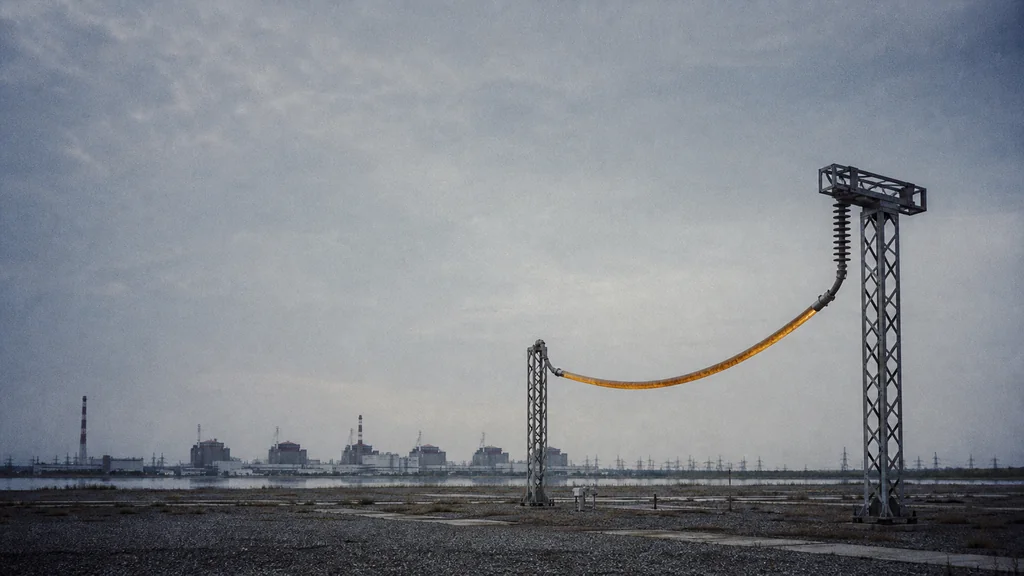
Europe’s largest nuclear plant hangs on ten days of diesel.
Image composition · tobriefEurope's largest nuclear plant lost its last connection to the electricity grid on 20 August, when fighting north of the Dnipro River severed the sole remaining power line. Ten days on, emergency diesel generators are all that keep cooling systems running at six shut-down reactors and their spent-fuel pools (LIGA, NV).
IAEA Director General Rafael Grossi put the clock at roughly 10 days. Without grid repairs or new diesel deliveries, he warned, the plant could lose all power (Straits Times, RBC-Ukraine).
A crisis built line by line
This has been building for years. Before Russia's full-scale invasion, Zaporizhzhia had 10 external power lines. They degraded one by one until the last, a 330 kV line called Ferosplavna-1, failed on 20 August (Ukrainian News, Rubryka). Military activity has blocked technicians from even diagnosing the cause. The IAEA is now negotiating a localized ceasefire so repair crews can reach the site (World Nuclear News).
The reactors have not produced power for over two years. But "shut down" does not mean inert. Radioactive decay in fuel assemblies and spent-fuel storage pools keeps generating heat. Pumps, valves and instruments that remove that heat all run on electricity (Nuclear News Network, News UN). If both grid power and diesel fail at the same time, cooling stops and temperatures climb. The risk is lower than if the plant were running at full capacity, but it does not reach zero.
Operators raised water levels in spent-fuel pools at all six units earlier in August, buying extra time before boiling if active cooling were lost (Nuclear News Network). IAEA inspectors checked most of the plant's 20 diesel generators and observed fuel trucks arriving from two nearby locations on 27–28 August (NV, 5 Kanal). But inspectors have not visited the main off-site fuel depot since March 2025, and fighting reportedly delayed the last scheduled delivery to that facility months ago (UNN, Rubryka). The 10-day diesel figure comes from plant staff, not from an independent IAEA inventory audit.
Three drone strikes during the week added a second danger: one near the cooling pond injured two employees, one hit the dry spent-fuel storage site, and a third struck a sprinkler system (the IAEA said on X, Agerpres). Radiation levels stayed normal. The agency did not assign responsibility.
The Rosatom question Europe keeps avoiding
European governments read the warning through their own nuclear politics.
France, Europe's most nuclear-dependent country, draws a careful line. Consultant Stéphane Audrand told Le Parisien that a plant in cold shutdown is not "a new Chernobyl" just because it lost grid power (Le Parisien). The French warning is simpler: war makes the surrounding machinery dangerous too. Substations, roads, fuel deliveries and exhausted staff all become safety risks (Euronews). Greenpeace France uses the crisis to demand Rosatom sanctions, noting that nuclear trade remains exempt from the EU's Russia sanctions packages (France 24).
Hungary is the conspicuous silence. Government-friendly media relayed the IAEA data without connecting it to Paks II, Budapest's Rosatom-financed reactor project (Világgazdaság). The reason is practical: Paks supplies a major share of Hungarian electricity, and Paks II is built and funded by the same Russian state nuclear company (World Nuclear Association). Budapest has every incentive to treat Zaporizhzhia as a war problem rather than an argument for sanctioning Rosatom. As long as the EU's sanctions regime exempts the nuclear sector (Council of the EU), Hungary has not had to spend its veto.
Poland frames the episode as Russian coercion while protecting public confidence in its own first nuclear build. Its nuclear regulator's position is that loss of external power is a standard design scenario that diesel can handle; Zaporizhzhia is uniquely dangerous because of war and occupation, not because of nuclear technology (BiznesAlert).
The immediate question is mechanical: whether Grossi's ceasefire push produces access for repair crews before diesel runs out. The larger question is political. Zaporizhzhia is the most visible consequence of Russian control over European nuclear infrastructure, yet the EU can treat it as a safety emergency while still refusing to price Russia's nuclear leverage into sanctions. That is the choice foreign ministers keep postponing.
Details about this article
- Model:
- claude-opus-4-6
- Generated:
- 8/30/2026, 1:52:03 AM
- Pipeline run:
- eu_pipeline_20260830_005006
- Watermark:
- SynthID (Google's invisible watermark)
- Human review:
- None before publication