122 reef systems face collapse risk
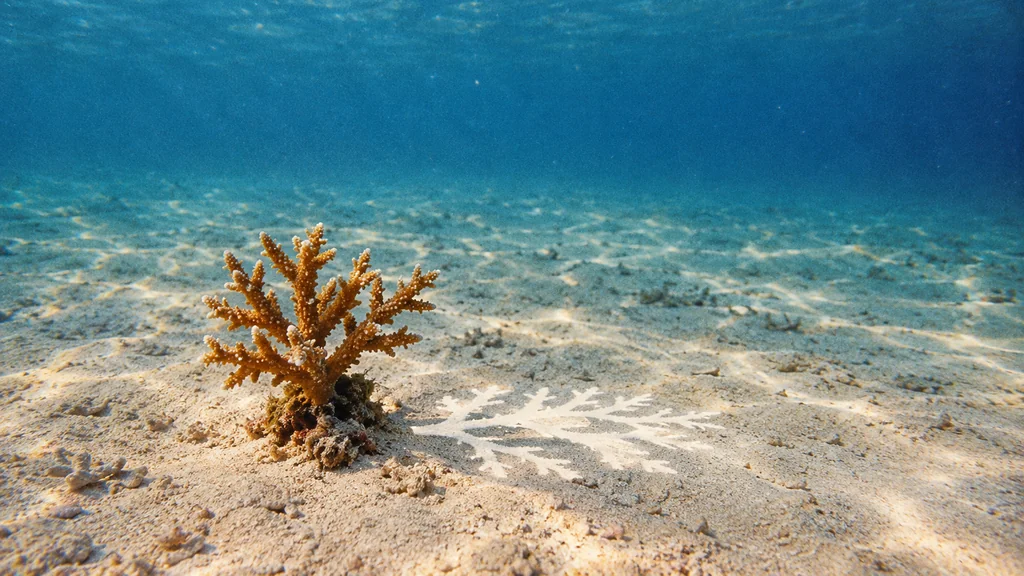
The reef is alive; its greatest danger lies in warmer water ahead.
Image composition · tobriefOn 22 October, the International Union for Conservation of Nature (IUCN) rated 122 of the world's 127 regional warm-water reef systems Critically Endangered (IUCN assessment). Only one, the Western Galápagos Islands, sits in the separate category for reefs that have already collapsed (IUCN press release). The rating measures how likely the remaining systems are to stop working as reefs. For all 122, that outcome has not happened yet.
We reported the headline figure on announcement day (To Brief). The method behind it explains why a living reef can carry such a severe label. More than 250 experts in ten regional teams built the assessment from decades of coral, algae and fish surveys, reef maps and satellite temperature records (UN press-conference transcript).
A risk score for a whole ecosystem
Most people know the Red List as the ranking that calls a tiger or a frog endangered. The Red List of Ecosystems applies the same idea to entire living systems, such as a forest, a wetland or a reef, and asks how close each one is to collapse (IUCN Red List explainer). Critically Endangered is its highest risk category. Collapsed is a separate, final category for systems where the loss has already occurred.
A cardiologist works the same way. A patient with high blood pressure, high cholesterol and a family history can be labelled high-risk for a heart attack while walking around perfectly well. The label describes a likely future and gives the patient time to act on it.
The unit being scored here is a regional reef system: all the reefs across a region that share a similar mix of species and conditions. The count of 127 could suggest a scattering of small patches. In fact, the 122 Critically Endangered systems cover 99.8% of the reef area assessed (IUCN assessment). Almost the entire world's warm-water reef lies in the top risk tier.
Why a forecast can outweigh today's coral
Looking ahead is part of the method. The assessors weighed projected marine heat, the ocean temperatures reefs are expected to face in the coming decades, alongside the damage already measured (IUCN assessment). A reef that looks reasonably healthy today can therefore score badly if the water around it is forecast to get much hotter.
Heat matters this much because of how corals feed. A coral is an animal that houses microscopic algae inside its tissue. The algae use sunlight to make food and share it with their host, a little like solar panels installed inside the body. When the water stays too warm for too long, the partnership breaks down and the coral expels the algae. Without them it turns white, which is the "bleaching" seen in news photographs (NOAA bleaching explainer).
A bleached coral is still alive, but it is starving. If temperatures ease, the algae can return and the coral recovers. If the heat persists, the coral is more likely to die (NOAA bleaching explainer). A reef system's future depends heavily on how often that stress arrives, and a forecast of rising heat is a forecast of more frequent stress.
A verdict still in draft
The assessment has not yet been finalised. Its results are scheduled for peer review and completion in 2027 (IUCN project schedule), so the detailed regional ratings could still shift as outside scientists examine the data and methods.
Its central finding is already clear. The world's warm-water reefs are, with one exception, still functioning ecosystems, and nearly all of them are at the highest risk of ceasing to function. Because ocean heat weighs so heavily in that risk, IUCN names cuts to greenhouse-gas emissions as central to reducing it (IUCN assessment). For the 122 systems on the list, collapse remains a forecast, and the main driver of that forecast is how much warmer the ocean gets.
Details about this article
- Model:
- claude-opus-5-5
- Generated:
- 10/23/2026, 1:33:14 AM
- Pipeline run:
- eu_pipeline_20261023_005007
- Watermark:
- SynthID (Google's invisible watermark)
- Human review:
- None before publication