21.07°C oceans capped Western Europe’s hottest summer
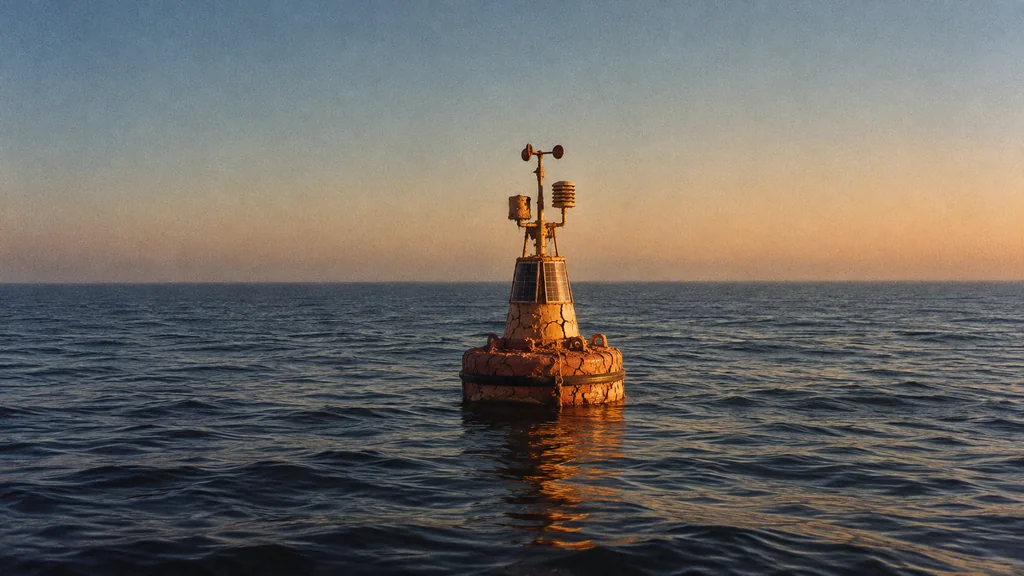
The instruments remain afloat as the climate beneath them changes.
Image composition · tobriefThe world's oceans hit their hottest August on record. Averaged across the surface between 60°S and 60°N, water temperatures reached 21.07°C, tying March 2024 as the highest monthly value in the satellite-era record and running 0.09°C above August 2023's previous summer peak, according to Copernicus. Global surface-air temperature averaged 16.96°C, an estimated 1.65°C above the pre-industrial 1850–1900 baseline. Together with July 2023, it was the joint warmest calendar month in ERA5, the European reanalysis that blends satellite, balloon, aircraft and station observations with a weather model to produce a consistent global record.
A single month above 1.5°C does not breach the Paris Agreement threshold, which concerns sustained warming over decades, not one season's weather. But August was not an isolated spike. It closed a summer that rewrote records across Western Europe.
Why the heat fed on itself
Copernicus measured the June-through-August mean across the region from Portugal to the Alps as the highest on record, surpassing 2003. Europe as a whole was less extreme: only its fourth-warmest August and third-warmest summer, behind 2024 and 2022. What set Western Europe apart was persistence, built by months of high-pressure systems that parked over the same latitudes.
In a blocking pattern, sinking air suppresses clouds and rain, letting sunshine heat the ground day after day. Once the soil dries, the land loses its equivalent of perspiration: instead of evaporating water and cooling itself, the surface converts more sunlight directly into heat. That feedback loop is well established in climate science (Seneviratne et al.).
Copernicus recorded record-low July soil moisture across parts of Iberia, France, Germany, Austria and Hungary. The combination of human-driven warming, persistent blocking and unusually dry soils is known to intensify heat extremes, though no study has yet quantified how much each factor contributed to 2026's temperatures specifically. Late August brought some rain, but localised downpours did not erase three months of accumulated deficits.
A season measured in endurance
France provides the clearest national illustration. Météo-France measured a summer mean of 24.0°C, a full 3.6°C above the 1991–2020 average and the highest since records began in 1900. The previous record, 23.1°C in 2003, fell by 0.9°C, a remarkably large margin for a three-month national average. Three distinct heatwave episodes spanned 53 days between mid-June and late August, compared with 33 in 2022. Stations logged 178 crossings of 40°C, double the 2003 count, and summer rainfall ran roughly 40% below normal (Météo-France).
Those numbers involve two different baselines worth untangling. The 3.6°C figure measures departure from today's recent climate (1991–2020). Météo-France's model-based attribution estimate puts the summer at about 5.0°C above pre-industrial conditions, of which roughly 2.4°C (range 1.8–3.0°C) was attributable to human-caused climate change. CNRM climatologist Aurélien Ribes offered a useful frame: 2026 was hotter in absolute terms, but less exceptional relative to today's shifted climate than 2003 was in its day. The floor has risen.
Spain recorded its warmest summer at 24.5°C since AEMET's series began in 1961, with 61 days within officially defined heatwave episodes across four events (AEMET). Yet August alone ranked only sixth among Spanish Augusts, reinforcing that this record was built on relentlessness, not a single extreme peak. At the De Bilt reference station in the Netherlands, the season averaged 19.3°C, the warmest since 1901, with a near-rainless July pushing accumulated precipitation into the driest 5% of years.
What the heat left behind
As we reported in July, wildfires had already triggered evacuations and EU civil-protection deployments across France and Spain. Spain's provisional tally through mid-August reached 254,730 hectares burned, though that was 13.8% below the same point in 2025. Heat and drought set the conditions; ignition, wind and response determine outcomes.
Independent global datasets from NASA, NOAA and Berkeley Earth have not yet published their August figures, and the near-real-time ERA5 result can be revised. What the available evidence establishes is a summer where human-caused warming, atmospheric blocking and drying soils combined in a configuration the IPCC has identified as the principal driver of increasing hot extremes over land. Western Europe's 2026 showed what that configuration looks like when it locks in for three months.
Details about this article
- Model:
- claude-opus-4-6
- Generated:
- 9/11/2026, 1:46:56 AM
- Pipeline run:
- eu_pipeline_20260911_005007
- Watermark:
- SynthID (Google's invisible watermark)
- Human review:
- None before publication