€70 Million Shell Deal Topples Pevkur
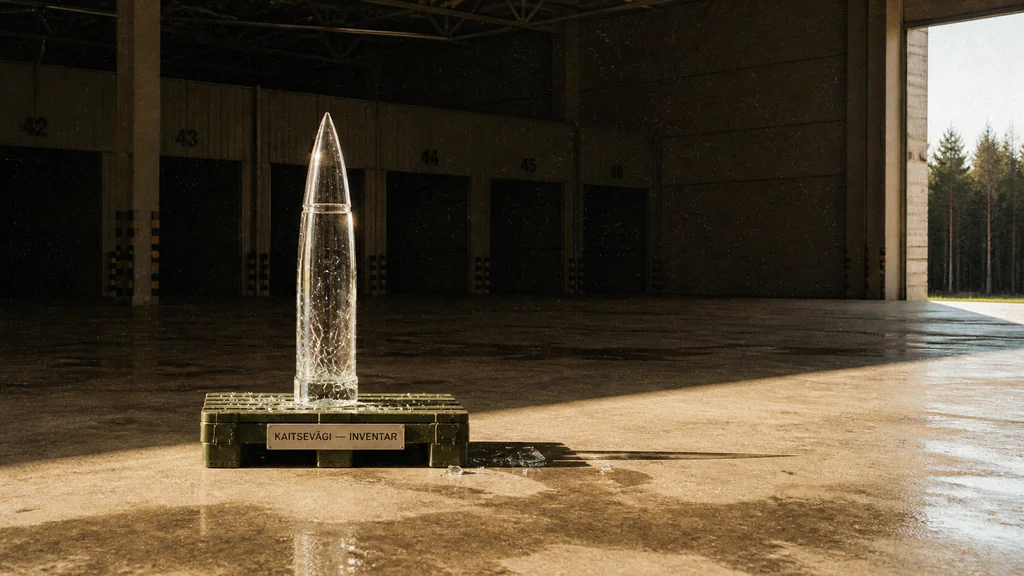
Estonia’s defence stocks look solid until the light passes through.
Image composition · tobriefEstonia's Defence Minister Hanno Pevkur resigned on 2 September. Two separate failures forced him out, and both point to the same problem: the country's defence systems could not keep up with its defence spending.
The first failure is an accounting breakdown. Estonia's National Audit Office (Riigikontroll) reported that it could not verify €1.2 billion in defence inventory balances (Riigikontroll, ERR News). That money is not missing. The materiel may well exist. But the Defence Ministry's inventory tracking was so poor that auditors could not confirm what Estonia actually has in its warehouses.
The second failure is a procurement scandal. Estonia's procurement agency signed contracts worth roughly €70 million with Datasel S.R.L., an Italian-registered company, for artillery shells bound for Ukraine. The first delivery was due by November 2024. Nothing usable arrived, and Estonia has taken the dispute to court (ERR News, Liga.net).
Records That Couldn't Keep Pace
The audit findings, published on 28 August, describe a ministry that wrote its own rules for recording stock and fell behind on entering deliveries into the books. The Defence Forces still lacked a modern inventory-management system. Auditors had raised similar warnings the year before (ERR, Riigikontroll). The core issue is straightforward: Estonia ramped up defence spending sharply, and its back-office systems did not follow (ERR).
The shell contract is harder to explain. Datasel, linked to India's Neco Defence Munitions, signed four contracts with Estonia starting in August 2024 (Euractiv). Advance payments kept flowing even after the first delivery failed. Riigikontroll examined €72.1 million in prepayments and flagged problems with €71.6 million of that total. The largest problematic supplier had received €59.8 million (Riigikontroll). Auditors warned these losses could fall on the state budget at the expense of other planned spending (Äripäev).
At a Riigikogu (Estonia's parliament) committee hearing on 2 September, each institution blamed another. The Defence Ministry pointed to the procurement agency. The agency pointed to its former director. Auditors said they had repeatedly asked for the disputed contract text and not received it. Confidentiality clauses blocked public discussion of the terms (ERR News, Riigikogu). Without that contract, the public can see the advance, the failed delivery and the court filing, but not whether recovery is realistic.
Datasel's corporate trail raises a basic supplier-vetting question. The company's only traceable Romanian presence is a branch registered near Bucharest in June 2025 with zero employees, created after the Estonian contracts were already signed (MetricBiz). Public materials showed no prior shell-production record and no financial scale matching tens of millions in ammunition advances (Euractiv). If routine due diligence missed this, the problem is not one bad contract. It is the vetting process itself.
Money Moves Faster Than Controls
This scandal lands at a pointed moment. Estonia received its first payment of €351.6 million in August under SAFE (the EU's new defence-loan instrument providing up to €2.34 billion in EU-backed financing) (European Commission). No public SAFE document ties Datasel to that loan line, and the 2024 contracts predate Estonia's SAFE agreement. But Estonia positioned itself as an early proof point for EU defence financing. That credibility frays when the country's own auditors cannot verify its defence stocks or explain how €70 million in advances reached a supplier with no visible production history.
Czechia's ammunition initiative shows a different model. Prague stages payments monthly against confirmed deliveries and runs an oversight commission to monitor implementation (Czech Defence Ministry, iROZHLAS). That approach has its own transparency gaps (Seznam Zprávy). But staged payments tied to deliveries would have stopped Estonia's exposure at the first missed shipment, not the fourth contract.
Europe is building defence-finance tools faster than member states are proving they can police the contracts those tools will fund. Pevkur's resignation names the political cost. The structural fix sits with every EU country now converting urgent defence money into procurement: who checks the supplier before the advance leaves the account? Estonia's parliament, courts and auditors owe that answer first. Brussels, designing SAFE's next disbursements, should be watching closely.
How was this article?
Help us get better
Help us get better
Details about this article
- Model:
- claude-opus-4-6
- Generated:
- 9/3/2026, 2:09:23 AM
- Pipeline run:
- eu_pipeline_20260903_005007
- Watermark:
- SynthID (Google's invisible watermark)
- Human review:
- None before publication