96% of reef ecosystems face collapse risk
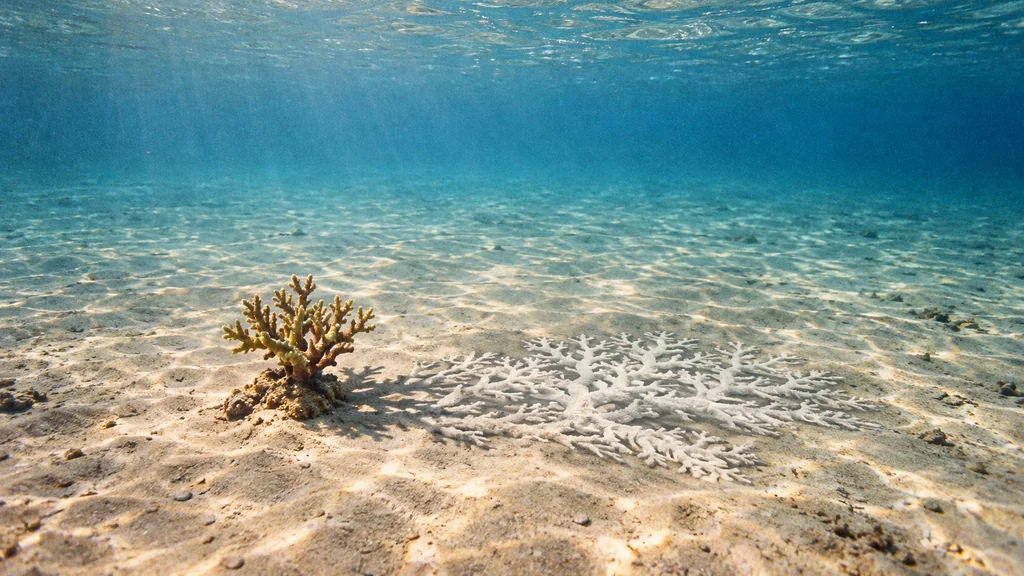
The reef is alive; its future depends on how warm the sea becomes.
Image composition · tobriefMost of the world's coral reefs are still alive, yet almost all of them now carry the highest risk rating conservationists use. The International Union for Conservation of Nature (IUCN) has classed 96% of 127 shallow-water reef ecosystems as Critically Endangered (IUCN). The rating describes an extremely high risk of collapse within roughly 50 years, mostly because of warming that has not happened yet (AFP). The outcome is still open.
A prognosis rather than a death certificate
Think of the rating as a doctor's prognosis. It judges how likely a patient is to decline and does not record what has already been lost. The IUCN announced the assessment on 22 October at the UN biodiversity conference in Yerevan, drawing on reefs across more than 80 countries and territories (AP). More than 250 experts contributed (University of Melbourne).
Each unit in the assessment is a whole regional system, such as the Great Barrier Reef or the Red Sea's reefs, so the exercise judges forests rather than trees. In IUCN's framework, an ecosystem has collapsed when it has lost the defining features and functions that made it what it was (IUCN explainer).
The future drives most of the result. Judged only on evidence from the past 50 years, 24% of the units would qualify as Critically Endangered, and adding projected change over the next 50 years lifts that share to 96% (IUCN). The projection assumes a middle-of-the-road pathway of about 2.7°C of warming by 2100, which is a scenario and not a forecast (AFP).
Damage has already been observed, though it is measured differently. A global monitoring network estimated that hard-coral cover fell 14% between 2009 and 2018 (GCRMN). Satellites later detected bleaching-level heat across about 84.4% of the world's reef area between January 2023 and September 2025 (NOAA Coral Reef Watch). That figure shows where corals were exposed to heat. It does not show where they died.
How heat breaks a reef
Corals are animals that build stony skeletons, and many house microscopic algae in their tissues. The algae turn sunlight into food and supply much of the coral's energy, rather like a lodger who pays most of the rent. When water stays too warm, the partnership breaks down. The coral loses its algae and its pale skeleton shows through, which scientists call bleaching (NOAA). A bleached coral is stressed but not dead, and it can regain its algae if the water cools in time.
How long the heat lasts matters as much as how high it peaks. Picture a running tally that grows faster when the water is hotter and keeps growing the longer the heat stays. NOAA's measure for this, called "degree heating weeks," combines how far water rises above a location's usual warm-season peak with how long it stays there. A larger tally predicts more severe bleaching and, eventually, coral deaths (NOAA).
What local choices can and cannot do
Heat is the most consistent threat worldwide, but local pressures pile on. Overfishing, including of algae-grazing fish such as parrotfish, threatens 63% of the assessed units (IUCN). Grazers matter because they keep algae from smothering the corals.
A 20-year study of Hawaiian reefs found that coral cover held steady through the severe 2015 heatwave at nearly one-fifth of sites (Nature). Reefs with less pollution and more fish fared better. The study observed this pattern without testing it experimentally, so it points to a link and does not prove that cleaner water and healthier fish stocks caused the difference.
Local rules cannot cool the sea. A 2025 model of 3,800 Great Barrier Reef sites projected substantial coral decline by mid-century under every emissions scenario it tested (Nature Communications). The same model found that recovery was possible later in the century if warming stayed below 2°C.
Most of the jump from a quarter of reef systems to nearly all of them comes from projected warming. The rating holds for the warming pathway the assessors assumed. Limiting warming below that pathway gives the world's reefs a better chance than the headline figure suggests.
Details about this article
- Model:
- claude-opus-5-5
- Generated:
- 10/22/2026, 7:39:20 PM
- Pipeline run:
- eu_pipeline_20261022_184701
- Watermark:
- SynthID (Google's invisible watermark)
- Human review:
- None before publication