US licence for chips rented by Chinese companies
AI Daily Synthesis
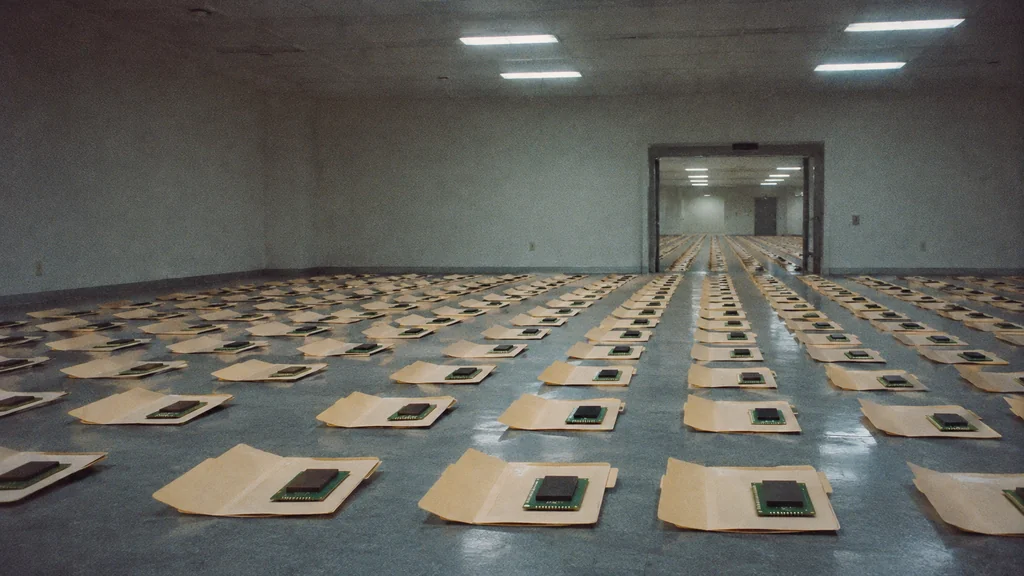
Image composition · tobriefAn Nvidia server can sit in a data centre in Malaysia and work for a company in China without the chip ever crossing the Chinese border. On 16 November, the US Bureau of Industry and Security (BIS), the Commerce Department agency that controls exports, announced a rule linking chip licences to whoever uses their computing power (BIS). The rule is not yet in force. It takes effect when it is published in the Federal Register, the US government’s official journal, on 19 November as scheduled (rule text).
The process is straightforward. A customer sends code, data and instructions over the internet. GPUs, the processors that run artificial intelligence, do the work at the overseas data centre and send back the result. Megaspeed, a Singapore-based company, rents out exactly this computing power online, using Nvidia servers in Southeast Asian data centres (CNA). According to Fortune, Alibaba rented computing power from data centres in this network to train models (Fortune).
The rental was legal as long as the hardware stayed outside China. An earlier BIS opinion found that providing computing power alone was not subject to export controls (BIS opinion). Separately, the company faces suspicions that it physically sent chips to China. It denies them, and no charges have been filed, according to the US think tank Atlantic Council (Atlantic Council). The case has a history. It has not been made public whether Megaspeed’s services will require a licence under the new rule.
Two checks on chip shipments
BIS does not directly regulate internet connections. It relies on the authority it already has over chips (Kharon). A bill that would give it explicit authority over remote access remains pending in the Senate (Congress.gov).
The first check is geographic. Every shipment of advanced chips to Indonesia, Malaysia, Singapore, Thailand and Brazil will need a US licence before the transaction (Nixon Peabody). BIS calls the five countries destinations with a heightened risk of diversion (BIS). Shipments to an end user based in the US or with a US-based parent are exempt under certain conditions, with monthly reporting to BIS (rule text). According to BNAmericas, Amazon, Microsoft and Oracle are expected to use the exemption (BNAmericas).
The second check applies anywhere in the world. Chips sent to a data centre that provides substantial computing power to companies in China or other countries under US restrictions will need a licence. Moving the customer elsewhere is not enough to avoid the requirement, because the location of its parent company also counts. If a data centre later starts serving such customers, the change counts as a new transfer of the chips and also requires a licence (Kharon).
The threshold is more than 12 million units of a regulatory measure of computing power based on each chip’s specifications, rather than the number of chips (Trade Compliance Resource Hub). Estimates based on those specifications put it at about 750 Nvidia H100 chips or fewer than 350 of the newer B200 chips (BERI).
Who the real customer is
The chip supplier must ask the data centre for details of its customers’ direct and indirect ownership (rule text). If the data centre does not provide them, the refusal is a “red flag” and may count as knowledge of a prohibited destination. The rule does not, however, require inspection of network traffic or each user’s work. Verification depends on company documents and the provider’s cooperation (Atlantic Council).
Before the rule was announced, Ke Yan, an analyst at Shenton Research, warned that providers would have to document where every chip was and who the end user was (Economic Times CIO). Singapore is asking Washington for “reliable access” to chips for its businesses. It also said it would not allow the country to be used to circumvent foreign controls (MDDI–METI).
Jeffrey Kessler, the US under secretary of commerce, signed the rule. According to BIS itself, however, it was written “by and at the direction of” the Treasury Department and the National Security Council. Three days earlier, Treasury Secretary Scott Bessent had said that his department, the Pentagon and the State Department had been seeking for months to put Megaspeed on a trade blacklist. He said the Commerce Department under Secretary Howard Lutnick had not agreed (Reuters). Commerce spokesperson Kristen Eichamer denied a report of a dispute between the two secretaries (The Hill). The blacklist and the rule are separate decisions.
Beijing has not responded specifically to the final rule. Asked on 13 November about the planned measures against remote access, Chinese Foreign Ministry spokesperson Mao Ning opposed the “abuse” of export controls (Chinese Foreign Ministry). China also has a domestic alternative. According to market research company IDC, Huawei accounted for 28% of accelerator shipments to Chinese data centres in the first half of 2026, and Nvidia for 34% (Huxiu, TMTPost). Those shares refer to shipments in the domestic market, not computing power rented abroad.
If publication goes ahead on 19 November as planned, data centres already serving Chinese customers above the threshold will have 90 days, until around 17 February 2027, to obtain a licence (Nixon Peabody). From that day, Washington will regulate both where a chip goes and whom it works for. But it will know only what it can learn from the documents of providers that, until yesterday, were legally renting out its computing power.
Details about this article
- Model:
- claude-opus-5-5
- Generated:
- 11/17/2026, 4:40:07 AM
- Pipeline run:
- incremental_20261117_033012
- Watermark:
- SynthID (Google's invisible watermark)
- Human review:
- None before publication