Public-sector and seafarers’ strike cancels ferries to the Cyclades
AI Daily Synthesis
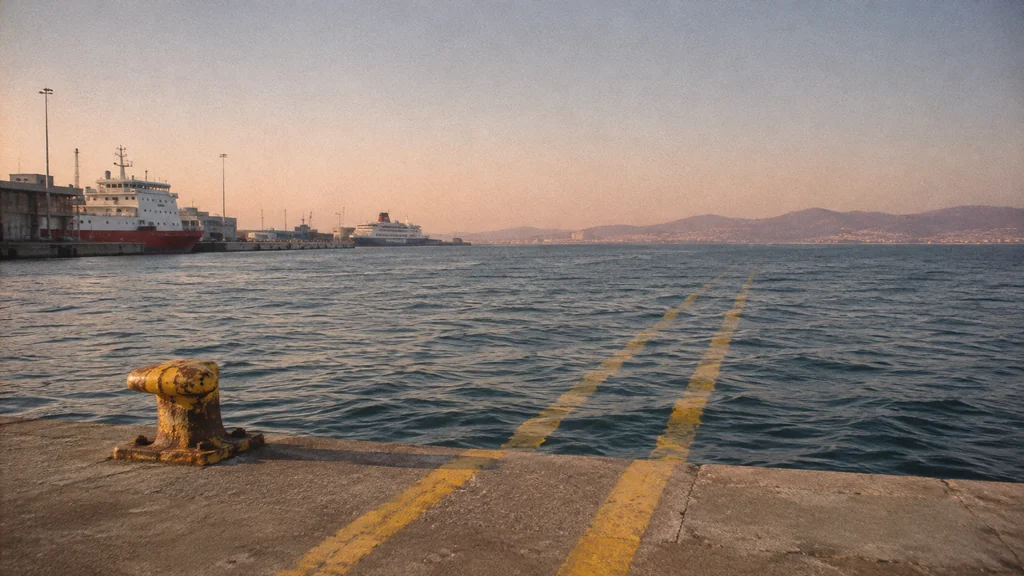
Image composition · tobriefBlue Star will not run two morning sailings to the Cyclades tomorrow, Wednesday 25 November. The 06:45 sailing to Paros, Naxos, Santorini and Ios and the 07:30 sailing to Syros, Tinos and Mykonos are listed as cancelled in the schedule changes published by ferry company ANEK (ANEK Lines). Until yesterday, the only known ferry cancellation was a Levante sailing on the Ithaca, Sami and Patras route, and that had been reported only in a news article (To Brief); there is now an official company list. Public employees will strike for 24 hours following a decision by ADEDY, the public-sector workers’ confederation. Dozens of local labour councils and sectoral unions will also strike, though there is no general strike in the private sector (The Press Project).
Wednesday morning
In Athens, ADEDY has called a rally at 10:30 in Klafthmonos Square, where municipal employees represented by their federation, POE-OTA, will also gather (ADEDY, POE-OTA). In Piraeus, the port city near Athens, the seafarers’ unions PEMEN and STEFENSON have called an initial gathering near the Blue Star ferries at 05:30 and a rally in Municipal Theatre Square at 10:30 (PEMEN and STEFENSON).
The two unions will strike from 00:01 to 24:00 across all types of vessel, demanding a 12% pay rise and a 35-hour week (PAME). PNO, the seafarers’ federation, said on 16 November that it was negotiating with employers and had not decided whether to join the strike (PNO). News reports also attribute a separate 24-hour strike at ports in Attica, the region around Athens, and on ships bound for the Adriatic to PENEN, another seafarers’ union (EfSyn), though its announcement has not been found. The situation at the ports will therefore depend on each company, and anyone with a ticket should check their own departure.
For Athens’s metro, news reports say unions at STASY, the company that operates the metro, suburban railway and tram, will stop work until 09:00 and from 18:00. That would leave trains on lines 1, 2 and 3, and trams, running only from 09:00 to 18:00 (Ethnos, Parapolitika). STASY itself has not published a timetable showing the first and last trains or arrangements for the airport connection.
For buses and trolleybuses, neither OASA, Athens’s public transport authority, nor OASTH, Thessaloniki’s public transport organisation, has issued a final announcement. According to Odigostoupoliti, citing an unnamed source, the general assembly of the Athens bus workers’ union did not discuss a strike, although individual employees joining the action could cause delays. No taxi strike has been announced.
At airports, OSYPA, the federation of civil aviation employees, will strike but will keep safety staff on duty for emergency flights, medical evacuations and overflights (Proson). No announcement has identified which commercial flights will be cancelled, and the effects remain unclear (Alfavita).
Who is striking
ADEDY’s executive committee decided on 17 November to call a strike across the public sector, including teachers. OLME, the secondary school teachers’ federation, explicitly called on its members to take part (ADEDY, OLME). Each school’s operations will depend on how many teachers strike; classes may be missed or hours changed.
In the private sector, The Press Project’s list counts 28 local labour councils, from Athens to Karditsa, a city in central Greece, and 13 federations, including those representing construction workers, private-sector employees and dairy and food workers (The Press Project). In.gr counts 29 councils and 14 federations (in.gr). Neither count is an official list.
GSEE, the main private-sector trade union confederation, could cover the entire private sector with a single decision. It has not called a strike for 25 November and has announced its own mobilisation for 9 December (GSEE). In practice, a private-sector employee is covered only if their local labour council or sectoral federation has decided to strike.
What the unions want and how the government responds
ADEDY and POE-OTA are demanding pay rises that exceed inflation and the restoration of the 13th and 14th salaries, two annual payments lost during Greece’s financial crisis (POE-OTA). The 2027 Budget forecasts a rise in pay per employee across the whole economy of 3.9% in nominal terms but just 1.3% after inflation. Prices are therefore expected to absorb about two-thirds of the increase (2027 Budget). The only public cost estimate, reported by Naftemporiki in August, puts full restoration at about €2.3 billion a year, including employers’ contributions (Chaniotika Nea).
National Economy and Finance Minister Kyriakos Pierrakakis said on 21 November that he understood the losses suffered during the crisis. He cited 32 public-sector measures with a permanent annual cost of €3.28 billion, without committing to restore the two salaries (Finance Ministry). ADEDY points to the purchasing power eroded by inflation; the minister points to payments already being made. Restoring the salaries would add a permanent expense that would need funding every year.
Pierrakakis’s answer rests on what is already being paid, while the only estimate of the cost of Wednesday’s demand comes from a news report. The General Accounting Office, which is part of his ministry, should publish what restoration would actually cost.
Details about this article
- Model:
- claude-opus-5-5
- Generated:
- 11/24/2026, 4:22:48 AM
- Pipeline run:
- incremental_20261124_033011
- Watermark:
- SynthID (Google's invisible watermark)
- Human review:
- None before publication