ASML’s 2028 scanner supply falls short
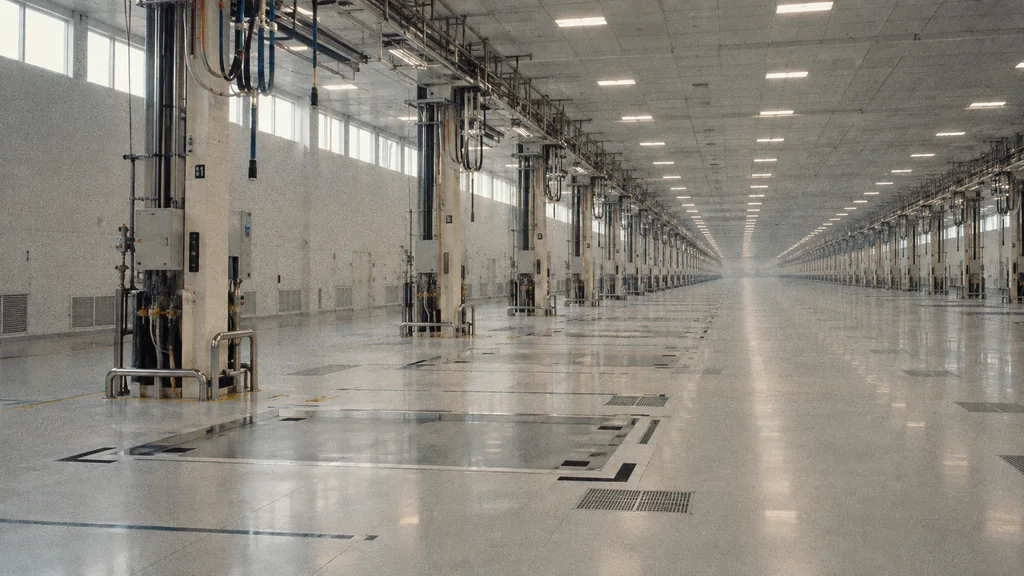
Customers forecast more scanners than ASML expects to deliver.
Image composition · tobriefASML expects the scanners it can deliver in 2027 and 2028 to fall short of what its customers forecast they will need, the company said on 14 October, without putting a number on the gap (ASML Q3 results). The Dutch company builds the machines that print circuit patterns onto silicon, so the warning bears on how fast new chip factories can be equipped. Whether it also means fewer chips is a separate question that the evidence does not yet answer.
What ASML said about machines and orders
The warning covers two machine families. Extreme ultraviolet (EUV) scanners use very short-wavelength light to print the finest layers of advanced chips. Deep ultraviolet (DUV) immersion scanners are older workhorses that print through a thin film of water.
In July, ASML planned to raise capacity for both by 30% in 2027, from a 2026 base of roughly 65 EUV and 130 DUV immersion systems (ASML Q2 results). That plan now trails customer forecasts. ASML says it is studying further expansion but has published no revised machine count (ASML Q3 results).
Customers have asked ASML to accept purchase orders for delivery in 2029 and 2030, and chief financial officer Roger Dassen said the company has not accepted them while it weighs total demand against what it can credibly supply (Q3 call transcript). Those requests are forecasts in writing. They are not yet confirmed work.
Demand that has already turned into revenue is growing. Third-quarter sales reached €11.662 billion on 113 new systems, up from €9.326 billion and 86 systems in the second quarter (ASML Q3 results). That count includes every kind of system ASML sells. It shows nothing about how many EUV or DUV immersion machines are firmly booked for 2027 and 2028.
When a missing scanner means fewer chips
A scanner does one step in a long process. It projects a circuit template onto a light-sensitive coating on a wafer, the thin disc chips are built on, and the factory then etches, deposits material and repeats the cycle layer after layer (imec).
A late scanner turns into scarce chips only if two things hold. First, a new production line must be waiting on that scanner alone, with its building, power, other tools and yield (the share of chips on each wafer that work) already in place. Second, existing factories must be unable to make the chips that line was meant to supply. ASML's warning establishes neither.
Exposure also depends on what a factory makes. STMicroelectronics' Catania plant, for instance, produces silicon-carbide power chips on 200-millimetre wafers (ST), and nothing in the record ties it to this shortfall.
Faster machines could absorb part of the gap. ASML's next conventional EUV model, the NXE:3800F, is rated at 260 wafers per hour against 230 for today's version and arrives in small numbers from early 2027 (ASML interview transcript). Those are rated speeds, not measured factory output, and ASML has not said how much of the gap they would close.
Who is exposed
Part of the constraint sits in ASML's German supply chain. An EUV machine takes roughly a year to build, and ZEISS optics and TRUMPF lasers are among the slowest parts to arrive (Reuters, July). ZEISS has been adding production space at Oberkochen (ZEISS), and chief executive Christophe Fouquet said on the results call that ZEISS was not the bottleneck (Q3 call transcript).
The companies planning around these machines include TSMC, Samsung, Intel, SK hynix and Micron, which Reuters named among the customers expanding (Reuters). ASML has said nothing about how it would divide a limited supply of machines among them, or whether prices would change. Fouquet ties their forecasts to expectations about how large and how lasting AI investment will be (ASML Q3 results), so the size of the gap also rests on whether that spending holds up.
ASML has confirmed that its planned machine supply sits below what its customers expect to need, and it has not sized the difference. Until it publishes a revised delivery count, no one outside the company can measure how much the gap will slow new factory openings, and still less how it will affect the supply of chips.
Details about this article
- Model:
- claude-opus-5-5
- Generated:
- 10/15/2026, 1:36:09 AM
- Pipeline run:
- eu_pipeline_20261015_005006
- Watermark:
- SynthID (Google's invisible watermark)
- Human review:
- None before publication