Atlantic heat loss points to slower current
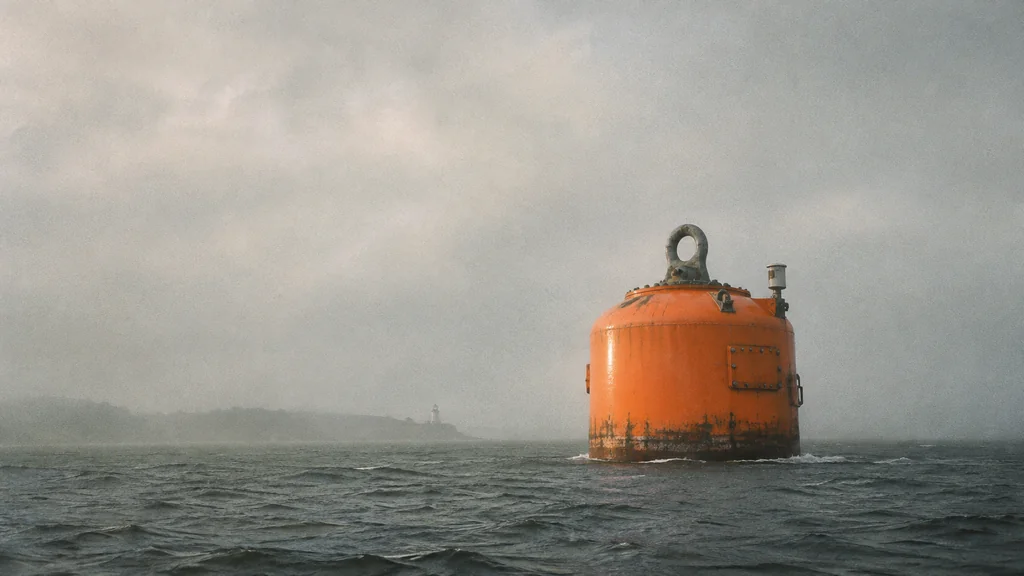
The Atlantic’s fading heat offers a clue to the current below.
Image composition · tobriefLess heat appears to be escaping from the northern Atlantic into the air, about 18% less between 1985 and 2023, according to a new preprint. Its authors read that as a sign that the Atlantic current carrying warm water north has slowed, by an estimated 14.2 ± 13.9% over 30 years (full-text audit). Nobody measured the current itself across that whole period, so the slowdown is worked out from the heat.
The current is the Atlantic Meridional Overturning Circulation, or AMOC. Picture a central heating loop. Warm surface water flows north and hands its heat to the air in the northern Atlantic. It then sinks and returns south at depth as colder, denser water (Met Office). That loop helps shape temperature and rainfall around the North Atlantic, though European weather also depends heavily on the atmosphere.
A current read from its radiators
The heating analogy captures the study's central idea. If the hot water in the pipes slows down, the radiators give off less warmth. So measuring the warmth coming off the sea surface offers a way to estimate the flow behind it, reaching back to years before anyone tracked the current directly. Winds, sea ice and other currents also change how much heat the ocean releases, which makes a cooler radiator a clue rather than proof.
The work comes from Michael J. Bell and colleagues at the UK Met Office, the universities of Reading, Oxford and Vienna, and Guangdong Ocean University. It has not yet passed peer review, the check in which independent scientists scrutinise a paper before a journal publishes it (Europe PMC).
Their first result concerns the heat. Across a broad band of ocean between 26.5°N and 70°N, from the subtropics to the edge of the Arctic, heat loss fell by about 18%, give or take 10 percentage points (Preprint). That number is a reconstruction pieced together from indirect records rather than read off a single instrument, and errors in those records carry into the result. It is still the study's firmest finding, because everything that follows builds on it.
From warmth to water flow
Turning heat into flow takes a second step, carried out inside climate models. In a simulated ocean, scientists can watch both the heat leaving the surface and the strength of the current. That lets them learn how much one shifts when the other does. It resembles calibrating a kitchen scale against known weights before trusting it with flour.
The team applied that model-derived relationship to the real heat trend, which produced the 14.2% slowdown. The study's estimated interval runs from roughly 0.3% to 28.1% (full-text audit). In other words, the result leans clearly toward weakening while leaving its size loose, and it is only as reliable as the models' grasp of how heat and flow move together.
The instruments that can check it
The most direct check sits in the water itself. RAPID is a line of instruments moored across the Atlantic at 26.5°N. Since April 2004 they have recorded temperature, salinity, pressure and current speed (RAPID). Think of it as a traffic counter strung across a motorway: it measures the flow rather than inferring it from heat, which makes it an independent witness.
The preprint compares its inferred trend with RAPID's record over the years the two share, and both point toward weakening (Preprint). That agreement is encouraging, but it covers only the RAPID era. The moorings cannot vouch for the decades before they went into the water, which is exactly the stretch the heat method was designed to reach.
The result this study has earned is the reconstructed decline in heat leaving the northern Atlantic over nearly four decades. A slower AMOC is a plausible reading of that decline, and a shorter direct record points the same way. For now it remains a model-based inference with a wide margin. The peer reviewers now examining the preprint are the first who must judge whether the step from heat to flow holds up.
Details about this article
- Model:
- claude-opus-5-5
- Generated:
- 11/4/2026, 2:15:32 AM
- Pipeline run:
- eu_pipeline_20261104_005008
- Watermark:
- SynthID (Google's invisible watermark)
- Human review:
- None before publication