Baltic cable repair plan awaits its ships
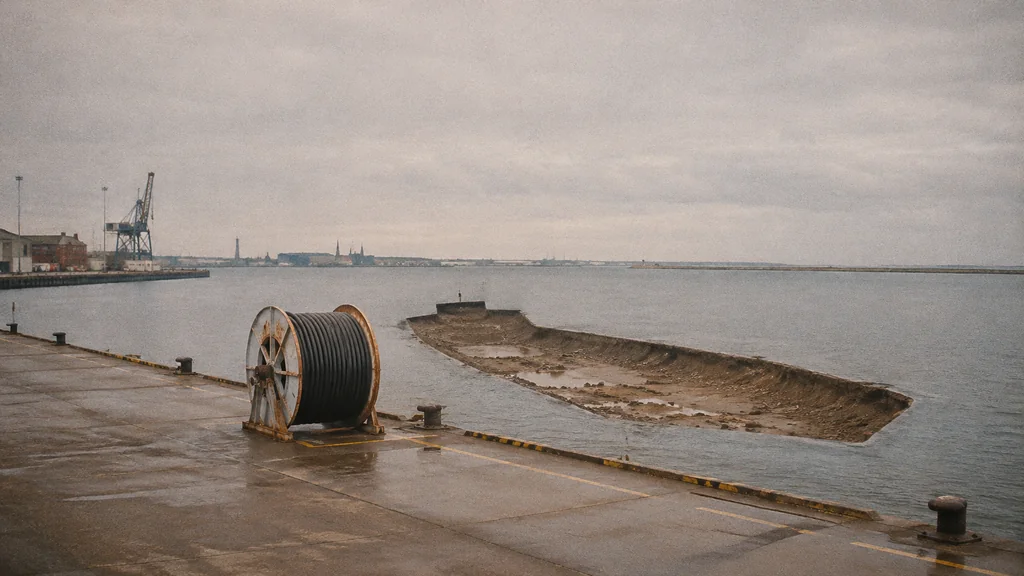
The Baltic repair plan has equipment funding; its ships remain to be secured.
Image composition · tobriefFinland, Sweden and Estonia plan to keep cable-repair equipment at a Baltic port and bolt it onto an ordinary ship when an undersea cable is cut. According to Finland's National Emergency Supply Agency, the EU will pay €9.55 million of the project's roughly €19 million cost (NESA). The headline target is to fit the kit within three days, a clock that starts when a suitable ship reaches port, not when the cable breaks (CEF pilot call).
The money may make a ship faster to equip. It does not guarantee a ship, a crew or a quick repair.
The clock starts at the dock
The project does not build a dedicated repair vessel. Instead, the Commission promises that at least one ship carrying the equipment will be available quickly (European Commission). Raigo Iling, an adviser at Estonia's climate ministry, told Delfi the partners would sign up three ships and fit the gear to whichever one is needed (Delfi).
The three-day target covers that fitting and nothing else (CEF pilot call). Before it, someone has to free up a ship and sail it to port. After it, the crew still has to reach the damage, lift the cable from the seabed, join its severed ends and test the line.
Estonian officials speak of installation in under a week during a crisis, without saying when that count begins (Estonian Justice and Digital Affairs Ministry).
What a real repair looks like
Latvia offers a measure. In January 2025, state operator LVRTC found damage to its cable to Sweden; its repair ship sailed eight days after detection, and the cable was fixed 33 days in (LVRTC).
The kit targets only the first stretch of that wait, the scramble for a ready ship, and only if one of the signed-up vessels is free. Most of the month went to work at sea that no pre-stored equipment shortens.
The commercial market has its own limits. In December 2025, Rasmus Normann Andersen of Danish firm JD Contractor told TV 2 that urgent repairs typically take two to four weeks, and that his fleet is built for peacetime accidents (TV 2 Denmark).
Project lead Tuomas Seppälä describes the kit as preparation for a crisis in which commercial repair ships are out of reach (Uusi Teknologia). Even then, warns Reigo Kebja, a board member at Estonian grid operator Elering, any repair still needs a specialist company, its crew, more equipment and time (Estonian Justice and Digital Affairs Ministry).
Who has signed, and who still has to
The EU side is done. The Commission selected the project on 8 October, and HaDEA, the agency that runs the EU's fund for cross-border digital networks, signed the grant on 13 November (HaDEA).
The partners have not finished. NESA, which coordinates, says its partners' participation, including that of unnamed "Swedish authorities", still depends on signed agreements (NESA).
The chain of command is also unwritten. Under the EU call, a country needing the ship would ask through a regional hub that monitors Baltic cables, but the call gives that hub no stated power to pull a vessel off other work (CEF pilot call). The published documents do not yet say how a neighbour such as Latvia would gain access, how requests would be ranked, or who would pay.
Scope is unsettled too. The grant describes modules for telecommunications cables (HaDEA), while the Commission's announcement speaks of repairing "all types of cable damage" (European Commission). That gap matters for power links such as EstLink 2 between Estonia and Finland, where finding a suitable ship shaped a past repair timeline (ERR).
The record so far shows a signed EU grant, unsigned partner and vessel agreements, and no announced test of the kit on a ship. To prove the concept, NESA would need to publish those agreements, name its Swedish partner and run a timed drill showing the equipment fitted within three days of docking (CEF pilot call). Until then, the Baltic has a funded plan rather than a repair service.
Details about this article
- Model:
- claude-opus-5-5
- Generated:
- 11/19/2026, 1:54:08 AM
- Pipeline run:
- eu_pipeline_20261119_005010
- Watermark:
- SynthID (Google's invisible watermark)
- Human review:
- None before publication