Belgium Won’t Risk Euroclear’s €193 Billion
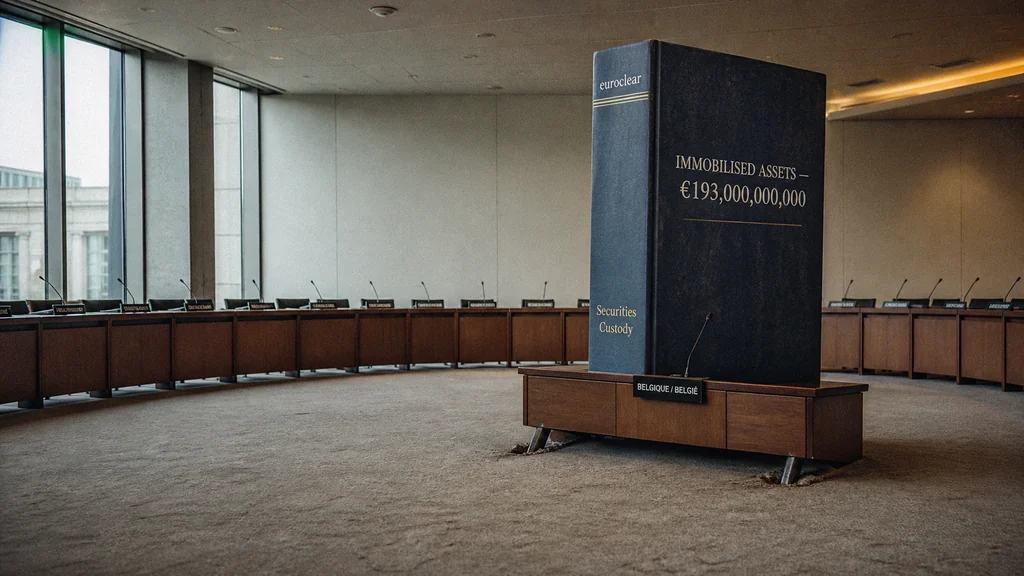
Europe seeks the assets while Belgium carries the liability.
Image composition · tobriefBelgium's defence minister shut the door on 28 August on renewed efforts to use frozen Russian sovereign assets for Ukraine. The reason is straightforward: no EU government has offered to cover the legal and financial exposure that falls on Brussels because of where the money sits.
Two days earlier, Sweden, the Netherlands, Poland and Spain had written to EU foreign-policy chief Kaja Kallas, asking the European Commission (the EU's executive arm) to explore ways of using immobilised Russian assets beyond skimming the profits they generate (Government of the Netherlands, Reuters/WTVB). Defence Minister Theo Francken responded that Prime Minister Bart De Wever would hold firm (Nieuwsblad). Belgium's answer makes sense only once you see what Belgium is being asked to risk.
Euroclear carries Europe's exposure
Euroclear, the Brussels-based firm that holds and settles securities for banks and governments across the world, sits on roughly €185–193 billion of the EU's approximately €210 billion in immobilised Russian central-bank assets (Meduza, Commonspace). That concentration turns a European policy question into a Belgian liability question. If the EU moves from taking the profits to using the assets themselves, Belgium and Euroclear face Russian lawsuits and retaliation first.
The pressure is already real. Le Monde has reported roughly 200 legal proceedings against Euroclear and nine arbitration notifications against Belgium (Le Monde). According to Ellipsis Avocats, a Moscow court has ordered Euroclear to pay nearly $250 billion, unenforceable in the EU but a clear signal of what Russia is willing to escalate (Ellipsis Avocats).
The current model, where the EU takes interest and investment proceeds generated by frozen assets rather than the assets themselves, keeps working. The EU transferred another €1.4 billion to Ukraine on 5 August, bringing total proceeds to about €8 billion (European Commission). But the four-country letter argues that the EU's €90 billion loan for 2026–2027, backed by the bloc's common budget, will not be enough, and that a larger mechanism drawing on the frozen principal could give Ukraine money it can count on beyond the next tranche (Euractiv).
Everyone wants the money, nobody wants the bill
Belgium's position is conditional, not absolute. Foreign Minister Maxime Prévot said during an August visit to Kyiv that Belgium had no principled objection to using the assets, so long as legal and financial risks were shared across all member states through binding guarantees (Kyiv Independent). The four-country letter itself validates that logic, explicitly asking for options where "risk rests with all EU member states" (Government of the Netherlands). Yet those governments have adopted Belgium's language without producing any mechanism that meets Belgium's demand for unconditional, uncapped guarantees (Euronews).
The gap between solidarity language and fiscal commitment shows up country by country. Poland's Radosław Sikorski said Warsaw was "ready to participate in insuring Belgium," but Polish reporting found no public legal formula for an uncapped indemnity (Radio ZET). Germany's Friedrich Merz argued risks should be divided by economic size, but not as a blank cheque. German reporting estimated Berlin's share in such a guarantee could exceed €50 billion (Bundesregierung, FAZ). France and the Netherlands support the principle but have not accepted unlimited liability (Ouest-France, Tweede Kamer).
Francken added a pointed reminder, telling Baltic states not to keep cornering Belgium while Belgium contributes to their security through NATO Baltic Air Policing, as reported by Nieuwsblad. The message was blunt: solidarity cannot mean one country demands boldness while another absorbs the consequences.
The issue was expected to surface around the 1–2 September informal meeting of EU foreign ministers in Ireland. The Commission says it has "never taken the issue off the agenda" (Commission briefing). But the political coalition for using Russian assets remains wider than the coalition willing to underwrite Belgium's full liability. Until someone writes a legally binding, EU-wide guarantee that covers Euroclear's exposure, Belgium's refusal is not obstruction. It is the price of hosting the infrastructure everyone else wants to use.
Details about this article
- Model:
- claude-opus-4-6
- Generated:
- 8/29/2026, 1:43:01 AM
- Pipeline run:
- eu_pipeline_20260829_005007
- Watermark:
- SynthID (Google's invisible watermark)
- Human review:
- None before publication