Berlin rethinks Bavaria’s Brenner rail link
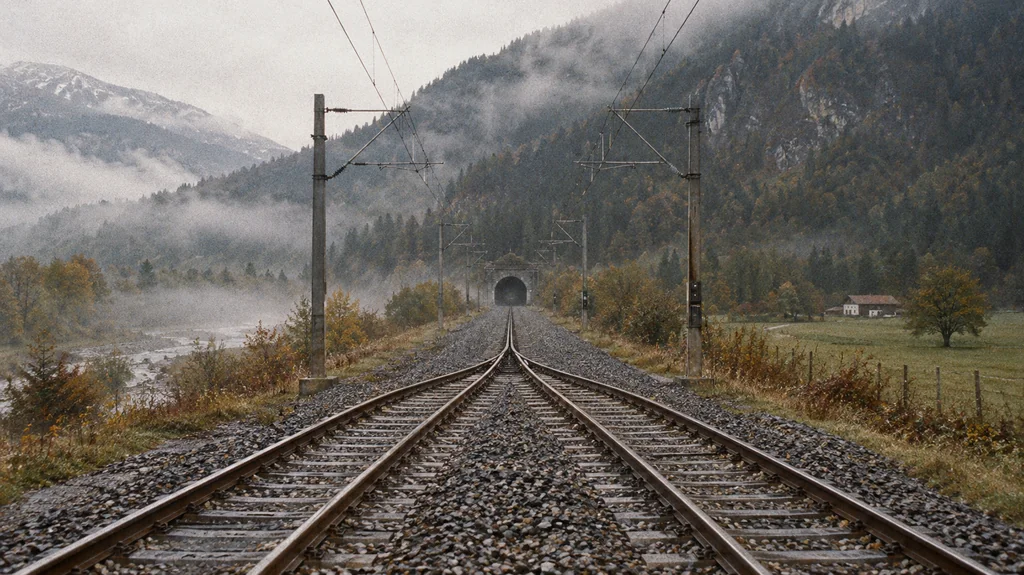
Germany weighs its rail capacity while the Brenner tunnel moves ahead.
Image composition · tobriefGermany has again delayed its decision on a new railway through Bavaria to the Brenner Base Tunnel, the Alpine freight tunnel being dug between Austria and Italy. On 23 September, at the request of the governing Union and SPD, the project was pulled from the Bundestag transport committee's agenda, two Bavarian papers reported (Merkur, OVB). On 1 October, transport state secretary Ulrich Lange said Berlin would first reassess how upgrades to existing lines change the capacity the route needs (BR24). That reassessment has not yet shown whether the old tracks can carry the extra freight trains the tunnel is meant to attract.
What the pause actually changes
On paper, very little. On 10 July the transport ministry sent parliament Deutsche Bahn's preferred route, which opened parliamentary debate but approved no construction and committed no money (BMV). The agenda change itself rests on regional press reports. The committee's own records have not yet confirmed it.
Lange now expects committee talks around November, with a vote only after regional demands are examined (Rosenheim24). The late opening date predates this pause. Deutsche Bahn's preliminary plan, published on 4 August, already put the new line's opening in the fourth quarter of 2043 (Trackopedia).
Lange gave two reasons for rethinking. The first is money. The federal budget for expanding and building lines is only a little over €3 billion a year, shared across every project in the country (Rosenheim24). Deutsche Bahn's estimate for the Brenner approach alone reached about €16.16 billion, including reserves for risk and inflation (Spiegel). That total would be spent over many years, so the two numbers cannot show whether the line is affordable. His second reason, capacity, is the one Berlin can actually test.
Getting trains through versus finding room for more
The tunnel does not need the new German line to open. It aims to open around 2032, roughly eleven years before Germany's projected line (Trackopedia). Its flatter route lets heavier freight trains cross the Alps without extra locomotives (CINEA).
A better tunnel does not create more train paths (scheduled slots on the track) on the lines leading to it. Deutsche Bahn told BR24 that longer trains could carry more freight in existing slots, and that the current two-track German line has some room to absorb the first extra traffic (BR24). The company still expects that line to stop the tunnel from being fully used.
How much room is left remains unproven. Estimates of the old line's ceiling differ widely, from a 2018 study to a much higher figure claimed by local opponents after upgrades (Ingenieur.de). A ceiling counts every train the line could carry, and regional passenger trains and today's freight already use part of it. No figure in the debate counts how many slots will be free when the tunnel opens.
Germany's neighbours are moving on their own timetables. In June, Austria kept 2039 as its target for full operation of its approach through the Lower Inn valley (Austrian mobility ministry). In May, Italy's rail manager RFI began tunnelling on a southern section it aims to open around the time the tunnel is finished (RFI).
Who gains time and who carries the risk
Residents around Rosenheim gain from the pause. They oppose the land take, noise and years of construction a new line would bring, and each delay pushes those further away.
The risk sits with those already paying. The EU contributed about €2.3 billion to the tunnel (CINEA). What Austria, Italy and the EU get back depends on two things nobody has measured together: how much freight wants to switch to rail, and how many slots the approaches can offer.
Tirol counted about 2.4 million transit lorries in 2025 (Land Tirol). Those lorries are the traffic extra rail capacity is meant to replace. Each spare freight slot through Bavaria could take some of them off the road, but only if a slot exists and shippers choose to use it.
Berlin has paused to reconsider. It has not yet shown that an upgraded old line has enough spare capacity for the freight increase the tunnel was built to bring, and future demand is uncertain as well. Before the Bundestag votes, the transport ministry and Deutsche Bahn owe lawmakers independently tested timetables for both options, the new line and the upgraded old one, built on the same freight forecast. Without them, the choice between building and upgrading rests on assertion.
Details about this article
- Model:
- claude-opus-5-5
- Generated:
- 10/2/2026, 2:14:14 AM
- Pipeline run:
- eu_pipeline_20261002_005006
- Watermark:
- SynthID (Google's invisible watermark)
- Human review:
- None before publication