Brenner tunnel’s €11.7bn bill meets full tracks
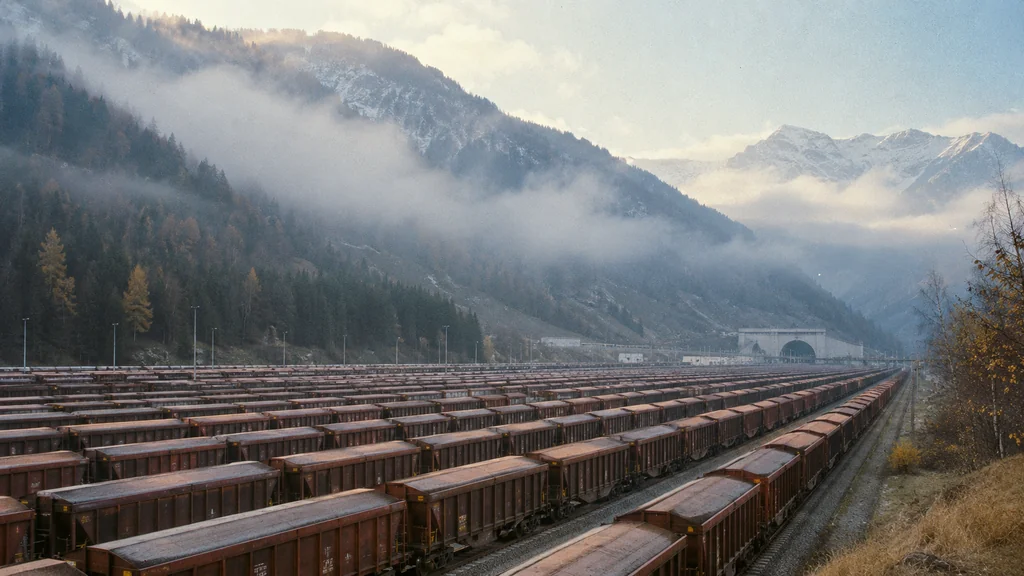
The new Alpine crossing opens before its freight corridor is ready.
Image composition · tobriefThe rail tunnel under the Brenner Pass will open in 2034, two years later than planned, at a forecast cost of €11.7 billion (BBT SE, Corriere dell'Alto Adige). Austria and Italy carry most of that bill. The freight gain they are paying for depends on the lines leading into the tunnel, and the corridor's own planning study finds several of those lines full even after the tunnel opens.
A bigger bill in Vienna and Rome
BBT SE, the Austrian–Italian company building the tunnel between Innsbruck and Fortezza, moved regular service back from 2032 on 20 October. It also raised its cost forecast from roughly €10.5 billion (Die Presse), a revision we covered last week (To Brief). The company blames redesigned railway equipment, newer safety rules and a converted service tunnel, though its account does not split the increase between redesign, delay and inflation (BBT SE).
EU grants for megaprojects do not rise automatically when total costs climb. Brussels would need to make a new award to cover any of the roughly €1.2 billion increase (European Court of Auditors). The remainder falls to Austria and Italy, which have not published how they will divide it.
Germany's approach line through Bavaria is a separate project with a separate bill, with a preliminary cost of nearly €11.4 billion (Bundestag). Italian coverage on 26 October merged the two into one story of German delay (Il Fatto Quotidiano). A BBT spokesman, however, said the tunnel's new timetable has nothing to do with Germany (Zeit/dpa).
German planners put the line's completion at late 2043, a date first reported in August (Trackopedia). That estimate assumes a route the Bundestag has not yet approved. It also assumes construction money that the government's own submission says is not available in the medium-term budget (BR24).
Where the trains get stuck
A railway's capacity is counted in train paths, which are reserved time slots for one train on one stretch of track. A freight train needs a path on every section of its journey. The tunnel makes the crossing far flatter, cutting the climb from roughly 24–27 metres per kilometre to about 4–7 (ÖBB). Heavy trains therefore need fewer extra locomotives to get over the Alps, but the tunnel adds no paths on the old lines around Munich or Bolzano.
The Brenner Corridor Platform, the joint planning body for the route, tested this in an April 2026 study. It modelled an open tunnel with several approaches still unfinished (Brenner Corridor Platform). In that scenario the connecting lines run out of slots. The stretch from Munich-Trudering to Rosenheim was fully booked through the day. So was the stretch from Ponte Gardena through Bolzano and Trento to Ala, where freight trains compete with commuter trains at rush hour.
The bottleneck is not only German. Italy's planned bypass around Bolzano has so far received only a small fraction of its cost in the national rail programme (MIT–RFI programme). Austria still targets 2039 for its own Schaftenau–Radfeld approach, years after the tunnel opens (Austrian mobility ministry).
Who waits, and who loses land
Freight operators wait first, because a flatter tunnel does them little good if they cannot get a slot on either side of it. Around Rosenheim the cost is land. In Rosenheim on 26 October, Parliamentary State Secretary Ulrich Lange promised "no planning stop" but said construction timing depends on financing, and officials said one connection area alone could threaten about 20 farms (Wasserburger Stimme).
Germany's case for the new line rests on a benefit–cost ratio of 1.4, meaning estimated benefits divided by costs, where anything above 1 counts as worthwhile. That ratio dates from 2025, and when Lange was asked about price changes he gave no revised figure (Bundestag written answers). The age of the ratio matters because a project that cleared the bar at old prices may not clear it at new ones.
The corridor's model is a scenario, not a forecast. It still shows the tunnel opening onto approach lines with no spare daytime slots on both sides of the Alps (Brenner Corridor Platform). Until Germany funds a route and Italy and Austria finish their own approaches, Austrian and Italian taxpayers are paying extra for a flatter crossing whose freight trains will still queue at Rosenheim and Bolzano.
Details about this article
- Model:
- claude-opus-5-5
- Generated:
- 10/27/2026, 1:28:58 AM
- Pipeline run:
- eu_pipeline_20261027_005007
- Watermark:
- SynthID (Google's invisible watermark)
- Human review:
- None before publication