Brenner tunnel slips to 2034, approaches lag
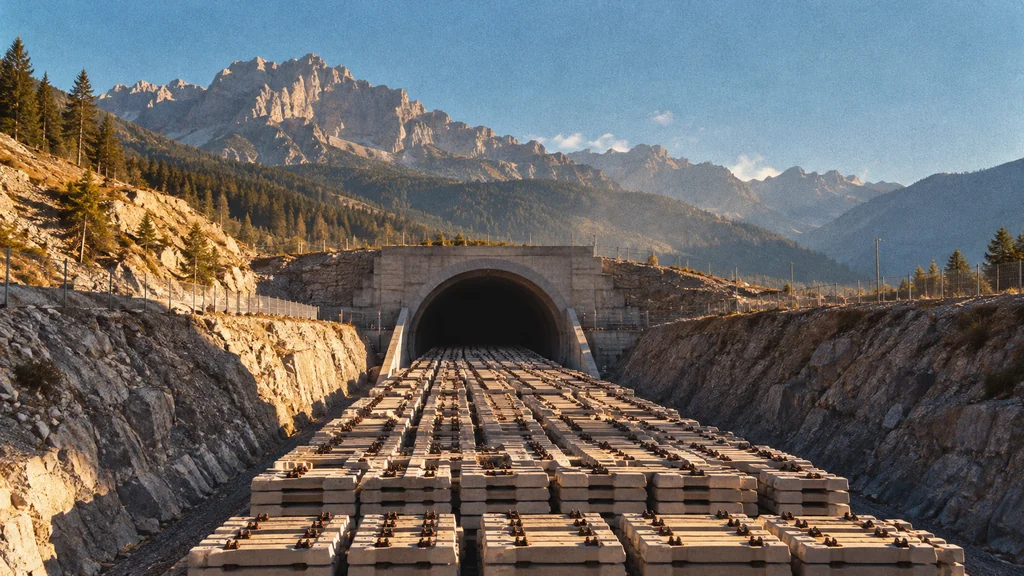
The Alpine passage is nearly dug, but the railway remains years away.
Image composition · tobriefRegular trains will not run through the Brenner Base Tunnel, the rail link under the Alps between Innsbruck and northern Italy, before 2034. That is two years later than planned, and the forecast cost has risen from about €10.5 billion to €11.7 billion (BBT SE, ORF). Even then, the older lines feeding the tunnel from Germany, Austria and Italy will limit how much freight it can carry.
A dug tunnel is not yet a railway
BBT SE, the Austrian–Italian company building the tunnel, announced the delay after a meeting of its supervisory board. The digging is almost done: 221 of roughly 230 kilometres of train and service tunnels have been bored (BBT SE). In August, crews broke through the first continuous main tube from end to end (ANSA).
That breakthrough did not fix an opening date, because a bored tunnel is still empty rock. Track, power, signalling and safety systems all have to go in. Then everything must pass testing, trial running and operating approval, and BBT now expects to finish that final stage in 2034.
BBT says it revised railway-equipment plans dating from 2008 to meet current safety rules (BBT announcement). The biggest change turns the exploratory bore, first dug to study the rock, into a service tunnel. Maintenance crews could reach equipment from there, so the train tunnels would need to close less often. BBT has not published what each change costs or how much operating time it saves.
Who covers the extra billion
BBT has not said how much of the cost increase comes from the redesign, how much from the longer build, and how much from higher prices. Rai Südtirol, the public broadcaster in South Tyrol, reports that part of the rise reflects the longer construction period and price increases (Rai Südtirol).
The EU co-finances the tunnel, and Austria and Italy pay the rest. The European Court of Auditors notes that a higher project cost does not automatically raise the EU grant (ECA). Unless Brussels agrees to pay more, the simplest reading is that Austrian and Italian taxpayers absorb the increase.
A fast tunnel between slow lines
The tunnel replaces a steep mountain climb with a gentle gradient. On a flatter route, freight trains can haul more weight with fewer locomotives (ÖBB). A freight train, however, needs a timetable slot (a reserved window to use a stretch of track) on every section of its journey, and not just inside the tunnel.
The Brenner Corridor Platform, which the three countries run under EU coordination, tested this in an April study. It modelled the tunnel open while several upgrades on the approaches were still missing. In that scenario, the Munich–Rosenheim section and the Italian line from Ponte Gardena to Ala were full across the day, and passenger trains pushed freight out at rush hours (Brenner Corridor Platform).
Those missing upgrades are a long way off. Austria still targets 2039 for full operation of its Schaftenau–Radfeld approach (Austrian transport ministry). In Italy, the bypass around Bolzano is costed at €1.57 billion, but only €18.8 million has been allocated to it (MIT–RFI programme tables).
Germany is further behind. Its new line through Bavaria exists only as preliminary planning, and the Bundestag has approved neither a route nor construction money (Bundestag). As we reported, the provisional opening has slipped to 2043 (To Brief). That date is a planning estimate and holds only if parliament approves the line and pays for it.
Trucks set the baseline the tunnel is meant to change. In 2023, 38.8 million of 51.7 million tonnes of freight crossing the Brenner went by road (Tyrol transport report). The delay pushes back a possible rail alternative for that traffic by two years. The capacity study explains why the tunnel alone may not deliver the shift once it opens.
On current plans, the tunnel will open years before key approach lines can use its full freight capacity. The Bundestag decides whether the Bavarian line gets built, and Italy's transport ministry decides whether to fund the bypasses south of the tunnel. Those two decisions will determine how much freight the tunnel ends up carrying.
Details about this article
- Model:
- claude-opus-5-5
- Generated:
- 10/21/2026, 8:15:44 AM
- Pipeline run:
- eu_pipeline_20261021_072148
- Watermark:
- SynthID (Google's invisible watermark)
- Human review:
- None before publication