Brent hits $113; diesel freight squeezes Europe
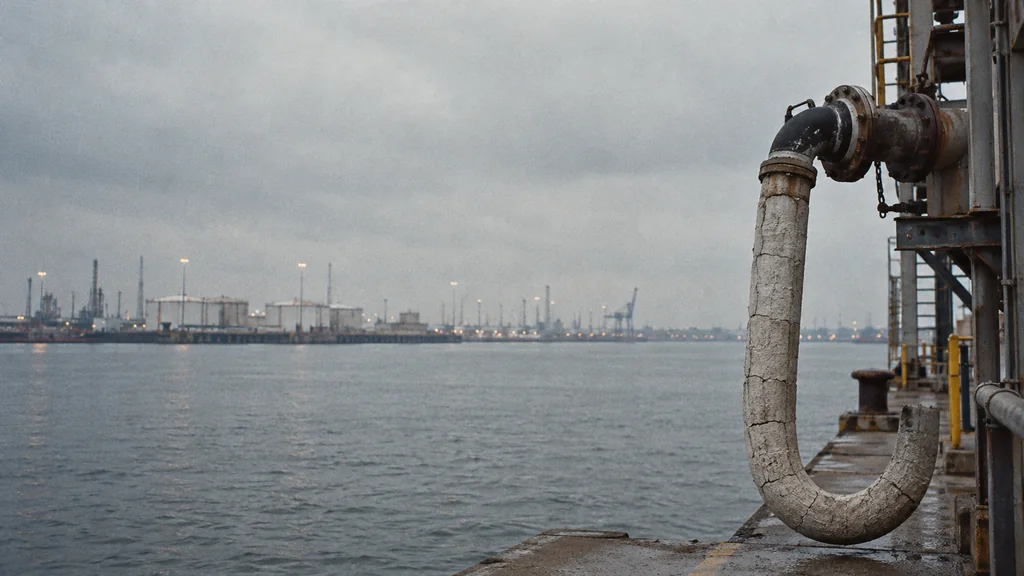
Freight costs shut the November diesel import window at Rotterdam.
Image composition · tobriefBrent crude, the benchmark for most of the world's oil, settled at $113.17 a barrel on 22 October, up 4% in one session (Dow Jones via Morningstar). The rise followed a deadly drone incident at Saudi Arabia's Shaybah oil field and Houthi claims of a fire at the Red Sea port of Yanbu (Saudi Press Agency, AP). Riyadh says Shaybah kept working, and no loss of Saudi output has been verified. For Europe, the clearer problem is the cost of shipping diesel.
Brent is a futures price, a contract for oil delivered later. It records what traders expect, not barrels that failed to arrive. Thursday's move capped a week of attacks on ships around the Strait of Hormuz, the narrow exit from the Persian Gulf (To Brief). Lloyd's List Intelligence counted at least 28 attacks or security incidents there in October (Lloyd's List Intelligence).
What Saudi Arabia confirms
Saudi Arabia's energy ministry said air defences intercepted a drone aimed at a processing facility at Shaybah. It said a fire in a contractor's vehicle outside the perimeter killed two people and injured two (Saudi Press Agency, Reuters).
The field has a stated capacity of one million barrels a day (Aramco). The ministry says operations were unaffected. It named no attacker.
Yanbu is still a claim. The Houthis said they started a fire there, but AP could not establish physical damage or halted operations (AP). The port matters because Saudi Arabia's East–West pipeline ends there. That pipeline lets crude reach the Red Sea without passing through Hormuz.
Crude keeps moving, but the trip costs more
Oil is still leaving the region. Reuters, drawing on Kpler tracking data, found Middle East oil exports at 17.3 million barrels a day so far in October, slightly above prewar levels. It also found that hiring a tanker for a voyage to China cost more than 12 times its prewar rate (Reuters).
Both things can be true at once. Shipowners charge more to sail into danger, and futures buyers pay extra for the chance that a field, pipeline or shipping lane fails. The available data cannot split Thursday's rise between attack risk, freight and anything else.
Diesel shows the strain more plainly. Refined products are fuels already processed in a refinery, such as diesel and jet fuel, and they trade separately from crude. Middle Eastern exports of them fell to 1.9 million barrels a day in September, against 4.7 million before the conflict (IEA).
The second finding comes from the Dutch port of Rotterdam, a hub for Europe's fuel imports. Kpler found that freight costs have closed the import window for November. That means the cost of shipping diesel to Rotterdam for November delivery now exceeds the price gap that would make the trade pay, from every origin it assessed (Kpler). The two findings point the same way, but the research does not show that the Gulf shortfall caused the Rotterdam problem.
When buyers feel it
Pump prices lag. Crude passes through refiners, wholesalers, distributors and taxes before it reaches a car. In a July estimate, the ECB (the European Central Bank) put the time for a crude price change to fully reach pump prices at roughly one to two months (ECB).
Belgium shows that lag. Its official diesel ceiling held at €2.4440 a litre on 20, 21 and 22 October (Statbel).
If wholesale diesel stays expensive, bulk buyers pay first. That means road hauliers, farmers and builders, who can pass costs on only as far as their contracts allow. Motorists would follow within weeks if the ECB's timing holds.
Thursday's $113 close is a price on risk and transport cost. It rests on documented ship attacks and expensive freight, while the Saudi ministry says Shaybah kept producing and Yanbu damage remains unconfirmed. Saudi Arabia and Aramco could show with loading data whether Yanbu's exports stopped, though that alone would not prove whether the port was hit. For Europe, the established constraint is narrower and closer to home: on Kpler's numbers, none of the routes it checked makes November diesel deliveries into Rotterdam worth the freight.
Details about this article
- Model:
- claude-opus-5-5
- Generated:
- 10/23/2026, 1:29:37 AM
- Pipeline run:
- eu_pipeline_20261023_005007
- Watermark:
- SynthID (Google's invisible watermark)
- Human review:
- None before publication