Bulgaria’s Lukoil reprieve ends 29 October
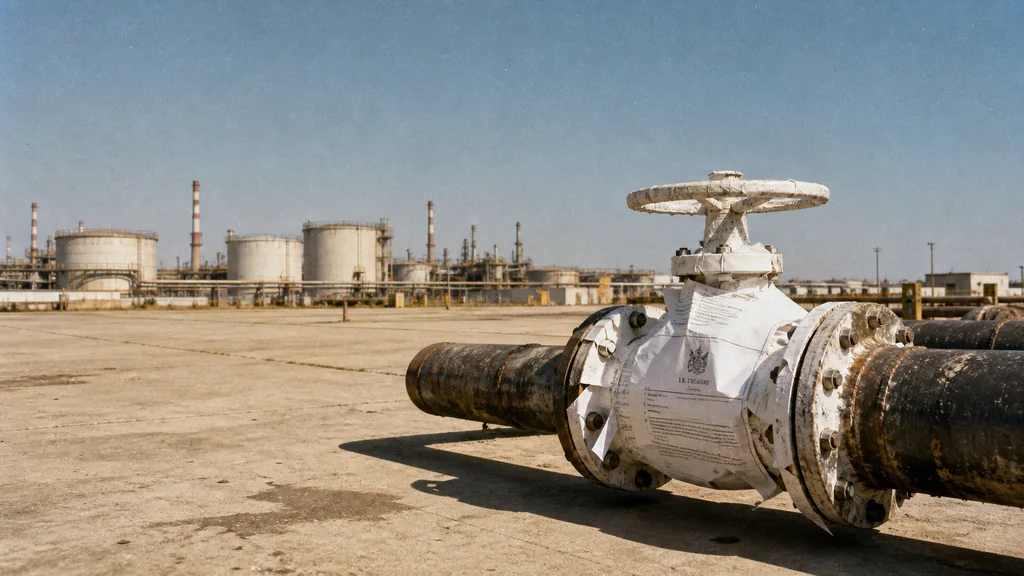
The fuel keeps moving while Bulgaria postpones the proof.
Image composition · tobriefOn 29 October, every bank transfer, insurance policy and fuel sale connected to Bulgaria's only major refinery becomes a potential sanctions violation. The UK's Office of Financial Sanctions Implementation (OFSI, the Treasury body that enforces British financial sanctions) extended the licence on 12 August, pushing the deadline from 13 August to 29 October (sanctions.com). Sofia had asked London to match the date with a parallel US licence (BNR News). This is the third extension since the original wind-down period passed in late 2025 (Interfax).
The licence lets banks, insurers and fuel buyers keep transacting with the Burgas plant (Fakti). What it does not show, and what no public data confirms, is that profits, payments or sale proceeds from the refinery have stopped reaching its sanctioned Russian parent, Lukoil.
Crude through September, payments through October
Physical supply looks manageable for now. Evgeni Simeonov, the special commercial manager overseeing the Bulgarian Lukoil assets, says crude is contracted through September, with October deliveries under negotiation (NOVA). Processing volumes climbed from roughly 450,000 tonnes earlier this year to 560,000 tonnes in July (Sega, Fakti). Rising output means the plant is commercially active and Bulgaria faces no immediate fuel shortage. It also means more revenue flows through a corporate structure whose ownership links to sanctioned Russia remain unresolved.
A refinery does not run just because oil sits in its tanks. It must pay suppliers, collect from buyers, arrange shipping and insurance, and settle through banks. The licence makes all of that lawful. Without it, the banks, traders and insurers dealing with the refinery face sanctions exposure, and most would walk away (24 Chasa).
Simeonov says the refinery buys crude exclusively from "global giants," not sanctioned companies (Vesti). No published data — customs declarations, supplier names, tanker identities or payment flows — supports or contradicts that claim. The new licence amendment adds a reporting layer: any entity using the licence for the first time must notify the UK Treasury within 14 days (sanctions.com).
Romania pays if Burgas stops
Bulgaria's fuel problem does not stop at its border. Both countries sit in the same Black Sea diesel-supply zone, and Romania lost its own nearby source when Lukoil's Ploiești refinery closed last November. Romania now produces only about 20–22 percent of its diesel domestically (Ziare.com). If Burgas goes offline, Romania must compete harder for imported diesel cargoes shipped from further away, pushing up the price both countries pay for diesel. Analyst Eugenia Gusilov told Romanian media that Bulgaria is better protected while Burgas operates; Romania, already importing costlier diesel, would feel a disruption more sharply (Adevărul).
EU sanctions are also shifting in ways that make Bulgaria's position harder to hold. The 21st Russia sanctions package goes beyond asking where crude comes from. It asks whether payments, ownership structures or intermediaries let sanctioned value keep moving (Skadden). A refinery that buys non-Russian crude but sends profits to a sanctioned parent still has a problem.
A licence is not a separation
Deputy PM Alexander Pulev called the extension a win that prevented a fuel-price shock (Darik). That framing treats the licence as a solution. It is a pause. US terms require any Lukoil asset-sale proceeds to sit in a blocked American account until ownership transfers receive separate approval (RBC). A broader UK licence for Lukoil International runs until February 2027, but the Bulgaria-specific permission expires in October (Kommersant). When Germany faced a similar problem at Rosneft's Schwedt refinery, it placed the plant under state trusteeship, transferring operational control rather than just licensing trade. Bulgaria has a special manager and a rolling licence, not a structural break.
London and Washington have strong reasons to extend again: a refinery freeze that disrupts fuel for millions of Bulgarians and ripples into regional diesel markets suits nobody. But each extension without public evidence — cargo origins, payment flows, refining margins — makes continuity look less like transition and more like preservation under a different name. October is less a supply deadline than a proof deadline, and Sofia is the one that owes the answer.
Details about this article
- Model:
- claude-opus-4-6
- Generated:
- 8/14/2026, 2:11:23 AM
- Pipeline run:
- eu_pipeline_20260814_005006
- Watermark:
- SynthID (Google's invisible watermark)
- Human review:
- None before publication