Caltech’s space antenna gains one bay
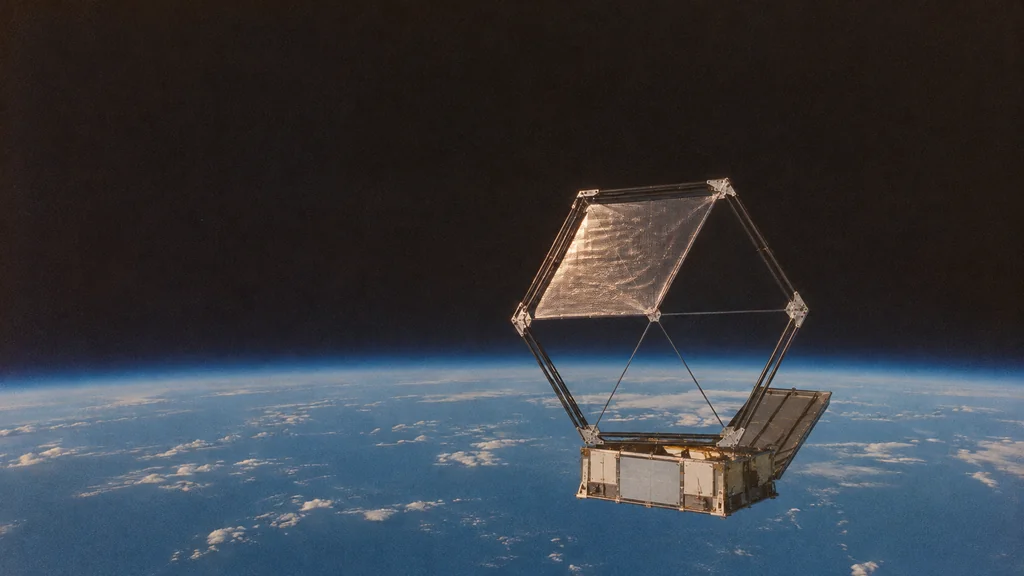
One new section takes shape; a working antenna remains out of reach.
Image composition · tobriefEverything sent to space must fit inside a rocket's nose cone, so a rigid antenna wider than that shell cannot launch in one piece. A Caltech machine called ASTRA has tested a workaround by carrying loose tubes and joints into orbit and assembling them into one new section of an antenna frame, with no astronaut touching the parts (Caltech). The result, announced on 5 November 2026, leaves the antenna unfinished but shows that a kit of parts can become structure in space (DARPA).
Why ship an antenna as a kit
Think of flat-pack furniture. A bookcase travels in a slim box and only becomes tall once someone builds it in the room where it will stand. Space engineers face the same packing problem, and they usually solve it by folding structures or by launching large modules to join together later.
ASTRA, short for Autonomous In-Space Tensioned Reflector Assembly, takes the flat-pack route. Its short parts were squeezed into a payload of roughly one cubic metre (Caltech). The goal is a reflector, the curved surface of a dish antenna that bounces radio waves toward a receiver.
The frame grows one bay at a time, a bay being one repeating cell, like a single box in a scaffold. In principle, adding bay after bay lets a structure become much larger than the package it travelled in.
How one bay came together
ASTRA launched from Vandenberg Space Force Base on 30 March 2026, aboard Momentus's Vigoride 7 vehicle, which rode SpaceX's Transporter-16 mission (Caltech). Andrew Detor manages NOM4D, the DARPA programme that funded it, and he has said roughly 15 months separated the idea of an orbital test from launch (Universe Today). In orbit, the machine first pushed out two bays built on Earth, giving the frame a starting point (Caltech).
Then came the new part. Motorised dispensers fed out stored struts made of composite fibre (the stiff, light material in carbon bicycle frames) along with custom aluminium joints, and an arm-like robotic manipulator joined them into a fresh bay (DARPA). Thin reflective mesh unfolded with the new section.
Caltech and DARPA describe this as the first demonstration of automated construction of a structure in space (DARPA). That claim comes from the mission's own team and is narrower than it sounds. Astronauts and robotic equipment had already helped assemble the International Space Station from large prefabricated sections, as a NASA account from 2002 shows (NASA). ASTRA's distinction is a machine joining small, separately stored parts into new structure without a crew.
Hands in orbit, a team on the ground
The machine handled the parts, but people directed it. Charles Sommer, Alan Truong and graduate student Tara Venkatadri sent build commands through the Vigoride spacecraft and checked each result against photographs downloaded from orbit (Caltech). Picture a skilled pair of hands in space, following instructions from a team watching through a camera.
The finished antenna needs 11 bays and would span 1.4 metres, yet after about six months in space ASTRA had built one new bay (Caltech). Detor's long-term ambition for the programme is building at scales of hundreds of metres or even kilometres (Universe Today). Caltech judged the full frame unlikely to be finished before the mission ends in December, and its engineers concluded the design needs simplification (Caltech).
The surface itself is meant to be light. Caltech's design uses two netlike sheets of perforated Kapton, a thin plastic film, pressed against each other by springs (Caltech). Earlier design work by the team argues that this needs less pulling force than knitted metal mesh, so the frame holding it could be lighter (AIAA paper).
The flat-pack idea has now flown and produced real structure once, starting from parts stored in a box. ASTRA has shown that a robot can assemble one antenna-frame bay in orbit, while a working reflector remains untested.
Details about this article
- Model:
- claude-opus-5-5
- Generated:
- 11/13/2026, 1:48:00 AM
- Pipeline run:
- eu_pipeline_20261113_005009
- Watermark:
- SynthID (Google's invisible watermark)
- Human review:
- None before publication