CERN’s 92 antiprotons survive the road
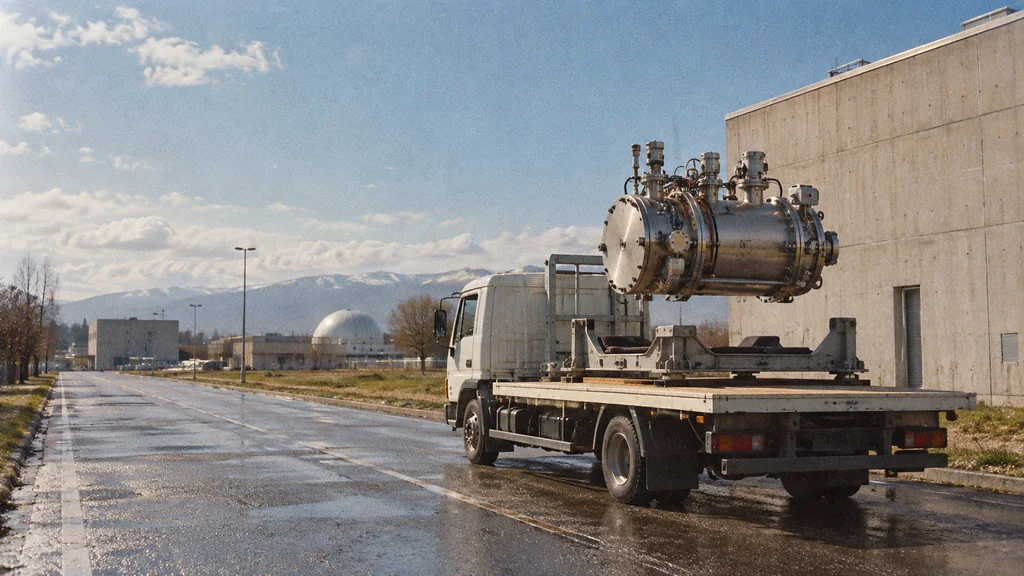
Ninety-two antiprotons survive the first careful turn onto a longer road.
Image composition · tobriefOn 24 March 2026, physicists at CERN disconnected an 850-kilogram apparatus from its laboratory services, loaded it onto a truck, and drove it around the Geneva campus for about half an hour. Inside, suspended by electric and magnetic fields so they never touched a surface, 92 antiprotons rode along. When the truck returned and the equipment was reconnected, the instruments detected no particle loss. The team then kept working with those same particles for more than a month. It was the first controlled road transport of trapped antimatter, and it clears a test that physicists have been preparing for years.
Why put antimatter on a truck?
An antiproton is the mirror twin of the proton: same mass, opposite charge. If it touches ordinary matter, both annihilate. You cannot store it in a jar. The only way to hold antiprotons is to cage them in electromagnetic fields, and the only facility that routinely produces them for experiments is CERN's Antimatter Factory.
That creates a problem. CERN is a busy accelerator complex. The magnets and electrical systems around it generate shifting background fields, and the experiment that wants these antiprotons, called BASE, needs to read extraordinarily faint frequency signals. Background noise sets a ceiling on how precisely the team can compare protons and antiprotons, a comparison that tests one of the deepest symmetries in physics: CPT symmetry, which predicts that a particle and its antiparticle should have identical masses and equal but opposite magnetic properties.
A quieter laboratory, shielded from accelerator noise, could allow sharper measurements. But a quiet lab cannot make its own antiprotons. The solution is a courier: fill a portable trap at CERN, drive it somewhere calmer, and measure there. The apparatus that does this is called BASE-STEP.
7.5 kilometres in 30 minutes
The trap works by combining a superconducting magnet, which bends the charged particles into spirals so they cannot escape sideways, with stacked electrodes that create electric barriers at each end. The antiprotons orbit inside this architecture, confined without contact. The whole assembly sits in a vacuum chamber where the collaboration reported a residual-pressure upper bound well below its design target, making collisions with stray gas molecules vanishingly rare.
The March transport covered roughly 7.5 kilometres around CERN's Meyrin site. Researchers extracted 92 antiprotons from the Antimatter Factory and loaded them into the open transport trap. They disconnected external power and cryogenic lines, moved the vessel by crane onto the truck, and drove. After 30 minutes the truck returned. The apparatus was reconnected, and the antiprotons were still there, controllable for over a month afterwards.
Throughout the drive, the team tracked the trapped population using a technique called image-current detection: the orbiting particles induce faint electrical signals in the electrodes, revealing whether anyone is still inside without opening the trap (CERN media kit).
The longer road
The Nature paper published on 16 September 2026 establishes that the portable trap can survive disconnection, road vibration, and reconnection with no detectable antiproton loss. That is genuine progress: until this demonstration, nobody had shown it could be done with actual antimatter rather than ordinary particles.
The planned destination is a dedicated laboratory at Heinrich Heine University Düsseldorf. That journey would take eight to twelve hours, far beyond what a loop around campus demands. The collaboration will need to sustain the trap's autonomous systems for much longer, and must still demonstrate extracting particles into a receiver trap at the other end. Whether a quieter lab actually delivers better measurements is itself an open question, separate from the transport engineering.
The CERN loop demonstrated short, reversible transport with no detectable antiproton loss, followed by continued storage and manipulation. It did not demonstrate delivery to another laboratory or an improvement in measurement precision. The science that justifies the whole effort waits at the end of a longer road, and a longer drive.
Details about this article
- Model:
- claude-opus-4-6
- Generated:
- 9/17/2026, 2:40:11 AM
- Pipeline run:
- eu_pipeline_20260917_005006
- Watermark:
- SynthID (Google's invisible watermark)
- Human review:
- None before publication