CERN’s one-in-ten-billion signal fits theory
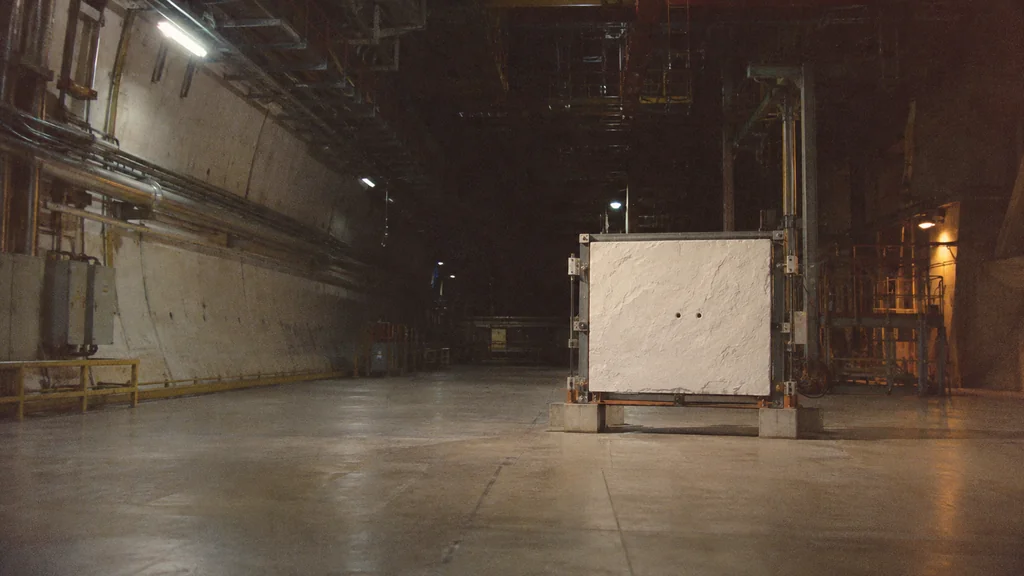
Two muons offer new evidence for a decay predicted once in ten billion.
Image composition · tobriefTheory says that out of every ten billion B⁰ mesons, about one should break up into nothing but a pair of muons (CERN, Physics World). On 3 November, the LHCb experiment at CERN's Large Hadron Collider reported the first evidence from a single experiment's own data that this decay really happens (LHCb). The rate it measured agrees with the Standard Model, physics' rulebook for particles. The measurement is still too uncertain to reveal a subtle departure from that rulebook.
Why count something so rare
Rare outcomes become useful when you can predict exactly how rare they should be. Picture an auditor who knows almost to the decimal how often a certain kind of entry should appear in a company's books. If the real count comes out higher or lower, money is moving through a channel nobody recorded.
B⁰ mesons are fleeting particles produced when protons collide in the LHC, and they fall apart almost as soon as they form. A muon is the electron's heavier cousin. Nearly every B⁰ meson decays into something else. Physicists track the small share that ends as a lone muon pair.
The Standard Model pins that share at (1.03 ± 0.05) × 10⁻¹⁰, with a margin of error that is narrow next to the number itself (LHCb paper). That precision turns the decay into a test. A measured share that drifted away from the prediction would point to particles or forces missing from the rulebook. In the auditor's terms, that would be the unrecorded channel.
Finding two muons in a crowd
The new analysis used collisions recorded in 2024 and 2025 by LHCb's upgraded detector (CERN seminar). Muon pairs turn up in those collisions all the time for ordinary reasons, so two muons alone prove nothing. The team looked instead at each pair's combined mass. It searched for a small surplus of pairs whose mass matches that of a B⁰ meson.
A genuine decay would appear as a modest bump on a smooth background of ordinary muon pairs. Think of a faint voice in a noisy room that you can only pick out once you know which pitch to listen for.
Combined with LHCb's earlier data, the bump reaches 3.2 sigma (CERN seminar). Particle physicists reserve the word "observation" for 5 sigma, which is why LHCb calls its result evidence (CERN). Sigma measures how hard an excess is to explain as a fluke. Random background alone would produce an excess this large roughly once in 1,500 comparable tests, according to CERN.
A match, with room to spare
Detecting the decay and checking its rate are two separate questions. LHCb measured a combined rate of 1.14 × 10⁻¹⁰, with a statistical uncertainty of +0.42/−0.39 in the same units (LHCb). That spread is far wider than the gap between measurement and prediction. The result therefore agrees with the Standard Model, within substantial uncertainty.
The same paper reports improved measurements of the same two-muon decay in a more common relative, the Bₛ⁰ meson, which also match theory (arXiv). A second decay lining up with prediction makes the overall picture harder to dismiss as a coincidence.
Caution has a history here. In 2015, LHCb and CMS, a separate LHC experiment, jointly reported evidence for this same B⁰ decay. Later analyses did not confirm that hint (LHCb). The new paper was posted on 30 October and submitted to the journal Physical Review X. It was still a preprint, not yet reviewed by outside experts, when the result was announced (arXiv).
The faded 2015 hint is a reason to hold this result loosely until more data arrive. It is not a reason to dismiss it. The new evidence comes from one experiment's own collisions and an upgraded detector, and the rate it measured fits the prediction.
LHCb now has evidence from its own data for a decay predicted to occur about once in ten billion B⁰ mesons (CERN). Its measured rate agrees with theory within substantial uncertainty. That means the rulebook held up in a place physicists probe because missing particles could have shown up there.
Details about this article
- Model:
- claude-opus-5-5
- Generated:
- 11/10/2026, 2:03:22 AM
- Pipeline run:
- eu_pipeline_20261110_005009
- Watermark:
- SynthID (Google's invisible watermark)
- Human review:
- None before publication