China puts heavy drone parts on licence
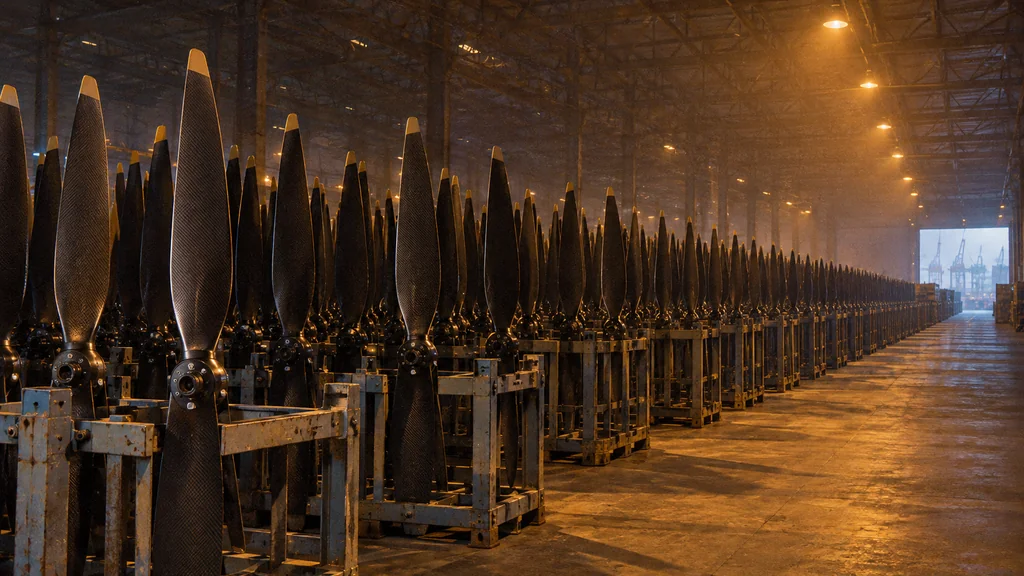
China’s licence requirement could leave heavy drone parts waiting at the port.
Image composition · tobriefFrom 18 November, Chinese firms will need a government licence to export certain high-power drone motors, large propellers, engines and autopilots (Chinese commerce ministry). The rule bans nothing and names no country. It does give Beijing a quiet way to slow heavy parts during the October–November window in which Kyiv says it must pay for winter drone orders (Interfax-Ukraine). No one has yet shown that any Ukrainian production line needs these parts.
A licence, not a ban
China published the rule, Announcement No. 49, on 19 October (Chinese notice). It defines its targets by engineering specification rather than by product name, and those specifications describe heavy aircraft.
A brushless propeller motor is covered only if it passes four technical tests at once. The first test is a rated voltage of at least 48 V (official announcement). Most small first-person-view (FPV) attack drones, the cheap quadcopters Ukraine flies in bulk, run below that line (BattlePolicy).
Propellers follow the same logic. Carbon-fibre propeller blades fall under the rule only from 762 mm, measured from the rotation centre to the tip (official announcement). That size belongs on heavy airframes, not on hand-launched quadcopters.
The commerce ministry decides who may export, and customs can hold a shipment while it questions a declaration (ministry FAQ). The customs power matters most for timing. A part can sit at a port for weeks without anyone formally refusing it.
Military end users also cannot use the simpler registration route that ordinary buyers get, according to the same ministry guidance. A Ukrainian arms maker buying direct would therefore face full case-by-case review.
Beijing says the measure serves national security and non-proliferation. The notice promises approval for compliant applications, but it sets no deadline and makes no explicit exemption for orders signed before 18 November (official announcement).
How exposed Ukraine really is
Ukraine has cut its direct dependence on China sharply. AP, citing Ukrainian customs data, reported that the share of drone parts imported directly from China fell from nearly 90% in early 2024 to 28% in January–August 2026 (AP). That figure counts only parts shipped straight from China.
Manufacturers told the agency they still rely on Chinese magnets, motors, chips and battery cells. They also said some parts arriving through Poland or Czechia may be Chinese-made (AP).
Buying through a European middleman may not put those parts beyond Beijing's reach. China's export-control law covers the transit and re-export of controlled items, and its dual-use rules require exporters to declare the final user (Export Control Law). The public record does not yet show when a Polish or Czech resale would itself need Chinese approval.
General dependence on China is still different from exposure to this rule. Battery cells, magnets and camera sensors fall outside the new motor and blade entries. The likely overlap is much narrower, covering high-spec propulsion sets, large propellers, certain engines, specialised autopilots and radios.
At least one major maker says it is not exposed at all. Fire Point, which makes the FP-1 long-range strike drone, reportedly builds roughly 200–260 a day and says 90% of its components are Ukrainian, sourced to avoid China (RFE/RL). Those figures come from the company, not from a verified parts list.
What Europe's money can and cannot do
The EU's main lever is the €90 billion Ukraine Support Loan for 2026–27, with €60 billion reserved for defence purchases (Council/EEAS). Brussels can pay for equipment and link European and Ukrainian factories. It cannot produce a compatible motor by November, and it cannot make a Chinese ministry approve an export.
Kyiv's orders were under pressure before Beijing acted. As we reported in September, a $27 billion gap in Ukraine's defence budget was already squeezing winter procurement (To Brief).
China now controls licences for a defined band of heavy drone components. Its customs officers can also slow those parts while Kyiv is buying. What has not appeared is a Ukrainian order or production line that depends on them. Ukraine's defence ministry and its manufacturers know which platforms use which motors, propellers and autopilots. They are the ones who must publish that account before the rule takes effect on 18 November (Chinese commerce ministry).
Details about this article
- Model:
- claude-opus-5-5
- Generated:
- 10/25/2026, 1:25:38 AM
- Pipeline run:
- eu_pipeline_20261025_005006
- Watermark:
- SynthID (Google's invisible watermark)
- Human review:
- None before publication