Crimea Bridge road falls, trains return
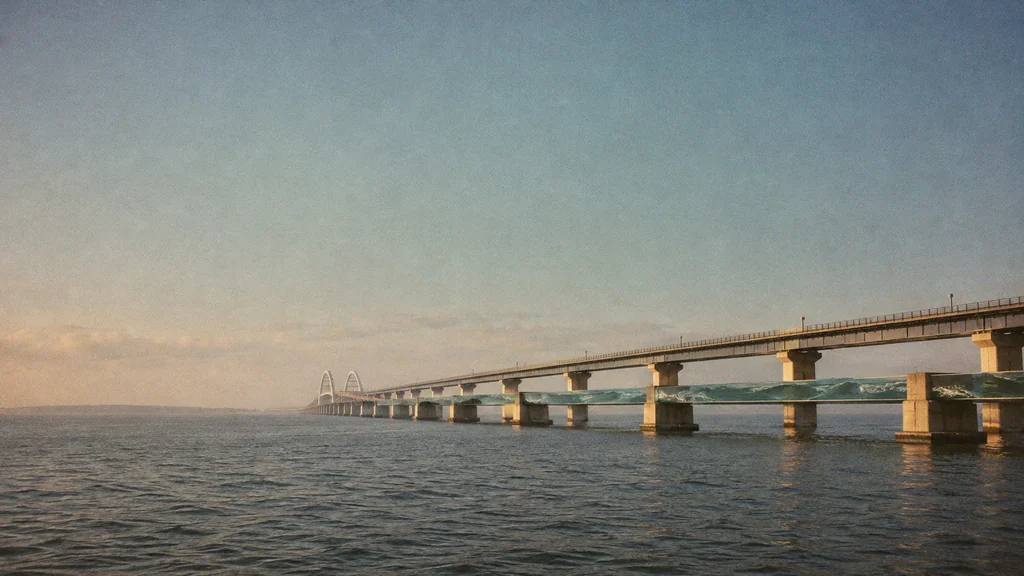
Road passage ends at Kerch while the measure of rail freight remains unknown.
Image composition · tobriefUkraine has cut the road crossing between Russia and occupied Crimea. On 17 November, Ukraine's General Staff said a road arch and the deck beneath it had fallen into the Kerch Strait, and CNN geolocated footage showing the section in the water (General Staff, CNN). Trains are running again, so the strike's effect on Russia's war effort remains unproved.
The Crimea Bridge is really two bridges side by side. Road and rail run on separate structures, each with its own steel arch over the shipping channel. The footage shows the road arch down and the railway arch still standing (CNN).
An earlier strike had already damaged the road arch, so the collapse may reflect both attacks. Moscow acknowledged structural damage and halted all road and rail traffic.
What still crosses
Passenger trains returned within hours. Russia's Transport Ministry said trains could use one of the bridge's two tracks while repairs continued on the other (Russian Transport Ministry). That evening, the federal rail agency declared movement "fully resumed", and the services it listed were passenger and commuter trains (Roszheldor report via RBC).
That phrase describes passenger timetables. It says nothing about freight. Neither Russian statement explains whether the second track works, what loads the line can carry or how much cargo is moving. Those figures decide whether the strike hurt Russia's army, and nobody has published them.
Cars have no fallback on the bridge. Russia has given no repair timetable. Warsaw's Centre for Eastern Studies (OSW), a government-funded think tank, judged that rebuilding the road arch is not feasible before the war ends (OSW).
Why the army may barely notice
Heavy trucks were already off the bridge. Russia banned freight trucks from the road deck in December 2022 and sent them to ferries or overland routes, and it reconfirmed the ban in April 2026 (Russian Transport Ministry, 2022, April 2026). The collapse therefore mainly removed a crossing for cars, buses and light vans.
Heavy supply still has two routes. One is the railway. The other is a land corridor through occupied Mariupol and Melitopol. Ukraine keeps attacking that corridor, but a September OSW study judged a complete blockade of Crimea unlikely (OSW).
The clearest immediate disruption falls on the people who drove or took buses across. They now face ferries, a single passenger track or a long detour through occupied territory.
Who brought the arch down
The weapons story is less settled than the images. President Volodymyr Zelenskyy said Ukraine's Palianytsia missile-drone hit the road section. He said Neptune, Ruta and FP-5 missiles were aimed at the rail section (President of Ukraine).
Destinus, the Netherlands-based company that makes Ruta, gives a different account. Its president, Oleksandr Danyliuk, told Reuters that nine Ruta Block 1 missiles were launched and seven hit, and the firm credits Ruta with the collapse (Reuters). Fire Point, the FP-5's maker, claims the road arch for its own missile.
No independent forensic account has settled the dispute. The documented European link is narrower than it might look. A Dutch-registered arms company is publicly claiming the decisive hit on Russia's flagship project in Crimea. That claim is marketing until someone outside the three competing accounts confirms it.
The road crossing is gone, probably for the rest of the war. Trains and land routes still run, and the available evidence does not show a serious interruption to Russian military supply. That conclusion rests on one gap: rail freight figures for the bridge. Moscow has not published them, and Ukraine has offered no independent estimate.
Details about this article
- Model:
- claude-opus-5-5
- Generated:
- 11/18/2026, 1:59:02 AM
- Pipeline run:
- eu_pipeline_20261118_005010
- Watermark:
- SynthID (Google's invisible watermark)
- Human review:
- None before publication