Cronos signing leaves Egypt export link missing
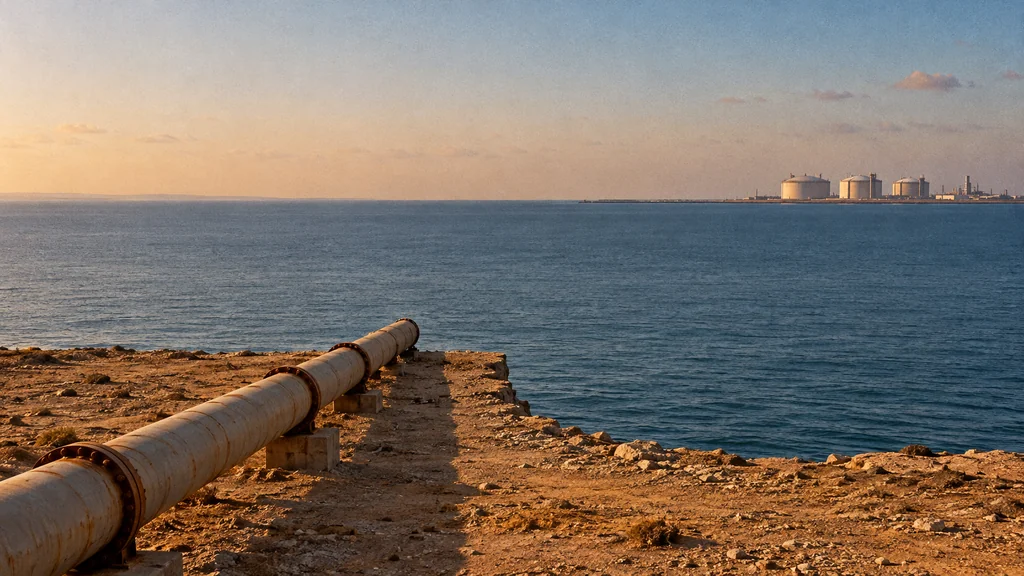
Cyprus pays for the wells; the route to Europe remains unfinished.
Image composition · tobriefPresident Nikos Christodoulides is due to receive Eni executive Guido Brusco in Nicosia today for the planned signing of contracts to build Cronos, Cyprus's offshore gas field (Cyprus Presidency). The contracts pay to drill wells and lay seabed pipes. They do not sell any gas to Europe, and the gas must first pass through Egypt, which may keep some of it.
The contracts cover designing, buying and installing the field's wells, seabed equipment and pipelines (Cyprus News Agency). They follow the final investment decision of July 2026, when Eni and TotalEnergies committed to pay for and build the field (TotalEnergies, Eni).
The price tag is unconfirmed. The Wall Street Journal reported that the package is worth $1.3–1.8 billion, a figure Reuters could not independently verify (Reuters). According to Politis, government sources said only that the estimated cost of the project fell in that range (Politis). So it is unclear whether the number measures today's contracts or the whole development.
Some of the work has already been handed out, with awards announced to Halliburton for the wells (Halliburton) and McDermott for the seabed installations (McDermott).
A missing link in Egypt
Cronos gas is meant to flow through a new subsea pipe to facilities serving Egypt's Zohr field (AP). The final destination is Damietta, a coastal plant that makes liquefied natural gas (LNG, gas cooled into a liquid so tankers can carry it). Egypt's oil ministry calls that plant technically ready (Egyptian petroleum ministry).
What links Zohr to Damietta for this gas is less certain. An unnamed Egyptian official described the connection as a proposal, and nothing public shows it has been approved or built (EnterpriseAM). Until it exists, the Cypriot wells lead to Egypt's gas network and stop short of an export plant.
Egypt may keep some of the gas
Egypt is short of gas. Its LNG imports nearly quadrupled in 2025, to almost 13 billion cubic metres, as pipeline deliveries from Israel fell (IEA). Damietta has felt that squeeze before: it resumed loading cargoes only in January 2025, after a halt linked to too little gas to keep it running (GIIGNL).
Cyprus's energy minister has described a provision letting roughly one fifth of Cronos gas go to meeting Egyptian needs (AP via ABC). That share would stand in for some of the cargoes Egypt now buys abroad. The rest would pass through a plant that Eni agreed in 2021 to own half of, alongside Egyptian state companies (Eni). How much Cairo earns from either stream depends on purchase prices and processing fees that have not been made public.
What Europe actually gets
At full output the partners plan about 2.8 million tonnes of LNG a year, each marketing half, and their announcement names no European buyer, terminal or delivery volume (TotalEnergies). That is a modest amount set against what the EU consumes each year (European Commission). Even that ceiling applies only if every cargo sails to Europe, and nothing published so far commits it to.
For Cyprus the stakes are larger. Cronos would be its first producing offshore gas development (Cyprus Mail), though the government has not published what it expects to collect in taxes or royalties.
In August, the energy minister said gas could reach Europe as early as March 2028 (Euronews), a target we covered at the time (To Brief). Today's planned signing pays for the Cypriot end of the chain. Meeting that date depends on Egypt building the missing link and settling how much gas it keeps, and on Eni and TotalEnergies choosing to sell their cargoes in Europe. On the evidence so far, Cronos is a field under construction with an unfinished export route and no confirmed European delivery.
Details about this article
- Model:
- claude-opus-5-5
- Generated:
- 10/26/2026, 1:34:13 AM
- Pipeline run:
- eu_pipeline_20261026_005007
- Watermark:
- SynthID (Google's invisible watermark)
- Human review:
- None before publication