Cyprus’s €3 Billion Cable Has No Backstop
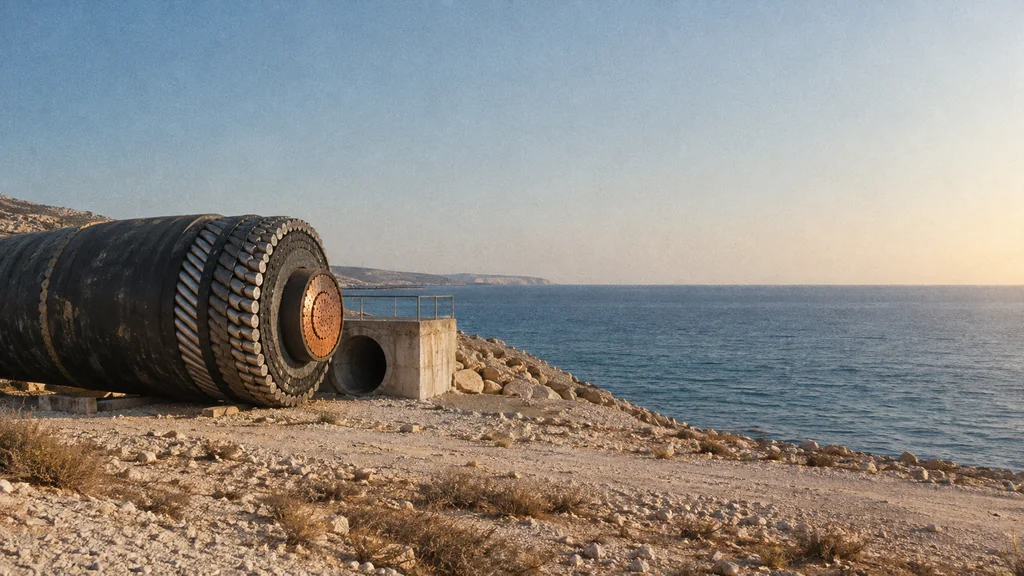
Cyprus confronts a cable whose costs no longer fit the plan.
Image composition · tobriefCyprus's parliament heard on 8 September that the Great Sea Interconnector, the subsea electricity cable meant to connect the island to Europe's power grid for the first time, will cost far more than anyone budgeted. The familiar price tag has been €1.9 billion. CERA (Cyprus's energy regulator) board member Neofytos Chatzigeorgiou told lawmakers the likely total is closer to €3 billion (Philenews). Finance Minister Makis Keravnos explained why: the old number covers mainly the cable itself, leaving out insurance, converter stations, storage and maintenance (InBusiness).
Neither figure is a regulator-approved budget. The studies that could produce one have not been finished.
Who pays what remains unanswered
The project has one fixed funding source: an EU grant of roughly €657 million from the Connecting Europe Facility, the EU's infrastructure subsidy programme (European Commission). That grant does not grow when the budget does.
Everything else must come from shareholders, lenders or electricity consumers. Meridiam, a French infrastructure fund, holds 66% of the project company; Greece's grid operator ADMIE holds 34%. The European Investment Bank has been asked for debt financing, but a spokesperson said no decision had been taken (Euronews). Whatever costs regulators eventually approve would be recovered through network tariffs, the per-unit charges on electricity bills that fund grid investment.
The cost-sharing formula splits capital spending 63% Cyprus, 37% Greece, with operating costs divided equally (Cyprus Mail). Keravnos told parliament the government was "not sure" the cable would reduce electricity prices (InBusiness).
The central gap is contractual. No shareholder agreement, completion guarantee or overrun clause has been made public. If costs climb beyond the current estimates, there is no disclosed document showing whether the shareholders, the contractors, national governments or consumers absorb the difference. That absence is the reason Cyprus's government has drawn a line.
The cable contract already consumed most of the old budget
The gap between old headline and new estimate has a concrete explanation. Nexans, the cable manufacturer, holds the core cable contract at roughly €1.43 billion, according to EnergyGame. Set that against the €1.9 billion headline and very little remained for converter stations, onshore works, storage, insurance or project management.
The timeline has also moved. The European Commission's own project page still listed construction starting in 2023 and completion by the end of 2026 (European Commission). Chatzigeorgiou told parliament the cable would operate from 2031 (Philenews). Delay raises costs, though by how much depends on financing terms and contract structures that remain undisclosed.
The strategic case is real but does not settle the bill
Cyprus is the only EU member state with no connection to a neighbouring electricity grid. A working cable could bring cheaper imported power when local generation is expensive and create a market for the island's surplus solar output. That strategic value is why the EU awarded its grant.
Former CERA chairman Andreas Poullikkas has argued that the 63–37 cost split does not translate directly into an equivalent bill increase, because grants and revenue from trading electricity between markets with different prices reduce the amount consumers must repay (OT). That is correct in principle. But how large the reduction is depends on how much electricity actually flows through the cable and what regulators allow onto bills. None of those inputs is settled.
Keravnos has drawn a clear line: Cyprus will not commit its proposed €100 million equity stake until the updated cost and its consequences for the national budget are established (Politis). The EIB's independent assessment, expected before year-end, is the next decision point (Cyprus Mail).
Cyprus still lacks a verified total cost and a binding answer on who absorbs overruns. The €3 billion estimate is provisional, but it explains why the government will not invest before the EIB, CERA and the project's owners publish those answers.
Stocks in this story
Details about this article
- Model:
- claude-opus-4-6
- Generated:
- 9/9/2026, 2:46:29 AM
- Pipeline run:
- eu_pipeline_20260909_005005
- Watermark:
- SynthID (Google's invisible watermark)
- Human review:
- None before publication