Danube shuts Romania’s last operating reactor
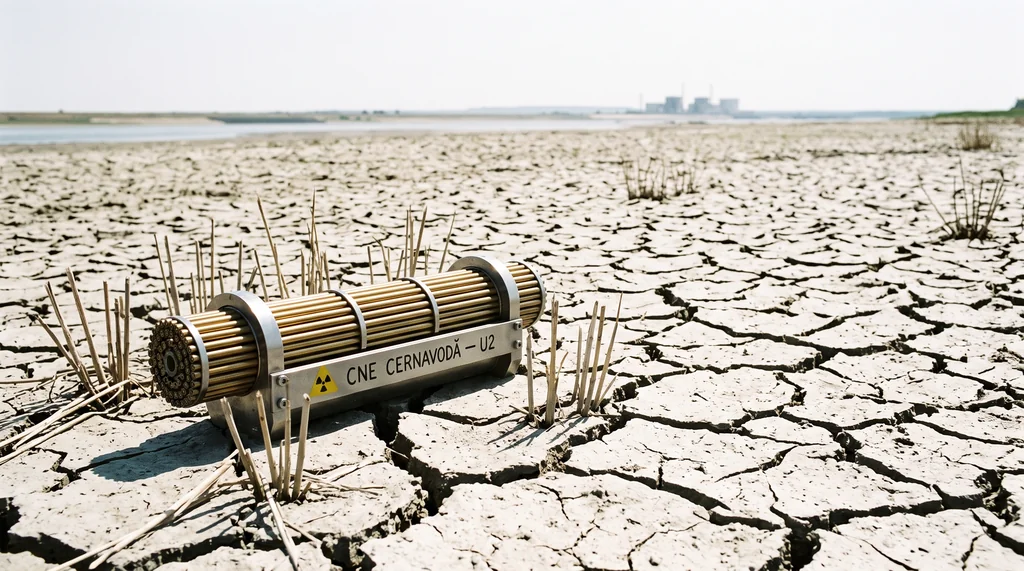
Romania’s nuclear certainty lies stranded by the shrinking Danube.
Image composition · tobriefRomania's last operating nuclear reactor began shutting down on 13 August. Cernavodă Unit 2 is going offline because the Danube has fallen below the plant's minimum cooling threshold, two weeks after Unit 1 stopped for the same reason (Agerpres, Argus). Together, the two reactors supplied roughly 1.4 GW of power that ran around the clock regardless of weather or time of day. Bucharest says imports, coal and wind can cover the gap, but its main backup is buying electricity from neighbours fighting the same drought.
Why a river shuts a reactor
Cernavodă needs continuous Danube water for cooling. The national water authority (ANAR) reported the gauge at Cernavodă hit -230 cm, a level officials called unprecedented (Digi24, Mediafax). Upstream flow at Baziaș was roughly 1,400 m³/s, about a third of the normal August average (Brussels Signal, Agerpres). Emergency rock-barge works bought days, not weeks.
The evening gap
Romania's replacement options look adequate in aggregate but fragile at the hours that matter most.
Imports are the biggest lever. Romania has 3.2–4.0 GW of cross-border wire capacity, meaning that much power could physically flow in, but wire capacity is not the same as available electricity. Someone on the other end has to be generating it and willing to sell (Curs de Guvernare). The other options are smaller: a 330 MW coal restart at Rovinari, about 300 MW of drought-limited hydropower, and wind that averages around 525 MW but can drop to 100 MW (Digi24). None replaces steady around-the-clock nuclear output.
The real squeeze comes between 19:00 and 23:00, when solar vanishes, wind is unreliable, and households keep running air conditioning and lights. Even before Unit 2 stopped, according to Adevărul, Romania was already importing about 2,150 MW at evening peaks while total consumption ran around 8,000 MW (Adevărul). Energy analyst Dumitru Chisăliță warned the question is no longer price but "who gets disconnected" on a bad evening (Mediafax). Officials say homes face no curtailment risk: the emergency plan puts large industrial users first for forced reductions (EMI Bulgaria).
Price is still part of the picture. When cheap nuclear disappears, Romania replaces it with coal and imports priced at whatever the market will bear. Those costs hit wholesale markets first and reach consumer bills later. Nuclearelectrica told its customers it may invoke force majeure, the legal clause releasing it from delivery obligations under extraordinary circumstances (ZF).
The neighbours Romania is counting on
The two that matter most are Hungary and Bulgaria.
Hungary is a competing buyer, not a supplier. Paks, its sole nuclear plant, lost roughly 1,770 MW of its normal 2,000 MW output to the same low Danube (MVM Paks, kormany.hu). Budapest has authorised grid operator MAVIR to disconnect industrial users above 0.5 MW, with penalties at 200% of the spot price (HVG).
Bulgaria is the region's main relief valve. Its exports hit 2,180 MW on 7 August, with 1,355 MW going to Romania (economic.bg). But Bulgarian output follows the sun: midday solar drives exports up, while evening supply depends on Kozloduy nuclear and Maritsa coal. Bulgaria's energy minister said Kozloduy had roughly a week and a half of Danube margin left (DBR). If that tightens, the region's biggest cushion shrinks with it.
Romania has notified the European Commission and asked for a regional adequacy assessment, a check of whether enough generation and cross-border capacity exists to meet demand under stress (HotNews). The Commission said Europe's electricity system "remains stable despite extreme weather" (European Commission). That describes Europe as a whole, not Romania's problem at 21:00. The risk sits in the evening import hour, when two drought-hit countries try to pull 2,000+ MW each from the same neighbours. Whether that triggers industrial curtailment depends on which Bulgarian plants are running at that hour, and how long Kozloduy's own Danube margin holds. Bucharest controls neither.
Details about this article
- Model:
- claude-opus-4-6
- Generated:
- 8/13/2026, 2:02:38 AM
- Pipeline run:
- eu_pipeline_20260813_005005
- Watermark:
- SynthID (Google's invisible watermark)
- Human review:
- None before publication