Diesel tops petrol before reserve relief arrives
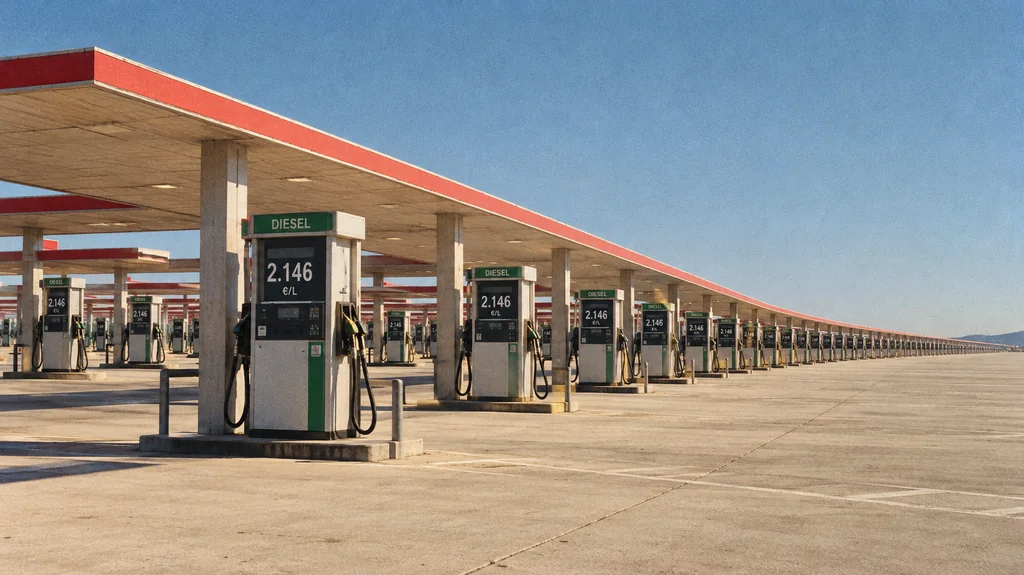
Diesel costs more now; reserve fuel is due through the winter.
Image composition · tobriefDiesel cost an EU average of €2.146 a litre on 26 October, up from €1.594 on 23 February (European Commission). Twelve governments have promised to release emergency stocks, but most of that fuel is scheduled to move between November and January (Agence Europe). October's prices show what drivers pay now, and almost none of the relief.
Diesel went from cheaper fuel to dearer one
The Commission's Weekly Oil Bulletin records national pump prices, taxes included, on the same Monday each week. Petrol rose over the same months, but by less: Euro 95 went from €1.637 to €1.954 a litre (February data, October data). Before the crisis, diesel was the cheaper of the two fuels. Now it is the more expensive one.
The difference shows up at every fill. By our calculation from the bulletin prices, a 50-litre diesel tank costs €27.60 more than in February, against €15.85 more for petrol (European Commission). The direct bill lands on people who run on diesel: commuters with older cars, hauliers and farmers. Whether lorry firms and farms pass those costs on into other prices depends on their contracts and on how much competition they face.
The supply picture explains why fuel is expensive in general. In its October report, the International Energy Agency (IEA, which coordinates emergency oil policy for importing countries) estimated that global supply was shrinking far faster than demand (IEA). Crude prices remain high: Brent, the main global benchmark, settled at $113.43 a barrel for January delivery on Friday (Reuters, Wall Street Journal).
The shortage also reaches finished fuel. Middle Eastern exports of refined products, meaning fuels already processed in refineries, fell to about 1.9 million barrels a day in September, from 4.7 million before the war (IEA). That figure covers petrol and jet fuel as well as diesel. It shows a squeeze on finished fuel, but it does not explain by itself why diesel rose faster. The clearest evidence of the diesel squeeze is the European pump data.
Relief runs on a November-to-January calendar
Twelve EU countries have committed to release 42.6 million barrels of crude and fuel by 31 January 2027, including 20.5 million barrels of diesel (Agence Europe). The plan completes part of the IEA's earlier coordinated action rather than adding to it (To Brief).
A release takes weeks. Governments authorise the stock to leave storage, buyers bid for it, and the fuel is loaded, shipped and sold on. Spain shows the lag: since 22 October, operators may sell about 4.4 million barrels they would otherwise have had to keep as diesel and kerosene stocks, with the fuel due to reach consumers by 15 December (Spanish official gazette).
France's promise faces its first test
Paris has made the most specific promise. The French government says the average diesel price should fall by 12 to 18 cents a litre from 1 November (French government). That is a target, not a measured result.
The price cut is supposed to come from the price operators pay for their fuel. France plans to sell about 10 million barrels of reserve diesel between November and January, and operators buy it at roughly its historical cost on condition that they pass the saving on (French government). The public reserve gives up the gap between that old cost and today's wholesale price. The state is betting that the gap shows up at the pump, not in distributors' margins.
Some experts expect less. Energy expert Philippe Charlez predicts a cut closer to 5 cents a litre (Le Populaire). Judging who is right will be hard. Crude prices and refinery margins will keep moving through the winter, so a change at French stations will not by itself prove what the reserve sale did.
The cost to drivers is already measured. European diesel drivers pay far more than in February, and more than petrol drivers. The relief is still a timetable, and the promised pump-price benefit has not yet been tested at a single station.
Details about this article
- Model:
- claude-opus-5-5
- Generated:
- 10/31/2026, 1:35:58 AM
- Pipeline run:
- eu_pipeline_20261031_005007
- Watermark:
- SynthID (Google's invisible watermark)
- Human review:
- None before publication