Doetinchem’s grid queue has no capacity
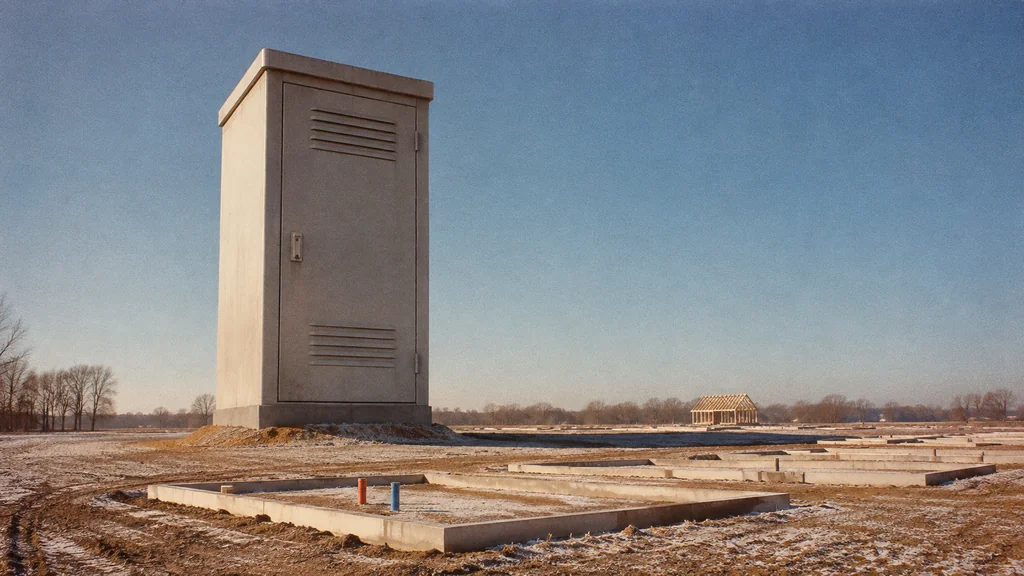
Around Doetinchem, planned homes wait behind a grid with no capacity to spare.
Image composition · tobriefFrom 1 January 2027, a developer or factory around Doetinchem can still apply for a new or heavier electricity connection, but the regional grid operator Liander says it cannot grant more capacity, meaning the amount of power a connection may draw at once (Liander). The bottleneck sits upstream, on the high-voltage network that national operator TenneT runs to feed the area (TenneT). Room on a local street cable can still vary. Liander expects the stop to last at least until 1 July 2027 (Liander).
Where the network is full
The Netherlands has two layers of grid. Liander runs the medium- and low-voltage cables that reach homes and businesses. TenneT runs the high-voltage backbone that supplies those cables, and Doetinchem's problem is at that upper level.
A grid can be full without a shortage of electricity overall. A cable or transformer can reach its safe limit for a few hours a day, typically between 16:00 and 21:00 (Utrecht municipality). The binding question is whether the wires can deliver power to a particular place at the busiest hour.
The affected area runs from Zutphen and Lochem down to Winterswijk and Aalten on the German border (Omroep Gelderland). Conditions differ inside the same province. Around Dodewaard, TenneT will release some capacity from January to customers already waiting, while around Doetinchem it can release none (TenneT).
Utrecht runs on a separate timetable. A connection pause covering Utrecht city, Woerden, De Ronde Venen, Zeist and Houten began on 1 July 2026 (Utrecht province). Around Breukelen-Kortrijk, there will still be no room for new or heavier connections from January (TenneT).
Who moves up the line, and what waiting costs
A full grid means applicants wait, so someone has to decide the order. The national energy regulator, the ACM, puts projects that free up grid room for others first (ACM). Hospitals and emergency services come next, followed by housing, schools and public transport.
Priority buys a better place in the queue. It does not enlarge a full transformer, so even a school can keep waiting.
Timing of registration matters too. Housing projects registered before 1 July 2026 keep their earlier claim, but only where the local network has room (Liander). Registering early secures a place ahead of later schemes. It does not secure electricity.
Doetinchem's municipality opened its own registration for housing projects on 17 September 2026 (Doetinchem municipality). It ranks schemes by start date and then by size, and warns that a place on the list guarantees neither capacity nor timing. Developers should also expect to pay a deposit of about 20% of the eventual connection cost.
That deposit is where waiting turns into money. A developer may have to tie up cash for a scheme whose houses cannot be connected on any known date. Meanwhile, land, financing and building contracts keep running. Smaller schemes with later start dates fall to the back of the line under the municipality's ranking.
Under the regulator's ranking, an ordinary firm that wants to swap a gas-fired process for an electric one has no priority category at all. The likely result is that it keeps burning gas for longer. No published source yet counts how many projects the January stop will actually hold up.
What the spring review can settle
The next formal review of capacity across the central Dutch region is due in April 2027 (TenneT). That calculation may show whether TenneT can release any capacity around Doetinchem from July. It will not tell any single applicant when their connection arrives.
Until then, the rules decide only the order in which people wait. Around Doetinchem, priority can move a hospital or a housing scheme forward in the queue, but there is currently nothing at the front to hand out. Whether there will be any new capacity to allocate is a question only TenneT's spring numbers can answer.
Details about this article
- Model:
- claude-opus-5-5
- Generated:
- 11/3/2026, 1:40:24 AM
- Pipeline run:
- eu_pipeline_20261103_005009
- Watermark:
- SynthID (Google's invisible watermark)
- Human review:
- None before publication