Drone strike sinks ship off Bulgaria
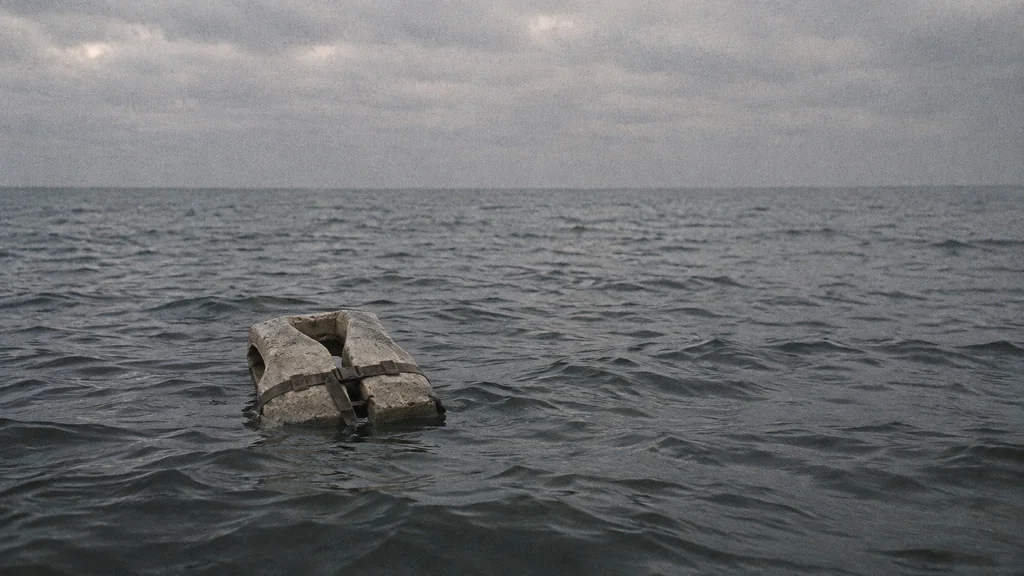
Rescuers find life jackets off Bulgaria’s coast, but no missing sailors.
Image composition · tobriefDrones struck two merchant ships inside Bulgaria's offshore economic zone early on 6 October and sank one of them (Bulgarian government). By evening its crew was still unaccounted for (BTA). Kyiv blames Russia and Sofia says it cannot yet tell, but no government has presented public proof. Bulgaria also has a step available that it has not taken: asking NATO allies for formal talks.
Rescuers reached the spot where the Togo-flagged Alfa Watan went down, about 70 nautical miles east of the coastal town of Byala (Bulgarian government). They found an overturned boat, three overturned life rafts and life jackets. They found no people. A ferry crew nearby had reported seeing aerial drones hit the ship.
The second ship, the Palau-flagged Able, caught fire. The passing Bulgarian ferry Dioscuria helped bring all 18 people aboard to Varna: 11 Turkish and seven Indian nationals (BTA). One mechanic, with burns over about 45% of his body, remained in critical condition (Radio Varna).
A rescued sailor described a blow from beneath the hull (Maritime.bg). That account is partly why officials suspect a sea drone as well as an airborne one.
Accusations without public evidence
Kyiv has been the most definite. Volodymyr Zelenskyy said Ukrainian forces ran no operation in the area and called the strike a combined Russian attack with air and sea drones (Ukrainian presidency). He said contacts between navies had established this. Ukraine has not said what those contacts showed, and it has released no fragments or launch tracks.
Sofia has named possibilities rather than a culprit. Prime Minister Rumen Radev said the drones were either Russian or Ukrainian. Defence Minister Dimitar Stoyanov called it a deliberate attack on merchant ships but said he could confirm neither, because no drone fragments had been recovered and no one had claimed responsibility (Dir.bg).
A third ship complicates the picture. On 5 October the Royad Mammadov caught fire and sank in Romania's economic zone after leaving Ukraine's river port of Izmail; two crew died and 11 were rescued (Reuters). Romanian authorities have not said what caused the fire.
Maritime security firm Ambrey judges it "highly likely" that Russia struck all three ships over their links to Ukrainian grain exports (Ambrey). Its public update shows no manifests or fragments behind that judgment. Moscow claimed strikes on other cargo ships bound for Odesa that week, but it named none of these three (Interfax).
The ships' movements prove less than that theory needs. Able had left Galați in Romania, Alfa Watan was heading toward Romania's Sulina, and the Royad Mammadov had left Izmail. All three ports sit in the Danube delta and serve Ukraine's trade. That ties the ships to ports, not to a shared cargo or motive. Radev said, on preliminary information, that Able carried wheat (BNR). Stoyanov later said there was no definitive information about either ship's load.
The route still matters to Europe. The European Commission's August report put about 40% of Ukraine's grain and oilseed exports since May 2022 on the EU's "Solidarity Lanes", the land and river alternatives to Ukraine's own seaports (European Commission). Those figures predate the attacks and say nothing yet about traffic since.
Sofia can call allies to talks
The location shapes Bulgaria's response. An exclusive economic zone gives a country rights over resources such as fish and gas, but it is not national territory and foreign ships sail through freely. Radev argued that this offshore site ruled out NATO's Article 4, the treaty clause that lets any ally call the others to consult (BNT).
The treaty says otherwise. Article 4 applies when any ally believes its territorial integrity, political independence or security is threatened, and it sets no condition that an attack happen on national soil (NATO). Bulgaria says it has raised the issue with allies. It has reported no formal request for consultations.
Two separate tasks follow. Investigators still have to establish who fired, and drone fragments are only one way to do that. Sofia can ask for allied talks whenever it chooses. Neither Kyiv nor Sofia has yet presented public proof of who sent the drones, and Bulgaria has not yet made that request.
Details about this article
- Model:
- claude-opus-5-5
- Generated:
- 10/7/2026, 1:39:46 AM
- Pipeline run:
- eu_pipeline_20261007_005007
- Watermark:
- SynthID (Google's invisible watermark)
- Human review:
- None before publication