Drone strikes shut Kyiv’s road-and-metro bridge
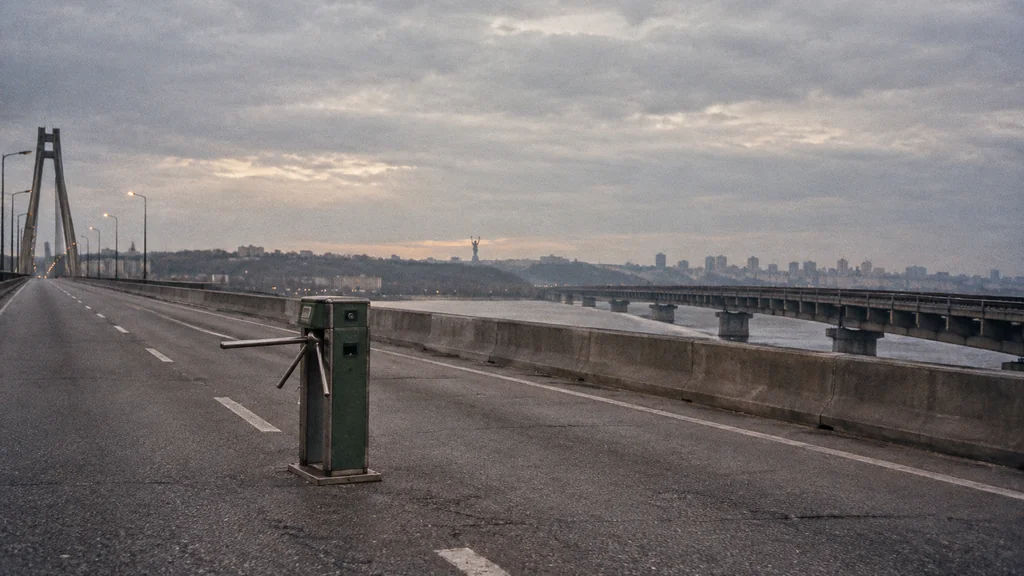
Kyiv waits for engineers while its daily crossing stands empty.
Image composition · tobriefRepeated Russian drone strikes have closed Kyiv's Southern Bridge, which carries six road lanes and the green metro line across the Dnipro (Yle). By Friday evening it was shut to cars and trains even with no air alert sounding. City officials said it stays closed until specialist institutes rule on whether it is safe (UA.News, RBC Ukraine). Whatever Moscow intended, the cost has landed on commuters in a city the river cuts in two.
A city split by one closed crossing
The first strike came on 1 October, when two drones hit near a bridge support as a metro train was crossing. Mayor Vitali Klitschko said nobody aboard was hurt, and an initial inspection found no critical structural damage (Kyiv Independent).
That early reassurance did not hold. Another hit that evening reportedly damaged a support, the road surface and a concrete barrier shielding the metro tracks, and more strikes followed on 2 October (DW Ukrainian). No final engineering assessment has been published, so nobody outside the inspection teams knows the bridge's real condition.
Kyiv sits on two banks, so closing one crossing pushes its traffic onto the others. Buses were diverted, streets around Pechersk jammed, and one reporter saw taxi quotes above 2,000 hryvnias that morning (TSN). The city administration said the Metro Bridge was narrowed to a single lane from the left bank to the right, and other crossings faced limits during air alerts (RBC Ukraine).
One cross-river route kept working. Kyiv City Express said its circular railway ran its full route across the river on schedule (ZN.ua).
The deaths of that night happened elsewhere. A drone hit a 25-storey apartment block in the Darnytskyi district, killing one person and injuring two (DW Ukrainian). No casualty on the bridge itself has been confirmed.
What Russia claims, and what the law asks
Russia's Defence Ministry listed a Kyiv bridge among targets it said served military purposes. It gave no detail specific to this bridge, and Reuters could not verify the claim (Reuters). Nothing in the public record shows military traffic on this crossing.
Ivan Stupak, a former Ukrainian security officer, argued that cutting bridge capacity could slow military trucks (Polsat News). That is a theory about what bridge attacks can achieve in general, not evidence about this one.
The laws of war set a sharper test than "civilian or military." Article 52 of Additional Protocol I, the 1977 addition to the Geneva Conventions that defines what armies may attack, permits striking an object only if it effectively contributes to military action and hitting it offers a definite military advantage at the time (ICRC). Traffic jams and a halted metro cannot answer either question. Settling whether these strikes were lawful would take evidence about how the bridge was used and what Russia stood to gain.
Why newsrooms abroad followed Kyiv's traffic
The closure travelled well beyond Ukraine's media. Finland's public broadcaster Yle explained how a single structure carries both road and metro traffic (Yle). Poland's Polsat News put the strikes to a security analyst and asked how Ukraine could protect its bridges (Polsat News). Reuters tracked each new hit through 2 October, relying on the mayor's statements (Reuters).
Most of that reporting leaned on Kyiv officials, since independent access to the damage is limited. What drew foreign editors was the subject itself. This was not frontline news. It was a European capital losing a main artery to repeated drone strikes, told through bus diversions and taxi fares that readers in Helsinki or Warsaw can picture in their own cities.
Russia has bombed a road and metro crossing that Kyiv cannot reopen until engineers clear it, and the next decision belongs to Kyiv's specialist institutes. They must say whether the bridge and its exposed metro section can safely carry traffic again. Until they do, the city's residents pay the price in longer journeys and costlier taxis, and squeeze onto the crossings that remain open.
Details about this article
- Model:
- claude-opus-5-5
- Generated:
- 10/3/2026, 2:05:44 AM
- Pipeline run:
- eu_pipeline_20261003_005006
- Watermark:
- SynthID (Google's invisible watermark)
- Human review:
- None before publication