Eleven operators widen an unfinished gas corridor
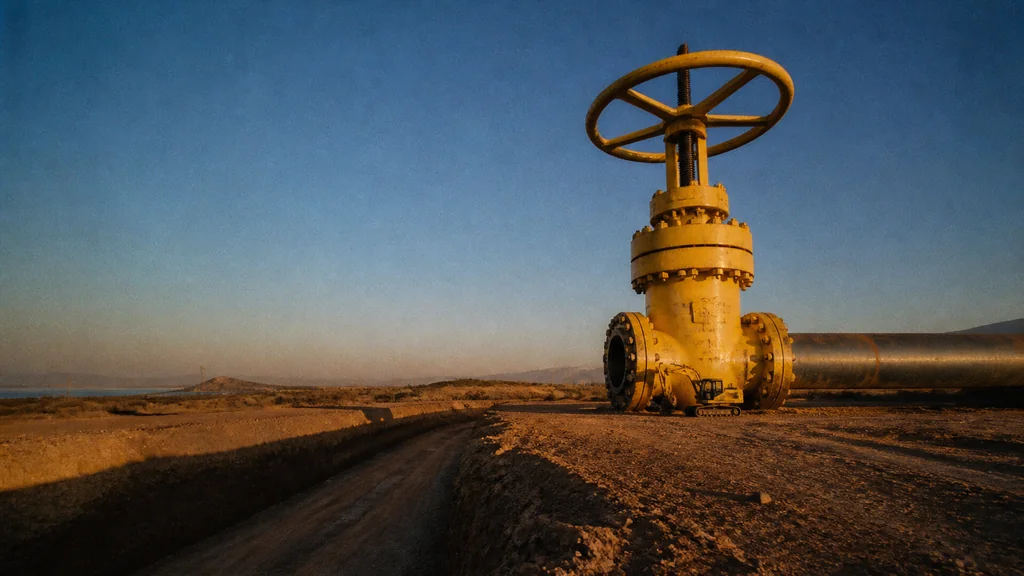
Europe enlarges the gateway before completing the route beyond it.
Image composition · tobriefEleven gas-system operators (the companies that run national pipeline networks) from nine countries signed a cooperation agreement in Thessaloniki on 4 September, extending the Vertical Gas Corridor toward the Western Balkans (Novini.bg, Powergame). The corridor is a chain of national gas networks, cross-border connectors and LNG terminals stitched together by bilateral deals. It is the route through which landlocked southeastern European countries hope to replace Russian gas before the EU's legal deadlines hit in 2027. But the expansion is a map of intent. Several of the pipes it draws on do not yet exist.
The southern links work
At the corridor's entry point, infrastructure is real and commercially active. Greece's Alexandroupolis terminal, a floating unit that converts shipped liquefied natural gas back into pipeline gas, has been running since late 2024 with 5.5 bcm per year of capacity (Adevarul). The older Revithoussa terminal near Athens has booked nearly all its unloading slots through 2040 (OT, Serbia Energy). Traders are betting on this route for the long haul.
Moving north into Bulgaria, the IGB interconnector has carried over 39 million MWh since it started operating (ICGB). As we reported in July, traders booked 46% of available Greek-Bulgarian border capacity for multiple years ahead, a sign the route is commercially serious (To Brief).
Bulgaria is the near-term bottleneck. Bulgartransgaz finished adding duplicate pipe on a constrained stretch between Kulata and Kresna on 1 September, so more gas can flow north. But the bigger upgrade, nearly doubling capacity at the Romanian border to 9.4 bcm per year, depends on further construction running through 2027–28 (Economic.bg, Jurnalul).
Beyond Bulgaria, Moldova has started selling time-limited rights for traders to move gas through its network toward Ukrainian storage. A record booking in March 2026 reserved 25,500 MWh per day on one route (Moldpres). Small volumes, but they prove gas can move through the full chain.
The Western Balkans branch is still mostly on paper
The Thessaloniki signing added North Macedonia's NOMAGAS and Serbia's Transportgas Srbija to the group. At a July meeting in Athens, operators had discussed available capacity, tariff rules and timelines at each border crossing, and created a joint working group (Gastrade).
Greece and North Macedonia are building a 123 km interconnector from Nea Mesimvria to Negotino, financed by the EIB and EBRD (NOMAGAS). North of that, NOMAGAS awarded a €29.4 million contract for its 22.4 km section of a link to Serbia, targeting completion by Q4 2028 (Balkan Green Energy News). The Serbian section, roughly 144 km, lacks comparable public contracting detail.
Serbia captures the corridor's central tension. Srbijagas has reserved 300 million cubic metres per year at Alexandroupolis for ten years (Vreme). That is a real booking, but it covers roughly a tenth of Serbia's annual consumption. Serbia keeps extending short-term supply deals with Gazprom (Enerdata). The corridor gives Belgrade a bargaining chip, not yet an alternative supply.
Who gains, who pays
The EU's Russian-gas phase-out regulation, adopted in January 2026, bans long-term Russian LNG contracts from January 2027 and sets a pipeline gas phase-out by late 2027 (European Commission, European Parliament). That gives the corridor urgency.
Greece and Bulgaria gain hub and transit fees. Romania gains twice: as a transit country now, and as a future producer once its Neptun Deep offshore field starts pumping, targeted for 2027 (OMV). North Macedonia moves from dead-end market to potential transit country. Hungary and Slovakia sit at the political edge: both still rely on Russian gas via TurkStream (the pipeline running from Russia through Turkey into southeastern Europe), and Slovakia's main transit operator moved only about 5.4 bcm in 2025, down from 17.8 bcm after Ukrainian transit stopped (Pravda.sk). Croatia's Krk LNG terminal offers a competing non-Russian route, with a capacity doubling planned for late 2026 (HRT).
But a warning sits inside the data. When Ukraine auctioned two transit routes in December 2025, no company booked a single cubic metre (LIGA.net). Cooperation agreements and tariff discounts are not enough if price, timing and demand do not line up. Thessaloniki made the corridor politically wider. It did not yet make it physically complete or commercially guaranteed.
Details about this article
- Model:
- claude-opus-4-6
- Generated:
- 9/5/2026, 1:41:44 AM
- Pipeline run:
- eu_pipeline_20260905_005005
- Watermark:
- SynthID (Google's invisible watermark)
- Human review:
- None before publication