Estonia’s €1.2 Billion Defence Blind Spot
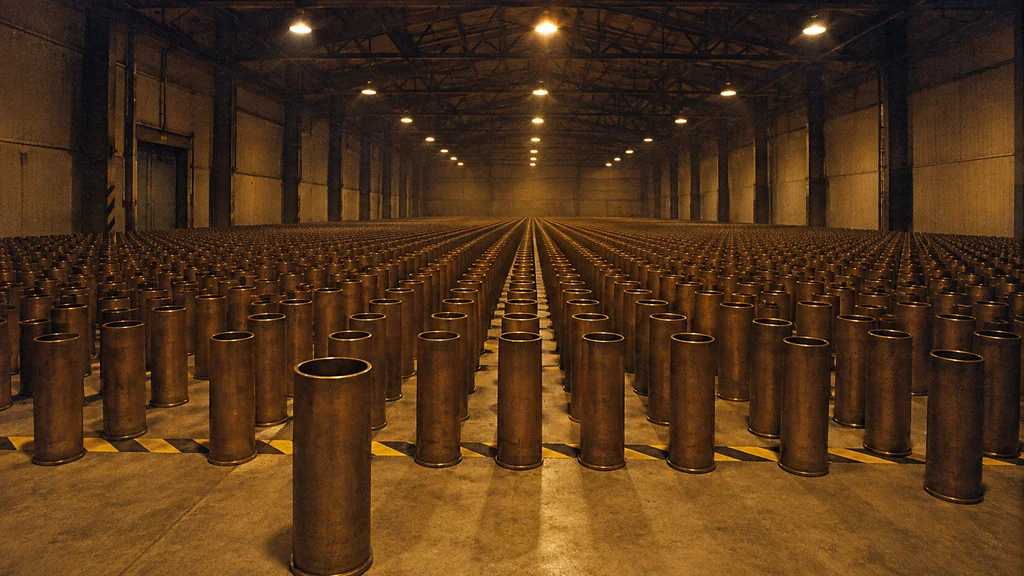
Estonia can count the casings, but not prove what arrived.
Image composition · tobriefHanno Pevkur resigned as Estonia's defence minister this week, forced out by two procurement failures that converged on one question: can a country bordering Russia show where its defence money went? Estonia's national auditors say not reliably. That problem reaches beyond Tallinn, because EU funds now flow through the same national systems that failed here.
As To Brief reported when Pevkur first announced his departure, the scandal centres on advance payments and missing accountability in urgent defence deals. The full picture involves two separate failures, and together they are worse than either alone.
The ammunition that didn't arrive
Estonia's Centre for Defence Investments (RKIK), the state agency that handles military procurement, contracted with Datasel S.R.L., an Italy-registered firm linked to India's Neco Defence Munitions, for artillery ammunition destined for Ukraine. The firm had no visible prior record selling this kind of ammunition (ERR News, Euractiv).
Estonia paid large advances. The ammunition either never reached Ukraine or was rejected as incomplete or substandard (Breaking Defense). Auditors examined €72.1 million in supplier advances and found problems with €71.6 million of that total. The largest problematic supplier had received €59.8 million (Riigikontroll).
Datasel disputes Estonia's account, saying it invoiced €58 million of supplied material and that Estonia terminated prematurely (ERR News). The case is now in arbitration. The public record does not settle whether goods were never delivered, delivered but substandard, or rejected without proper contractual basis. If Estonia cannot recover the disputed funds, roughly €70 million falls on the Estonian state budget (Kyiv Independent).
Who is responsible remains contested. Pevkur says the minister sets policy but does not choose suppliers. Former RKIK chief Magnus-Valdemar Saar says major decisions had ministry leadership approval (ERR). No publicly available record explains why Datasel was considered an acceptable supplier.
The inventory no one can verify
The second failure is separate but compounds the damage. Estonia's National Audit Office (Riigikontroll) said it could not verify the correctness of €1.2 billion in defence inventory balances. The Defence Forces' stock accounting did not reliably show which items, in what quantities and values, were recorded or unjustifiably omitted (ERR News, Riigikontroll). This does not mean €1.2 billion of equipment vanished. It means auditors could not confirm the books matched reality, which makes every other defence claim harder to trust.
A country that has staked its credibility on Ukraine support and eastern-flank readiness could not demonstrate that one urgent ammunition chain was controlled and that its own stocks were auditable.
EU money, national proof
The scandal matters beyond Estonia because EU defence money depends on national ministries to choose suppliers, check deliveries and keep usable records. Brussels does not pick contractors or inspect warehouses.
The European Peace Facility (EPF), an off-budget fund managed by the Council (where member-state governments sit), can reimburse countries for weapons donated to Ukraine or procurement undertaken on its behalf (Council). According to ERR News, the Commission is examining whether Estonia must return EPF-linked sums over the failed ammunition deal. Estonia also has a €2.34 billion agreement under SAFE (the EU's new defence loan instrument), with a first €351.6 million payment already disbursed (European Commission DG DEFIS).
Both instruments leave the hard part at national level. When a supplier fails, the contracting state must recover the money through its own courts. Czechia's ammunition initiative offers a contrast: Prague's model embeds donor governments inside the verification chain, and donor auditors have not found the corruption that critics predicted (CT24). Speed can work — when proof travels with the money.
Estonia's scandal does not prove EU defence procurement is corrupt. It proves the weak point in Europe's biggest new spending commitment: basic questions about who selected the supplier, what checks were done, what arrived, and who accepted it went unanswered until an auditor discovered, after the minister had resigned, that almost all the money paid upfront was problematic. The Commission and member states owe that answer before more EU-backed defence money moves through the same national systems.
Details about this article
- Model:
- claude-opus-4-6
- Generated:
- 9/4/2026, 6:36:40 AM
- Pipeline run:
- eu_pipeline_20260904_005006
- Watermark:
- SynthID (Google's invisible watermark)
- Human review:
- None before publication