EU fuel costs jump 23.8%
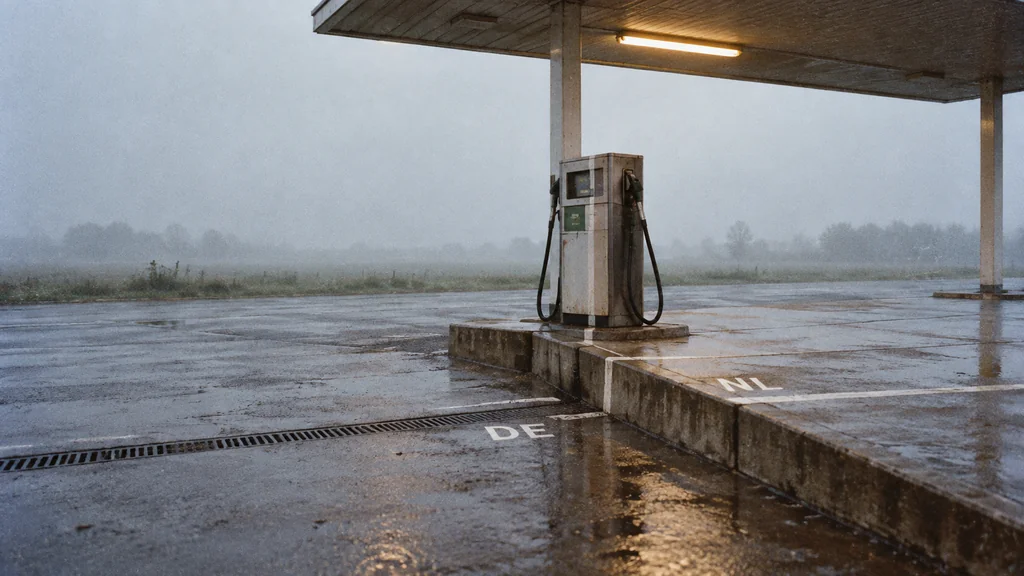
Tax policy lowers one side of the border overnight.
Image composition · tobriefFuel for private cars cost EU consumers 23.8% more in August 2026 than a year earlier (Eurostat). The figure comes from the harmonised index of consumer prices, the inflation measure every EU country compiles the same way. It tracks what drivers pay at the pump, after tax and after any relief. That means it shows market costs filtered through national policy. It cannot say how much of the rise came from oil and how much from governments.
Why a fixed tax changes the arithmetic
A litre of fuel is built in layers. At the bottom are crude oil, priced in dollars, and the margins for refining, transport and retail. On top, governments add excise, a fixed fuel tax of so many cents per litre. They then charge value-added tax (VAT) on everything below it, including the excise. Germany's fuel tax follows this pattern (German Finance Ministry).
The fixed layer bends the percentages. When crude jumps, the excise stays put, so the pump price rises by a smaller share than oil. The reverse happens when a temporary cut ends: the pump price climbs even if oil does not move. Germany cut its fuel tax by 14.04 cents a litre in May and June, at an estimated cost of €1.6 billion, and the cut ended in July (Bundestag).
Fast and broad, or cheaper and aimed
Germany is choosing speed again. On 18 September the federal government and all 16 state governments agreed another 14-cent cut from 1 October to 31 December. The estimated cost is €2.5 billion, split equally between federal and state budgets (Bundesregierung, ZDF). As of 22 September it still needed votes in the Bundestag, the lower house, and the Bundesrat, the chamber representing the states (Tagesschau). Germany is not alone: Spain has run a shrinking excise cut since July, due to lapse on 30 September unless extended (BOE).
A tax cut lowers the government's take, but retailers set the final price. Economists call the share of a cut that reaches the pump "pass-through." After Germany's 2022 fuel discount, the ifo Institute found that only part of it reached drivers (ifo). The state loses the full revenue either way.
France has taken the other route. Its 22 September package expands support for people who drive to work. According to Libération, up to 5.5 million people could qualify, with references to a €100 payment.
The new design addresses a documented weakness of France's previous across-the-board fuel rebate. The Cour des comptes, the national public auditor, put that scheme's cost at €7.6–8 billion and found that the heaviest fuel users captured more of it (Cour des comptes). A payment to eligible workers reaches the groups the government chooses, though eligibility rules only approximate need. It also leaves the pump price, and France's fuel inflation figure, exactly where they were.
When a neighbour's cut crosses the border
National choices leak across frontiers. According to NRC, diesel cost about €2.81 a litre in the Netherlands on 18–19 September, against about €2.47 in Germany before the new cut. Dutch stations near the border warn that a wider gap will send their customers east (Omroep Gelderland). Each tank filled in Germany moves the sale, and the fuel tax and VAT on it, to the German side. Nobody has yet measured how many litres cross.
Each approach buys something different. Broad cuts work at the pump from the day they start and pull the index down. The price is subsidising every litre, including those bought by wealthier and foreign drivers, while some of the saving can stay with retailers. Targeted payments cost the budget less but leave headline inflation high.
That is why Eurostat's table needs careful reading. Crude, exchange rates, refining and retail margins all shape it alongside tax. But the ranking compares pump prices after governments intervene, so it cannot tell readers which country suffered the largest underlying oil shock. A country that cuts its fuel tax will look better in the table than a neighbour that sends cheques, even if both spent money to protect the same drivers.
Details about this article
- Model:
- claude-opus-5-5
- Generated:
- 9/23/2026, 6:53:40 AM
- Pipeline run:
- eu_pipeline_20260923_005006
- Watermark:
- SynthID (Google's invisible watermark)
- Human review:
- None before publication