EU gas stores enter winter at 72%
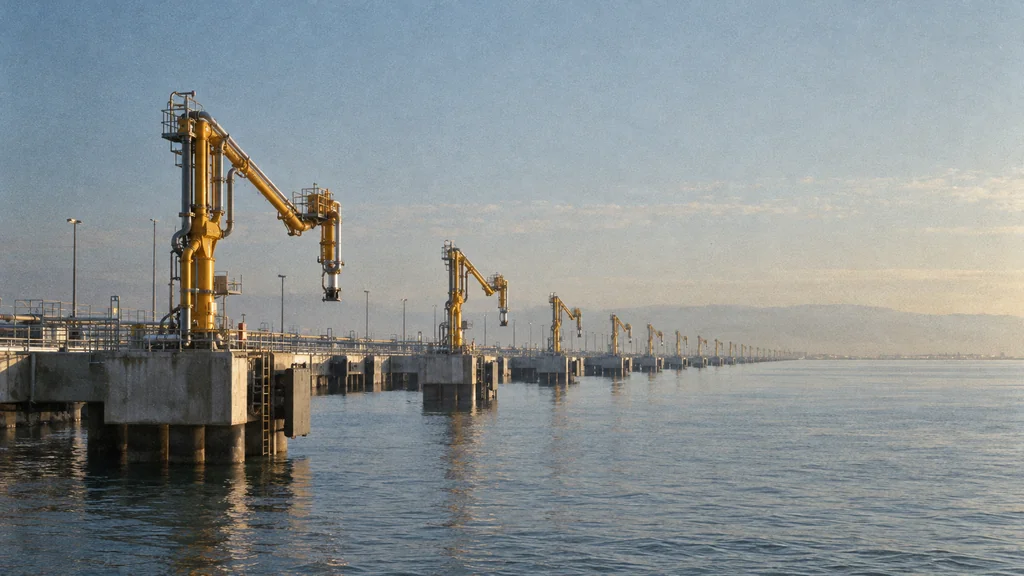
Europe has room to receive gas; winter still depends on arriving cargoes.
Image composition · tobriefEU underground gas stores were 72% full on 1 October, against 83% a year earlier (ENTSOG, GIE AGSI+). One analysis of storage data put end-September stocks at their lowest for that time of year since records began in 2011 (John Kemp). ENTSOG, the association of Europe's gas-pipeline operators, still concludes that the system has enough flexibility for winter, and on 8 October the European Commission endorsed that view (European Commission).
That finding is about pipes and terminals. Whether enough gas flows through them depends on the weather and on cargoes nobody has bought yet.
Spare capacity does not bring tankers
A liquefied natural gas (LNG) terminal receives tankers of supercooled gas, warms it back into gas and feeds it into the grid. ENTSOG estimates Europe's terminals could process about 1,600 terawatt-hours (TWh) this winter, against roughly 914 TWh handled last winter (ENTSOG). That slack only helps if ships arrive, and the outlook does not forecast how many will.
Storage covers what imports cannot, because demand on a freezing day rises faster than tankers can sail in. In an ordinary winter, EU stores would end March 29% full; with 20% less LNG, they would fall to 13% (ENTSOG). The lower figure leaves less gas to absorb a second surprise, and part of it is strategic reserve that traders cannot sell. It also means a longer climb back next summer.
A cold winter is harder. With Russian pipeline flows minimised, 7% to 12% of demand would have to be saved by users, found elsewhere or left uncovered (ENTSOG). That describes a gap to close, not a rationing forecast. In the harshest mixes of cold and supply disruption, the gap reaches 15% (Euronews).
Why gas landing in France may not reach Germany
On 1 October, Germany's stores were 58% full and Poland's 99% (ENTSOG). Gas crosses borders only as fast as the connecting pipes allow. France can bring in 1,309 gigawatt-hours a day through its onshore LNG terminals, yet it can send only 100 gigawatt-hours a day into Germany at the Obergailbach crossing (CRE). Bottlenecks like this are why ENTSOG warns that landlocked states in central, eastern and southeastern Europe may struggle to reach LNG even when Europe's total import capacity looks ample.
The refill bill arrives in 2027
Traders usually earn money from storage by buying cheaper summer gas and selling it in winter. ENTSOG's 30 September price snapshot put summer 2027 gas at €53.405 per megawatt-hour, above the €49.030 quoted for the following winter (ENTSOG). When summer gas costs more than winter gas, the commercial case for storing weakens, though storage fees and purchase terms also shape the decision.
The Netherlands shows how that plays out. Gasunie, the state grid operator, said filling stores this summer made little commercial sense given expected winter prices (Gasunie). On 11 September the cabinet cut its storage target from 80% to 64%, arguing that 93 TWh covers an average winter (Dutch government), a move we had reported as under consideration (To Brief). When the market will not fill stores, state-owned EBN can step in with public support, shifting the price risk to taxpayers (Dutch parliamentary letter).
A deep drawdown makes that harder. Starting from 13%, stores would reach only 80% by late September 2027, even with good LNG supply (ENTSOG).
Industry used 60% of Germany's gas in 2025, so factories carry the largest exposure if prices stay high, although supply contracts and hedging (locking in prices in advance) slow how fast it reaches them (Bundesnetzagentur). Regulated tariffs delay the hit for some households: Poland's regulator has extended myORLEN's household tariff until 31 December 2026 (URE). On 6 October, Orlen deputy chief Robert Soszyński said the company would seek an increase for 2027 if wholesale prices hold or rise (Bankier).
ENTSOG's scenarios show the network has the capacity for an ordinary winter, while low starting stocks leave less room for a cold spell, weak LNG arrivals and the 2027 refill. The outlook models pipes and terminals; it does not forecast cargo deliveries. The Commission has urged market players to preserve stocks through late winter (European Commission). Keeping that buffer means paying for costly cargoes now. Drawing stores down saves money this winter and pushes the cost into a refill that starts from a lower base.
Details about this article
- Model:
- claude-opus-5-5
- Generated:
- 10/9/2026, 1:26:53 AM
- Pipeline run:
- eu_pipeline_20261009_005006
- Watermark:
- SynthID (Google's invisible watermark)
- Human review:
- None before publication