EU parcel fee has no price
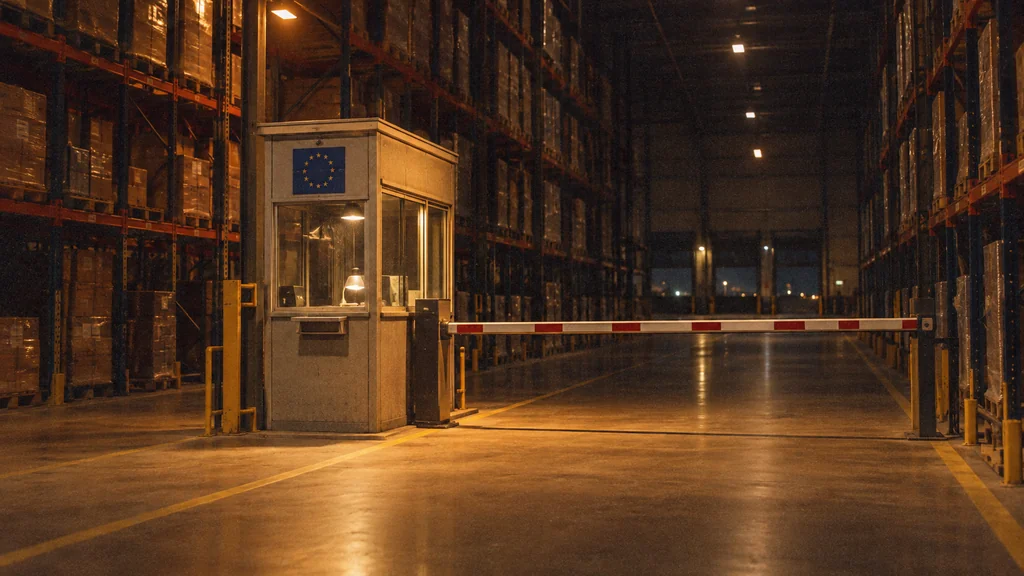
Europe’s customs border moves inside the platforms that carry its trade.
Image composition · tobriefThe European Parliament voted on 16 September to replace the EU's entire customs code, creating a handling fee on goods shipped directly from outside the bloc to European consumers. Headlines across Europe immediately quoted figures of €2, €7 or even €10 per parcel. None of those numbers are law. The Commission has not set the fee, and the amount, calculation method and collection details still require secondary legislation that has not been drafted (European Parliament, EUnews).
What Parliament did settle is who answers to customs when a parcel arrives. In the standard model, that is now the online marketplace — Temu, Shein, AliExpress — not the shopper. The platform becomes a "deemed importer," responsible for data, duties and compliance (Brussels Times). Collection must begin by 1 November 2026, but only once the Commission's implementing system is ready.
Two charges, not one
The confusion matters because two separate instruments are now stacking up, and most reporting blurs them together. The €3 flat customs duty, operating since 1 July under Regulation (EU) 2026/382, abolished the old exemption that let consignments worth up to €150 enter duty-free. It is a tariff, charged per product category in a shipment — not per parcel. A package with shirts and a phone case can attract €6, not €3. Polish customs data illustrates the gap: authorities cleared more than 26 million consignments containing roughly 130 million product categories in the preceding year, about five categories per shipment on average (Prawo.pl).
The handling fee is something different. It is meant to recover what it actually costs customs authorities to process e-commerce data, run risk analysis and inspect goods. It sits on top of the €3 duty, not instead of it (RTL Belgium). The €2 figure circulating in coverage was one option discussed during negotiations. The €7 and €10 figures were lobby demands from Poland's e-commerce chamber and the European textile industry association Euratex, respectively (dlaHandlu.pl, Fakt). None became law.
The border moved, the goods didn't
The €3 duty has already reshaped logistics. Belgian customs recorded a 53% year-on-year fall in small parcels at Liège airport in July, while simplified customs declarations dropped roughly half (Boursorama/AFP, The Loadstar). As we reported earlier, Dutch parcels from outside the EU fell 46% in July and August (To Brief). Similar drops appeared in Slovenia and France.
But Liège's total cargo tonnage rose 4% over the same period (Aktus-CCI). Standard bulk declarations increased by around three million. Dutch customs explicitly said foreign webshops are shifting toward bulk imports and EU warehousing (Euronews). Shein and Temu are reportedly building fulfilment capacity around Wrocław in Poland. A parcel dispatched from a Polish warehouse to a German consumer is no longer an import. The goods still entered the EU as a bulk shipment — declared, taxed and subject to customs control — but the last mile becomes domestic delivery.
The question is whether this improves enforcement or just moves it. Border parcel desks lose volume. Warehouse inspections, product-safety authorities and domestic market surveillance gain it.
Who pays, who gains
EU retailers are the clearest winners. They competed against a channel where direct imports dodged customs duty entirely. That advantage is gone. Customs authorities gain a named counterparty — a platform with data and financial capacity — instead of chasing millions of individual recipients.
Consumers face a more ambiguous outcome. Any fixed charge hits cheap purchases hardest: the existing €3 duty alone equals 60% of a €5 item before VAT. No platform has publicly committed to absorbing costs or disclosed a pass-through policy (Tagesschau). Large platforms can spread compliance costs across enormous volumes and invest in EU warehousing. Small third-country sellers cannot. The reform could level competition between European and non-EU retailers while simultaneously strengthening the biggest platforms against their smaller rivals.
The biggest piece Parliament approved was not a price. It was a chain of responsibility: the platform answers to customs, the Commission sets the fee, and the consumer's actual bill remains genuinely undecided. Anyone quoting a specific surcharge is selling certainty the law does not contain.
Details about this article
- Model:
- claude-opus-4-6
- Generated:
- 9/17/2026, 2:41:19 AM
- Pipeline run:
- eu_pipeline_20260917_005006
- Watermark:
- SynthID (Google's invisible watermark)
- Human review:
- None before publication