EU power shift advances, veto reform stalls
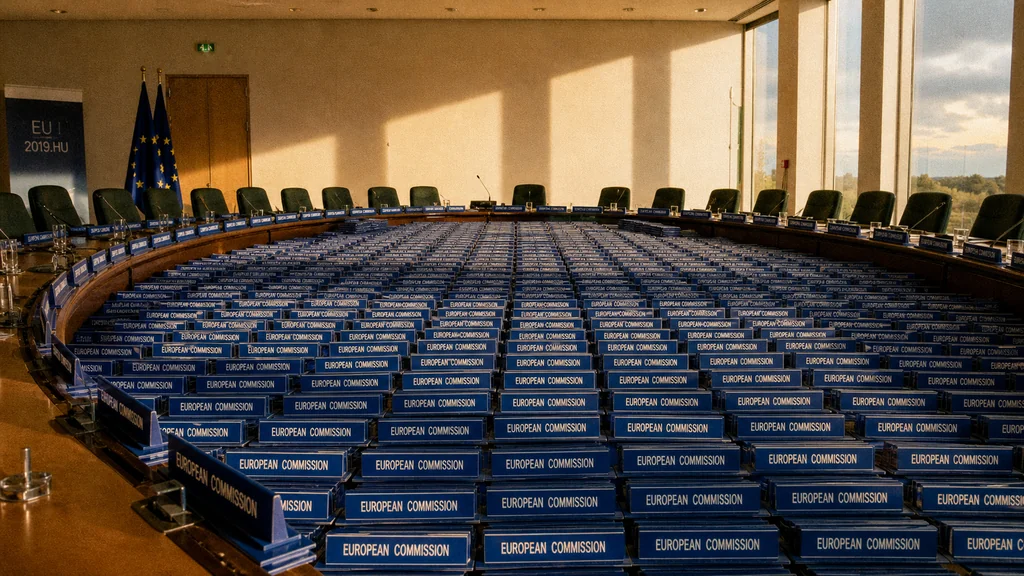
Commission machinery multiplies while national seats disappear from view.
Image composition · tobriefWhen EU foreign ministers met at Druids Glen in Wicklow on 1–2 September for the twice-yearly Gymnich (an informal gathering designed for open debate, not binding decisions), two reform proposals competed for attention (EEAS, The Journal). Both promise faster, more coherent foreign policy. But the reform that can actually move forward would concentrate power in the Commission. The harder one, fixing the national veto, stays stuck behind the same rule it tries to change.
Kallas has the title but not the tools
The EU's foreign-policy chief, High Representative Kaja Kallas, is supposed to coordinate everything the bloc does abroad. In practice, the money and staff for development aid, defence industry, humanitarian relief and neighbourhood policy sit in separate Commission departments she does not run (Le Monde, Euronews).
Paris and Berlin want to fix that. Their July ministerial-council conclusions called for reform of external-action structures, with the October European Council (where heads of state set EU direction) as the target for launching formal work (Elysée, Bundesregierung). The reported fix would move those tools closer to Kallas. But here is the trade-off: she would also sit more firmly under Commission President Ursula von der Leyen's chain of command (Politico).
The EU's diplomatic service, the EEAS (a hybrid body drawn from national foreign services, the Commission and the Council secretariat), would be refocused on strategy and military missions rather than running budgets and programmes. That means the EEAS could lose control over money, staff assignments and agenda-setting, even as its chief gains access to more instruments (EUPerspectives). No public Franco-German paper has been released. The design remains leak-based, reported consistently across outlets but unconfirmed in detail.
This reform can move relatively fast because it requires revising a 2010 Council decision that created the EEAS, not amending EU treaties (Council Decision 2010/427/EU).
The veto problem stays locked
The second track tackles something deeper. A non-paper from 11 countries, including France, Germany, Austria, the Netherlands, Spain and Sweden, proposes a code of conduct against obstructive vetoes in foreign policy (ANSA, Euronews). Under EU treaties, foreign and security decisions require unanimity: one government can block sanctions or crisis responses even when the other 26 agree (Article 31 TEU).
The non-paper urges constructive abstention, where a country steps aside rather than blocking. It asks governments not to hold foreign-policy files hostage to unrelated demands. And it calls for exploring routes toward qualified majority voting (where decisions pass with a weighted majority rather than consensus). The tool has precedent: Cyprus, Ireland, Austria and Malta have each stepped aside on specific decisions rather than vetoing them (Euronews).
The escape hatch also needs unanimity. The countries protected by the veto must agree to weaken it. That makes the code of conduct aspirational rather than enforceable.
Who pays
The two tracks create different losers. The machinery reform strengthens the Commission presidency as the command point for foreign policy. For smaller states, this matters because the High Representative currently answers to member states through the Council as well as to the Commission. A more Commission-bound foreign chief weakens that intergovernmental link, which is how capitals like Tallinn or Dublin stay in the loop on decisions that affect them directly.
Estonia illustrates the tension. Tallinn wants faster sanctions coordination and has publicly said Hungary and Slovakia slowed key decisions on Ukraine (Estonian Government). But speed through Commission hierarchy comes at a price if it reduces the Council channel where small states have a seat (ERR).
The veto track costs different people. Cyprus treats its veto as insurance on EU-Turkey files; weakening it strips a small country of its strongest diplomatic lever (RIK, Kathimerini). Hungary has used the veto to delay sanctions packages. For both, the current system is protection, not obstruction.
Wicklow produced no decisions, by design (Irish Times). The October European Council is the next test. The reform most likely to advance is the one that reorganises the chain of command, because it needs a Council decision rather than a treaty change. Brussels may get a tidier org chart well before it gets a faster way to decide.
Details about this article
- Model:
- claude-opus-4-6
- Generated:
- 9/2/2026, 2:02:29 AM
- Pipeline run:
- eu_pipeline_20260902_005006
- Watermark:
- SynthID (Google's invisible watermark)
- Human review:
- None before publication