EU’s €2 fee multiplies in mixed baskets
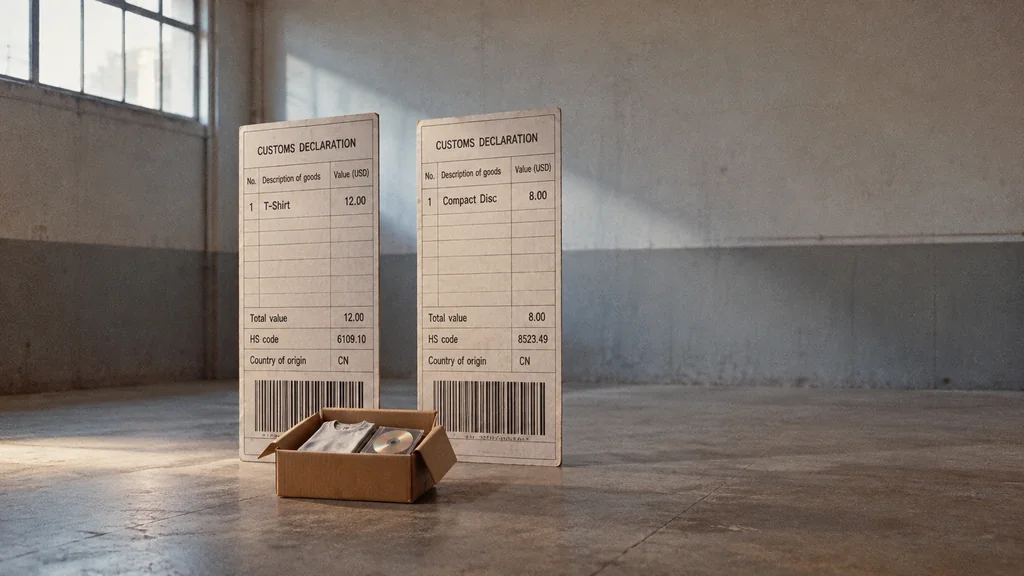
Each different item gives customs another line to charge.
Image composition · tobriefFrom today, 1 November, online orders shipped into the EU from outside the bloc carry a €2 handling fee for each type of goods in the parcel (EUR-Lex, implementing regulation). The fee counts what is inside the box rather than the box itself, so a basket of several cheap, different items pays it several times. When we last covered the fee, its start date was still only expected (To Brief).
How customs counts your basket
Customs charges by line on the import declaration, the form that tells customs what is arriving. A line groups goods that share a tariff code (the number customs uses to classify a product), a description and, where relevant, an origin (Commission guidance).
Five identical T-shirts therefore sit on one line. A T-shirt and a CD sit on two, even when they travel in the same parcel.
A temporary €3 duty is also charged per line. On an order worth €150 or less, the T-shirt-and-CD pair therefore carries €10 in fixed charges before VAT, while the five T-shirts carry €5 (Bandcamp). Estonia's tax and customs board gives a three-line example. A T-shirt, jeans and a skirt pay €9 in duty and €6 in fees, or €15 before VAT and delivery (Estonian customs).
The two charges run on different clocks. The €3 duty replaced the old exemption for consignments worth up to €150, began on 1 July 2026 and is due to end on 1 July 2028 (Commission guidance, Regulation 2026/382).
The €2 fee is meant to pay for data checks, risk analysis and controls, and it has no end date (EUR-Lex). It also ignores value. On orders too expensive for the €3 duty, ordinary tariffs apply instead, but the fee still comes on top.
VAT then makes the bill larger. The Commission's guidance, revised on 6 October, puts the fee in the VAT base, the amount on which VAT is calculated. A seller passing the full €10 from the T-shirt-and-CD basket to a German buyer would therefore charge €11.90 once 19% VAT is added (Commission VAT note).
Timing follows the paperwork, not the purchase. The fee applies according to the date the declaration is lodged, so a parcel ordered in October can still attract it (Estonian customs).
Who pays, and for what
In law, the fee falls on whoever owes the customs debt, meaning the import charge owed to customs. That is normally the seller, the platform or their representative, not the shopper. Sellers can still recover it at checkout.
Nobody has yet measured whether Temu, Shein or AliExpress will pass the new fee on, absorb it or discount it. BEUC, the European consumer organisation, insists that whatever shoppers do pay must be shown upfront (BEUC).
Very cheap goods feel the fee most. A December 2025 study by French customs, written before either charge existed, found that half of the nearly 800 million e-commerce articles reaching France each year in small parcels were worth under €3.40 (French customs).
That study counts articles, while the fee counts declaration lines. When a cheap article occupies its own line because nothing else in the parcel shares its tariff code, the €2 fee comes close to its price (EUR-Lex). When it shares a line with similar goods, the charge is spread across all of them.
The revenue adds up. Under current EU rules for customs revenue, member states keep 25% as collection costs and send the rest to the EU budget (EUR-Lex). According to Reuters, an unpublished Commission document projects roughly €6 billion a year in 2028–34. That figure covers small-parcel charges combined, not the handling fee alone.
The fee's stated purpose is customs control. So far, no published figures show extra inspectors hired or more unsafe products stopped at the border because of it.
What the numbers already show is narrower. On a cheap order with several kinds of goods, each additional type adds €2 on top of the €3 duty, so mixed baskets pay more than single-product ones of the same value (Bandcamp). Whether the money makes the products in those baskets any safer has not yet been demonstrated.
Details about this article
- Model:
- claude-opus-5-5
- Generated:
- 11/1/2026, 1:26:01 AM
- Pipeline run:
- eu_pipeline_20261101_005008
- Watermark:
- SynthID (Google's invisible watermark)
- Human review:
- None before publication