Euclid’s 900 million galaxies, dark energy later
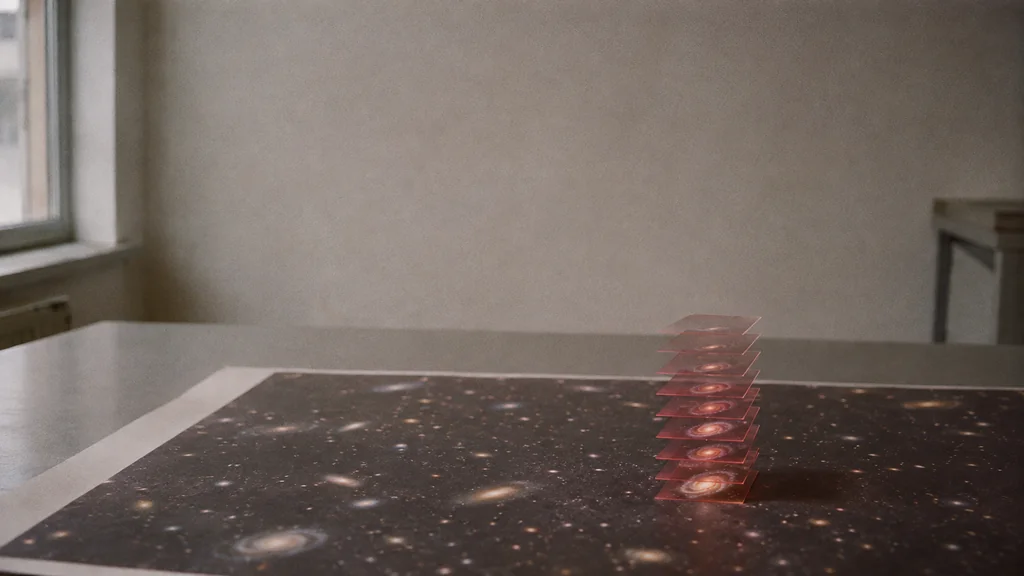
Euclid gives galaxies depth; its dark energy test still awaits their shapes.
Image composition · tobriefNo tape measure reaches a galaxy, so astronomers work out its distance from its light. On 12 November, the European Space Agency and the Euclid Consortium made public a huge set of such observations, holding light from more than one billion objects (ESA). The calibrated galaxy-shape measurements needed for Euclid's main test of dark energy are due with the full first data release in mid-2027 (release guide).
The release, called DR1-Foundation, covers roughly 14% of the sky Euclid plans to survey during its mission (ESA). According to Physics World, more than 900 million galaxies sit inside it.
Turning a rainbow into a distance
A telescope directly measures only where an object sits on the sky. The third dimension is hidden in its light. Spread a galaxy's light by wavelength, like a rainbow, and recognisable features appear, a bit like the stripes of a barcode. As the universe expands, those stripes slide toward longer, redder wavelengths, a shift called redshift. Astronomers then use a model of cosmic expansion to turn that shift into a distance.
Euclid estimates redshift in two ways (spectroscopy pipeline description). A spectrum, the full rainbow, shows the stripes themselves, so it gives a fairly precise value for one object. Measuring brightness through a few colour filters is more like guessing the barcode from a blurry photo. The answer is rougher, but it works for far more galaxies.
ESA counts more than 160 million spectra in the release (ESA). Euclid records them "slitless", spreading the light of many sources across its detector at once instead of isolating each through a narrow slit. That approach covers a lot of sky, but faint or ambiguous spectra may not give a trustworthy distance. Each one has to pass quality checks before researchers can rely on it (spectroscopy catalogue specification).
The release also holds rarer finds. ESA reports about 15,000 candidate strong gravitational lenses, more than all previous catalogues combined (ESA). In a strong lens, the mass of a foreground galaxy bends light from a galaxy behind it into arcs or multiple images. The release also flags more than 60 million candidate quasars, the brilliant cores of some distant galaxies (Max Planck Institute for Gravitational Physics). The word "candidate" matters in both lists. These are likely examples picked out of the images, and they have not yet been confirmed.
Why dark energy has to wait
Dark energy does not glow in any image. Researchers infer it, along with dark matter, from patterns. How galaxies cluster at different cosmic ages reflects both the expansion of the universe and the growth of structure, and dark matter's gravity bends light from more distant galaxies (Paris Observatory).
That gentle bending, called weak lensing, is Euclid's central tool. Every galaxy starts with its own shape and tilt, so a single galaxy reveals nothing. Think of leaves scattered on a lawn. Each lies at a random angle, but if slightly more of them point one way than chance would allow, you know a wind has passed. In weak lensing, the mass between us and the galaxies, dark matter included, plays the part of the wind.
Detecting such a faint shared stretch requires shape measurements calibrated with great care. Those are not in this release. The guide schedules them for full DR1, along with galaxy-cluster catalogues and higher-level cosmology products (release guide). One astronomer's commentary noted that no cosmology result accompanied this batch (astronomer's commentary).
The redshift estimates are already public, so researchers can start placing selected galaxies, lenses and quasars at estimated distances and studying them in three dimensions. The dark-energy measurement depends on the calibrated shapes, and the Euclid Consortium is responsible for delivering them with full DR1 in mid-2027 (release guide).
Details about this article
- Model:
- claude-opus-5-5
- Generated:
- 11/13/2026, 1:43:57 AM
- Pipeline run:
- eu_pipeline_20261113_005009
- Watermark:
- SynthID (Google's invisible watermark)
- Human review:
- None before publication